Autopapyrus · Audi Q5 2.0 TFSI (CDNB, 180 hp) 2014
https://autopapyrus.com/guides/audi/q5/cooling-system-leak-test/
https://autopapyrus.com/guides/audi/q5/cooling-system-leak-test/
Compiled automatically from service literature and owner experience. Specs are for the typical configuration — check them against your exact car before you start.
Audi Q5 2.0 TFSI (CDNB, 180 hp) 2014: Cooling System Leak Test
The cooling system leak test is performed by pressurizing the system to 1.0-1.4 bar. The 2.0 TFSI engine (CDNB) is prone to leaks at the water pump (where it joins the block), at the expansion tank (cracks caused by a sticking cap valve), and at the radiator gaskets and heater core. This procedure lets you find hidden leaks before overheating occurs.
Part
- 🔩 If leaks are found: gaskets, hose clamps, coolant expansion tank, expansion tank cap (rated pressure 1.6 bar). Cost depends on the component
 There's a full repair manual for this car
Every system, wiring diagrams and torque specs — not just this job. Haynes AutoFix (online) and 1 more.
See manuals →
Step by step
12 steps- Let the engine cool to below 50°C (122°F). A hot system is under pressure and opening the cap can cause burns.
- Open the hood and locate the coolant expansion tank on the right side of the engine bay (black plastic with a yellow cap).
- Slowly unscrew the expansion tank cap counterclockwise to release any residual pressure.
- Check the coolant level. On a cold engine it must be between the MIN and MAX marks. If necessary, top up to MAX (total system capacity is about 10 L (10.6 qt), G12++ or G13 coolant mix).
- Install adapter VAG1274/8 in the expansion tank neck in place of the cap, and connect the VAG1274 pressure tester.
- Use the hand pump to build up 1.0 bar (14.5 psi). This is enough to reveal most leaks. To test the cap valve and the system at its limit, raise the pressure to 1.4-1.6 bar.
- Note the pressure on the gauge and wait 10-15 minutes without interfering. The allowable pressure drop is no more than 0.1 bar in 10 minutes. A sharp drop or complete loss of pressure indicates a leak in the system.
- While the pressure holds, inspect all accessible components with a flashlight from below and above. Typical leak points: the water pump-to-cylinder block joint (front of the engine, below the alternator), the radiator-to-hose connections (front of the engine bay), the expansion tank along its welded seams and any cracks, and the heater system hose clamps (a leak under the dash may show up as fogging on the inside of the windows).
- Test the expansion tank cap separately. If the valve does not release excess pressure at 1.6 bar, the cap is faulty (stuck due to scale buildup) and must be replaced. Cap part numbers: 1J0121321B or 3B0121321 (rated pressure 1.6 bar).
- Release the pressure with the tester's relief valve, remove the adapter, and refit the original cap (or a new one).
- Start the engine and warm it up to operating temperature (about 90°C (194°F) on the gauge). Let the radiator fans cycle on, then repeat the visual inspection with the engine hot, since some leaks only appear with thermal expansion.
- Shut off the engine, let it cool, and check the level in the expansion tank. If there were air pockets, the level may drop. Top up to MAX.
Common mistakes and warnings
- The 2.0 TFSI engines of the EA888 family (CDNB, CDNC) have a typical problem: water pump leaks at the joint with the block, and air getting into the system through the expansion tank on vehicles with a start-stop system (air is drawn in through the tank when the thermostat is open and the auxiliary heater circulation pump runs while the engine is stopped). Regular leak testing and replacing the tank cap every 2-3 years prevent overheating and tank cracks. Do not use homemade adapters without an accurate pressure gauge. Pressure above 2 bar can rupture the plastic components of the system.
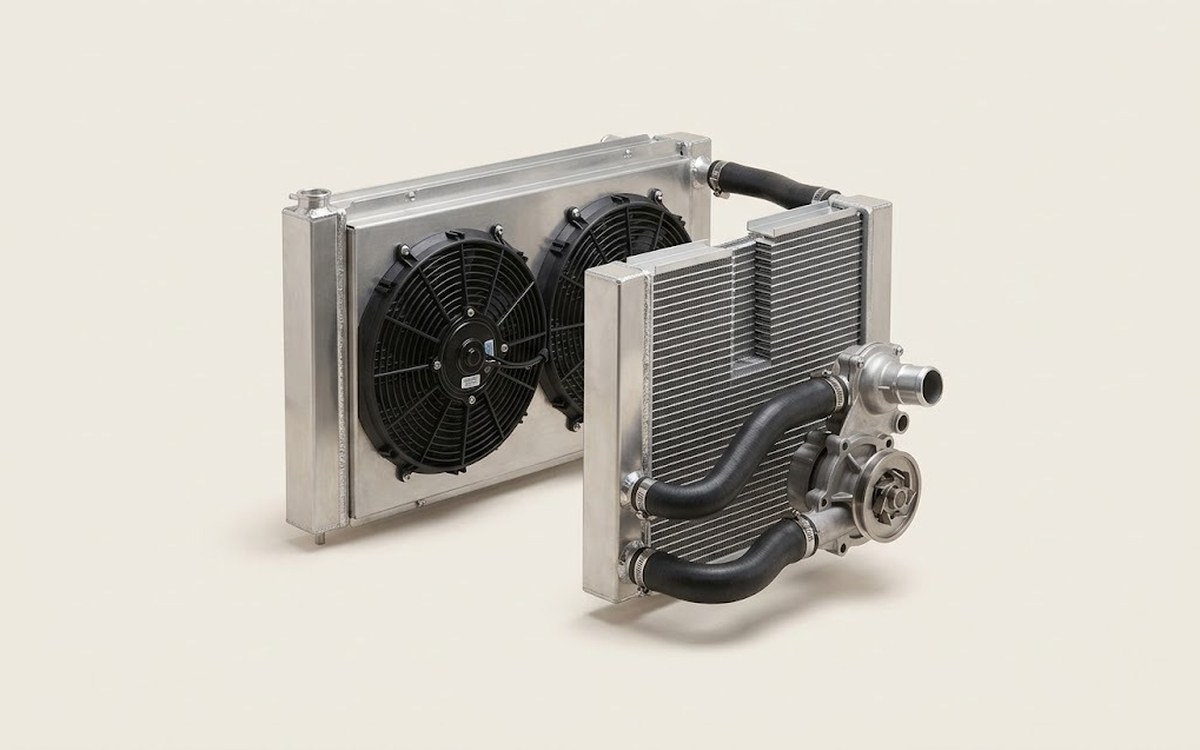 How it works · 3D
How the Engine Cooling System Works
How the part you're working on actually works — in plain English, on a 3D model.
Open in 3D →