Autopapyrus · Changan Alsvin (1st generation)
https://autopapyrus.com/guides/changan/alsvin/front-stabilizer-link-replacement/
https://autopapyrus.com/guides/changan/alsvin/front-stabilizer-link-replacement/
Compiled automatically from service literature and owner experience. Specs are for the typical configuration — check them against your exact car before you start.
Changan Alsvin (1st generation): Front Stabilizer Link Replacement
The stabilizer links (sway bar end links) on the Changan Alsvin are a wear item with an average service life of 40-50 thousand km. With aggressive driving or on poor roads, the service life is shorter. Replace them in pairs (both sides at once), even if only one side knocks, because the other side will inevitably wear out as well.
Part
- 🔩 Front stabilizer link, left and right (set of 2). Aftermarket equivalents are available from Korean and Chinese manufacturers
Step by step
9 steps- Raise the front of the vehicle with a jack and support it on jack stands. Remove the front wheels with the lug wrench.
- Apply penetrating lubricant to the link mounting nuts and let it soak in for 5-10 minutes.
- Hold the link stud with a 6 mm hex key (there is a hex recess in the center of the stud) while loosening the upper nut with the 17 mm socket wrench.
- Remove the lower nut that secures the link to the control arm or strut, using the same wrench.
- Remove the old link. Inspect the mounting points on the stabilizer bar and the control arm, and clean off any dirt and rust.
- Apply grease to the threads of the new link. Install the link and thread the nuts on by hand, but do NOT tighten them.
- Repeat the procedure on the other side.
- Lower the vehicle off the jack to the ground so the suspension settles into its normal working position. ONLY NOW tighten both nuts of each link to 40-50 N·m (30-37 lb-ft) (check the exact value in the manufacturer's service manual).
- Install the wheels and tighten the wheel bolts in a crisscross pattern to 110-130 N·m (81-96 lb-ft).
Common mistakes and warnings
- Tighten the link nuts ONLY when the suspension is loaded (vehicle standing on the ground). Tightening with the suspension hanging leads to premature wear of the link's rubber bushings. A wheel alignment is not required after replacing the stabilizer links, because the wheel alignment angles do not change.
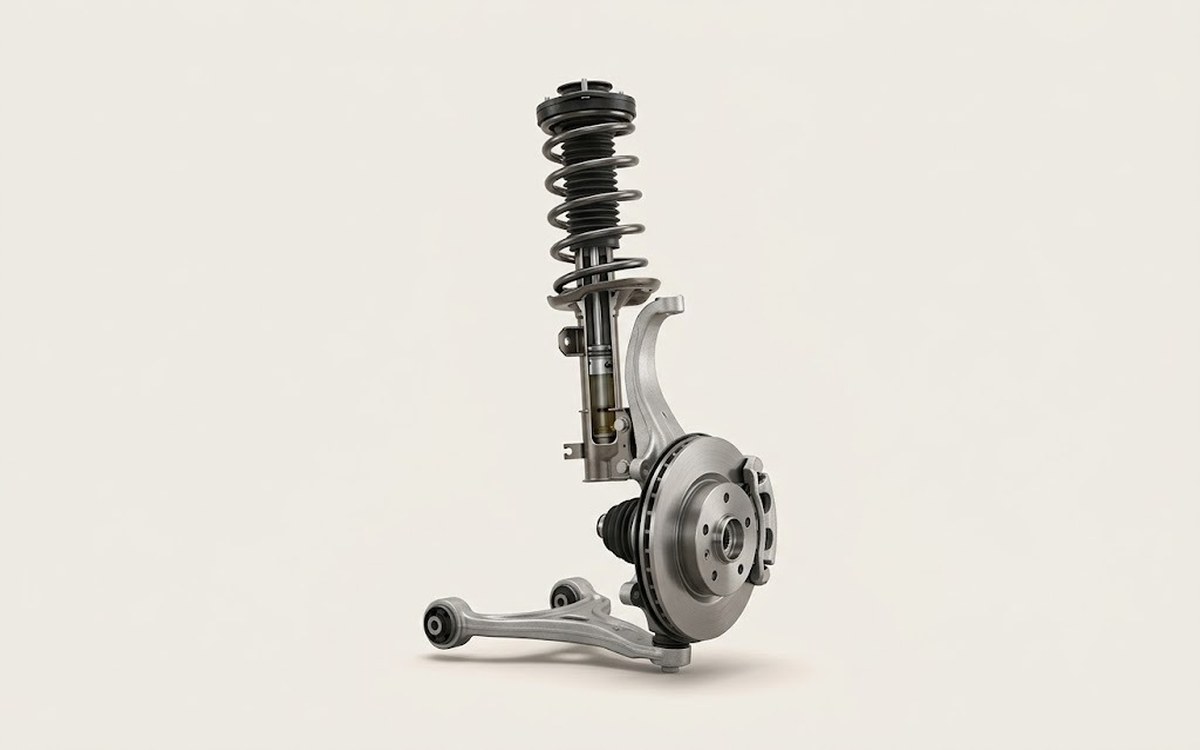 How it works · 3D
How Car Suspension Works
How the part you're working on actually works — in plain English, on a 3D model.
Open in 3D →