Autopapyrus · Kia Sportage (2nd generation, KM)
https://autopapyrus.com/guides/kia/sportage/right-engine-mount-replacement/
https://autopapyrus.com/guides/kia/sportage/right-engine-mount-replacement/
Compiled automatically from service literature and owner experience. Specs are for the typical configuration — check them against your exact car before you start.
Kia Sportage (2nd generation, KM): Right Engine Mount Replacement
On the Sportage KM with the G4GC engine, the right mount carries most of the engine's weight. When it wears out, you get vibration in the body and steering wheel at idle, and a clunk when pulling away or lifting off the throttle. The exact procedure for this model is not documented in detail in open sources, so below is the general principle for replacing a mount of this type. Check tightening torques against the manufacturer's specifications.
Part
- 🔩 Right engine mount (engine mount on the timing belt side, rubber-metal or hydraulic, depending on trim level). Aftermarket options: Febi, Sasic, Ruville, Corteco, Lemförder. It is best to verify the part number against the removed part itself, since numbers differ between markets and trim levels
 There's a full repair manual for this car
Every system, wiring diagrams and torque specs — not just this job. Haynes AutoFix (online) and 4 more.
See manuals →
Step by step
10 steps- Park the car on level ground, set the parking brake, and chock the rear wheels. The engine must be cold. Disconnect the negative battery terminal.
- Open the hood and locate the mount on the right side of the engine, near the front timing cover. It attaches to the engine bracket and to the top of the right frame rail. To get access, remove the decorative engine cover. If the air duct or air filter hose is in the way, remove it too.
- Inspect the mount. Check for cracks and separation of the rubber, for leaking fluid (on a hydraulic mount), and for engine sag. Take photos of the fasteners and bracket position so you can reassemble everything the same way.
- Place a hydraulic jack or engine support under the oil pan, using a wide wooden block so you don't crush the pan. Raise the engine slightly, just until the weight is off the mount. Lift smoothly and evenly, and watch the hoses, wiring, and drive components.
- Treat the threaded connections with penetrating oil beforehand. Remove the nuts or bolts securing the mount to the body and to the engine bracket. If necessary, remove the mount bracket.
- Raise the engine a few more millimeters and remove the mount, with or without the bracket. If a drive component or hose is in the way, don't force it; move it aside or remove it first.
- Clean the mounting surfaces of dirt and rust. Compare the new mount with the old one for shape and for the position of the studs, holes, and locating tabs.
- Install the new mount and thread all fasteners in by hand. Lower the engine so the holes line up without binding. Tighten the fasteners with a torque wrench in the order usual for such mounts: first the attachment to the body or bracket, then the rest. Use the manufacturer's torque specifications; for M10-M12 threads these are typically several tens of N·m. Do not tighten by feel.
- Remove the jack, reinstall the air duct and decorative cover, and reconnect the battery.
- Start the engine and let it idle. Check for vibration at various engine speeds and for clunking when shifting into D/R (automatic) or when pulling away (manual). If vibration persists after replacement, check the other mounts: the left (transmission) mount and the rear torque rod.
Common mistakes and warnings
- Never support the engine on a jack alone without a block and backup support. Do not put your hands or head under a raised engine, and use jack stands for the vehicle body. If you have no experience lifting a powertrain, have a repair shop do the replacement. Replace the mount together with the other mounts if they are also cracked; otherwise the new one will fail quickly because of uneven load.
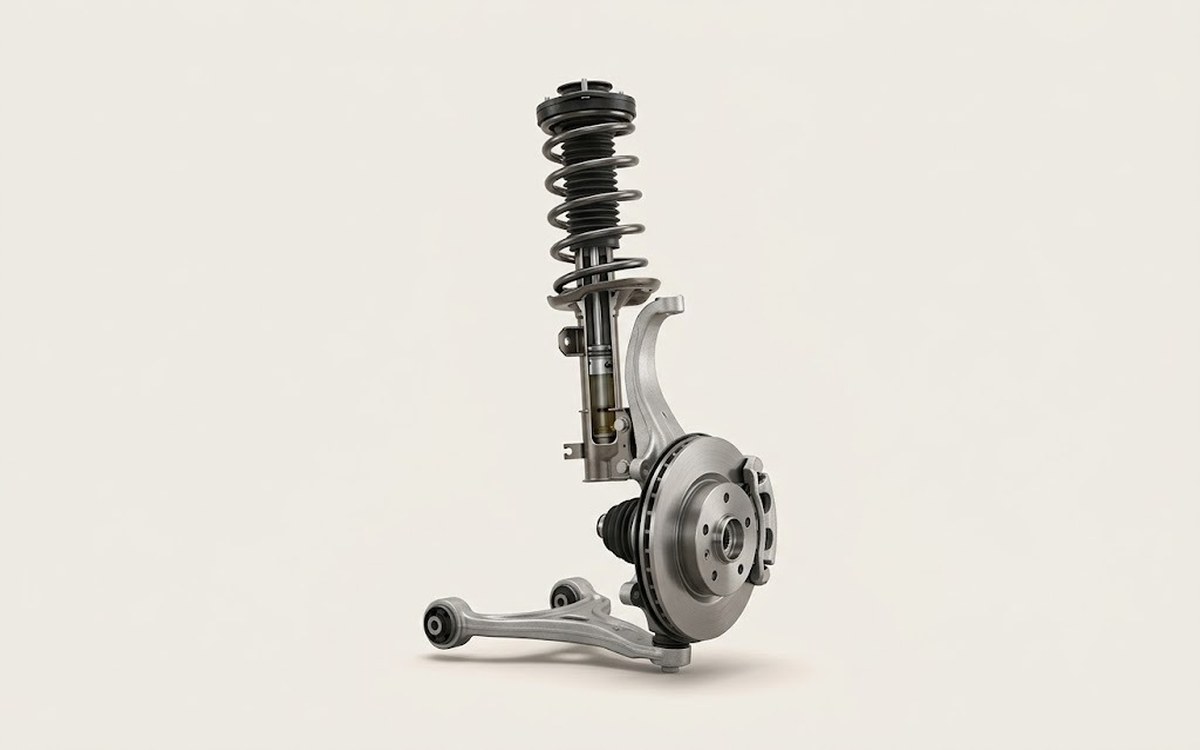 How it works · 3D
How Car Suspension Works
How the part you're working on actually works — in plain English, on a 3D model.
Open in 3D →