Autopapyrus · Lada 2108-09 1.3 (1987)
https://autopapyrus.com/guides/lada/2108-09/diagnosing-engine-misfire-rough-running-on-three-cylinders/
https://autopapyrus.com/guides/lada/2108-09/diagnosing-engine-misfire-rough-running-on-three-cylinders/
Compiled automatically from service literature and owner experience. Specs are for the typical configuration — check them against your exact car before you start.
Lada 2108-09 1.3 (1987): Diagnosing engine misfire (rough running on three cylinders)
A misfire on a carbureted 1.3 almost always comes down to one of three causes: ignition (spark plugs, wires, distributor), an air leak or carburetor problem, or a mechanical fault (valve clearances, compression). Work from the simplest and cheapest checks to the most complex, first determining which cylinder is not firing.
Part
- 🔩 typical candidates: spark plug set, high-voltage (ignition) wires with boots, distributor cap and rotor, ignition coil, ignition module (on electronic ignition systems), carburetor gasket, fuel filter
Step by step
12 steps- Identify the nature of the fault. If the engine runs rough at all speeds and the misfire is steady, look for a dead cylinder. If it happens only at idle or during acceleration, suspect the carburetor or an air leak. If it happens only in damp weather, suspect arcing through the wires, cap or rotor.
- With the engine running, pull the boot off each spark plug in turn, holding it by the insulator (use a rag or a dry rubber glove, because of the high voltage). If engine speed and sound do not change, that cylinder is not working. The firing order is 1-3-4-2, and cylinder 1 is on the timing belt side.
- Remove the spark plugs and inspect them. Dry black soot means a rich mixture or weak spark. Oily deposits mean worn valve stem seals or piston rings. A whitish coating and melted electrodes mean a lean mixture or an air leak. Cracked insulators or burnt electrodes mean the plug must be replaced. The gap on new plugs is 0.5-0.7 mm with a breaker-point ignition and 0.9-1.1 mm with an electronic (breakerless) ignition (check which type your car has).
- Check the high-voltage wires. The resistance of a wire with its boots is usually no more than 10-25 kΩ per wire. In the dark, with the engine running, you can see arcing as sparks. To test, carefully spray the wires with water from a spray bottle: if the engine starts to run rough, a wire or the cap is leaking voltage.
- Remove the distributor cap. Inspect the rotor, the carbon contact, and the inside of the cap for cracks, carbon tracking, and deposits on the terminals. On a breaker-point system, check the condition and gap of the points (usually 0.35-0.45 mm when fully open) and the condenser. Replace a defective cap or rotor.
- Check the ignition coil: primary winding resistance is about 3-4 Ω and secondary winding resistance is about 5-9 kΩ (approximate values, so compare with the specification for your coil). On an electronic ignition, check the ignition module and the Hall sensor by swapping in a known good unit.
- Check for air leaks. Inspect the brake booster and vacuum advance hoses, the connectors, and the carburetor and intake manifold gaskets. With the engine running, spray the joints with carburetor cleaner or water. A change in engine speed points to a leak. Tighten the fasteners or replace the gaskets.
- Check the carburetor. Replace the fuel filter, check fuel delivery from the fuel pump, the fuel level in the float chamber, and that the idle jets and main fuel jets are clean. Blow the jets out with compressed air or use a cleaner (never use wire). Adjust the idle with the mixture (quality) and idle speed (quantity) screws.
- Check and adjust the valve clearances on a cold engine. For the 1.3, the reference values are 0.20 mm for intake and 0.35 mm for exhaust (verify against the label or the service manual). A burnt valve often causes a steady misfire in one cylinder.
- Measure compression on a warm engine with the spark plugs removed and the throttle fully open. A healthy engine reads about 11-12 kgf/cm², and the difference between cylinders should be no more than 1 kgf/cm². If one cylinder reads low, pour in 15-20 mL (0.5-0.7 fl oz) of oil and repeat the test. If compression rises, the piston rings or cylinder wall are at fault. If it does not change, suspect a valve or the head gasket.
- Check the ignition timing and the condition of the timing belt (timing marks). A slipped belt or an incorrect advance angle causes uneven running and hesitation.
- Reassemble everything, tighten the spark plugs without overtightening (approximately 31-39 N·m (23-29 lb-ft), but preferably follow the service manual), start the engine, and make sure the misfire is gone.
Common mistakes and warnings
- The high voltage in the ignition system can give a painful shock, so work with dry gloves and do not hold onto metal. Do not pull wires off a running engine by their metal parts. Do not check for spark by grounding the wire while the engine is running. Work on the fuel system away from open flames and sparks. The exact procedure for your carburetor version and ignition system (breaker-point or electronic) depends on the trim and equipment, so the gap and resistance values given here are approximate and should be verified against the manufacturer's specifications.
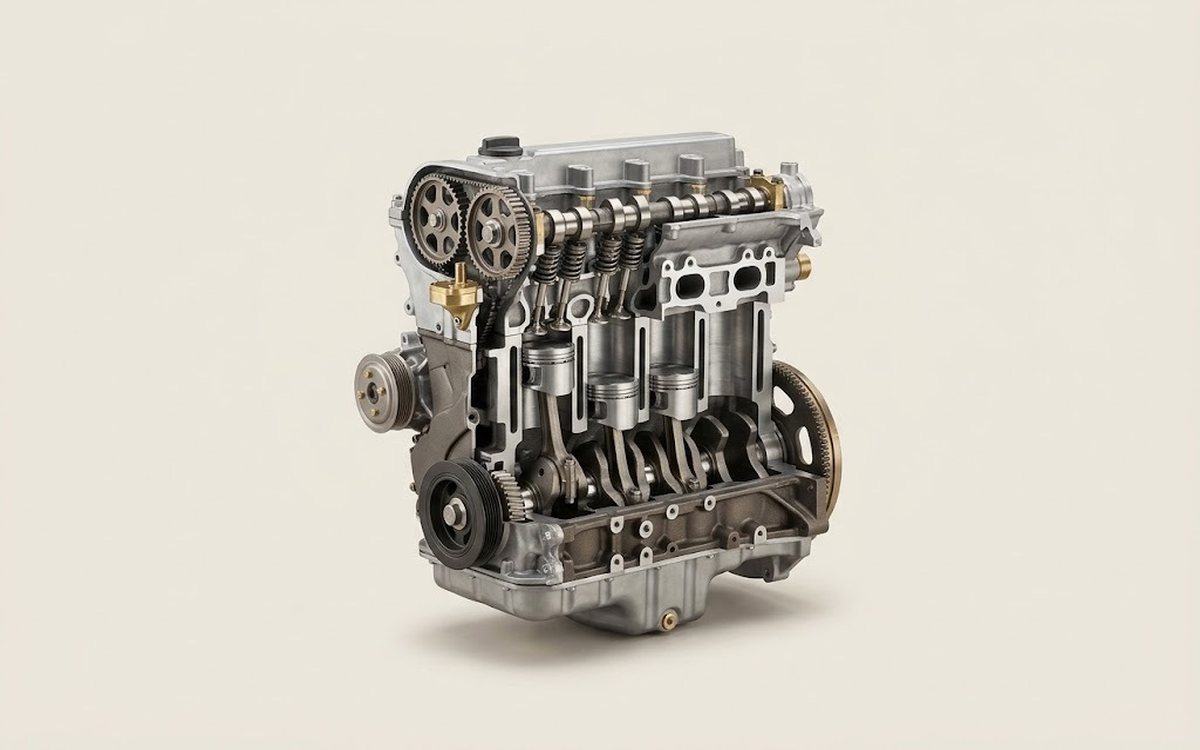 How it works · 3D
How a Car Engine Works
How the part you're working on actually works — in plain English, on a 3D model.
Open in 3D →