Autopapyrus · Mitsubishi Chariot 2.4 (4G64, 150 hp) (1998)
https://autopapyrus.com/guides/mitsubishi/chariot/diagnosing-and-fixing-engine-misfire/
https://autopapyrus.com/guides/mitsubishi/chariot/diagnosing-and-fixing-engine-misfire/
Compiled automatically from service literature and owner experience. Specs are for the typical configuration — check them against your exact car before you start.
Mitsubishi Chariot 2.4 (4G64, 150 hp) (1998): Diagnosing and Fixing Engine Misfire
A misfire on the 4G64 engine in the Chariot (Grand Chariot/Space Wagon) is most often caused by ignition system problems: worn spark plugs, failed ignition coils, spark plug wire breakdown, or cracked rubber boots. Less often, the cause is clogged fuel injectors, a blown head gasket, or leaking valves. Diagnosis starts with reading trouble codes and checking for spark at each cylinder.
Part
- 🔩 spark plugs (OE Mitsubishi MD360935 or equivalents NGK BKR6E-11, Denso K20PR-U11), ignition coils (Mitsubishi MD362913 or equivalents), valve cover gasket (Mitsubishi MD050496), spark plug wires (if needed)
Step by step
14 steps- Connect an OBD scanner and read the trouble codes. Codes P0300-P0304 point to the specific cylinder that is misfiring.
- Shut off the engine, open the hood, and remove the engine cover (if equipped).
- Inspect the spark plug wires and the rubber coil boots for cracks, melting, and arc-through. Boots often crack and let the spark arc to ground.
- Remove the ignition coils (one per spark plug). Disconnect the connectors, remove the 10 mm mounting bolt, and pull the coil straight up together with its boot.
- Check the spark plug wells for oil. If there is oil, the valve cover gasket is leaking, which shorts out the plugs and coils.
- Remove all spark plugs with a 16 mm spark plug socket and inspect the electrodes for wear, carbon fouling, and oil deposits. The gap should be 1.0-1.1 mm.
- If the plugs are worn (rounded electrode, gap over 1.2 mm) or oil-soaked, replace the full set.
- Check the ignition coil resistance with a multimeter: primary winding 0.5-1.0 ohm, secondary winding 10-15 kOhm (exact values depend on the coil type). If the resistance is out of range or the circuit is open, the coil is faulty.
- Swap the coils between cylinders. If the misfire moves to another cylinder, that coil is definitely faulty.
- If there is spark at all cylinders, check compression. The normal value for the 4G64 is 12-13 bar, with no more than 1 bar difference between cylinders. Low compression points to a burnt valve or a blown head gasket.
- Check the injectors. With the engine running, disconnect the connector of the misfiring cylinder's injector. If the engine's behavior does not change, that injector is not delivering fuel (clogged or open winding).
- If you found oil in the spark plug wells, replace the valve cover gasket, after first cleaning the wells and plugs of oil.
- Install the new or serviceable components in reverse order. Tighten the coil bolts to 8-10 N·m (6-7 lb-ft) (hand-tight with a light final snug using a wrench).
- Clear the trouble codes with the scanner, start the engine, and confirm the misfire is gone.
Common mistakes and warnings
- On the 4G64, the coil driver circuits inside the ECU often fail. If the misfire persists after replacing the plugs and coils, the engine control unit will need to be diagnosed. Do not drive the vehicle with a misfire for long, because unburned fuel enters the catalytic converter and damages it. If you suspect a blown head gasket (white smoke from the exhaust, emulsion in the oil), take the vehicle to a repair shop for detailed diagnosis.
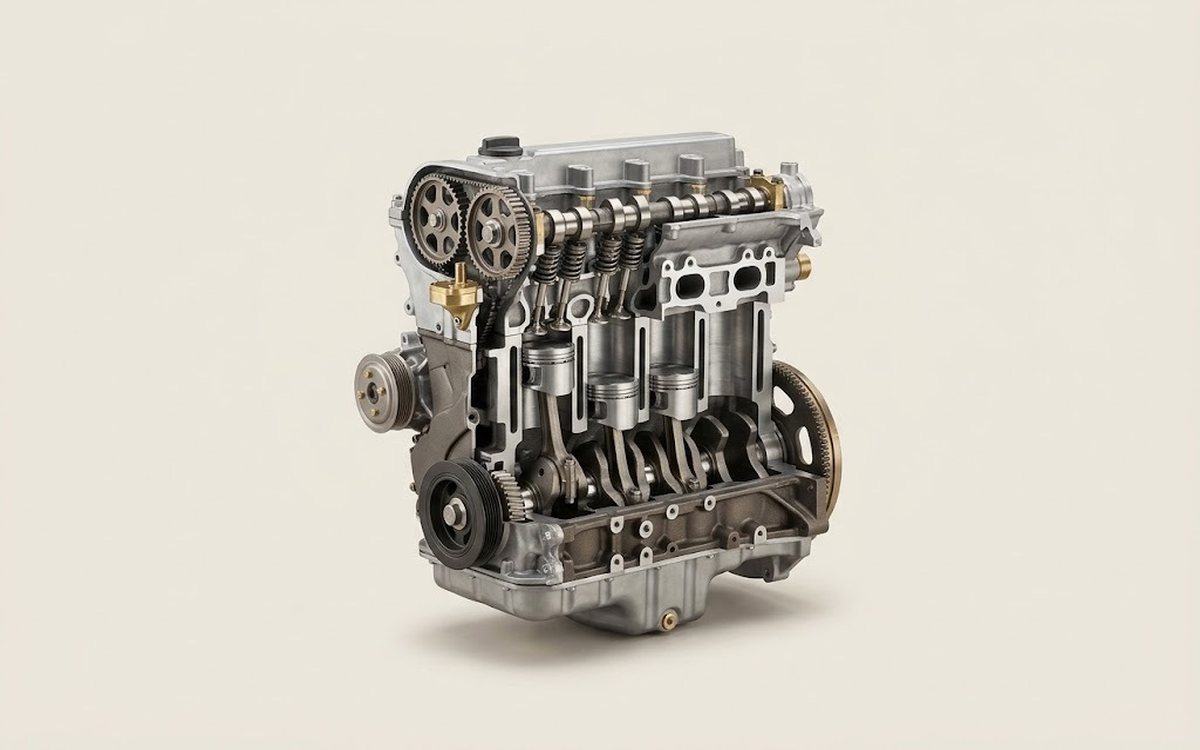 How it works · 3D
How a Car Engine Works
How the part you're working on actually works — in plain English, on a 3D model.
Open in 3D →