Autopapyrus · Nissan Presage (I, U30)
https://autopapyrus.com/guides/nissan/presage/diagnosing-no-reverse-in-the-automatic-transmission/
https://autopapyrus.com/guides/nissan/presage/diagnosing-no-reverse-in-the-automatic-transmission/
Compiled automatically from service literature and owner experience. Specs are for the typical configuration — check them against your exact car before you start.
Nissan Presage (I, U30): Diagnosing No Reverse in the Automatic Transmission
A click when you shift the selector into R (reverse) with no vehicle movement on a Nissan Presage U30 with the RE4F04A automatic transmission is a typical symptom of a mechanical failure inside the transmission. The most common causes are: a reverse clutch drum snap ring that has popped out (a design weakness of the RE4F04A), worn reverse clutch friction discs or a worn brake band, low ATF level, a clogged filter, or faulty solenoids. Diagnosis starts with checking the ATF level and condition, then a line pressure test and a visual inspection of the pan for wear debris (metal shavings, clutch material). If these steps do not reveal the problem, the transmission must be disassembled and the reverse assembly inspected.
Part
- 🔩 Typical candidates: reverse clutch drum assembly with snap ring and backing plates (a known RE4F04A issue), reverse clutch friction discs, brake band, valve body solenoids. Nissan Matic D ATF or equivalent (4-5 L (4.2-5.3 qt)). Transmission pan gasket, filter (when changing the fluid)
Step by step
8 steps- Check the ATF level. Warm the engine to operating temperature (5-7 minutes of driving). Park on level ground, start the engine while holding the brake, move the selector through all positions (P-R-N-D-2-1 and back), then set it to P. With the engine idling, pull out the ATF dipstick (red handle near the battery or on the transmission side under the hood, depending on layout; check the manual). Wipe it dry, insert it fully, and pull it out again. The level should be in the HOT range (fluid temperature 65-80 °C) between MIN and MAX. If it is below MIN, add Nissan Matic D ATF through the dipstick tube using a narrow-tube funnel in portions of 0.2-0.3 L (0.2-0.3 qt), checking the level after each portion. Low fluid reduces system pressure (reverse needs 14-15 bar, while forward gears need only 10-12 bar), so the vehicle may fail to move only in R.
- Evaluate the ATF condition. Note the color and smell of the fluid on the dipstick. Fresh ATF is clear red or pink with no burnt smell. Dark brown or black fluid with a burnt clutch smell indicates worn discs or band. Suspended metal particles are a sign of failing gears or bearings. If the ATF is old (over 60,000 km without a change) and dark, change the fluid and filter before further diagnosis, because a clogged filter can block pressure in the reverse circuit.
- Check the click and the engine response. On level ground, holding the brake pedal, move the selector from P to R. If you hear a click, the selector is mechanically fine and the signal reached the transmission (the solenoid actuated). If the engine speed does NOT drop (as it would under load), the reverse clutch is not engaging and there is no mechanical connection between the engine and the wheels. Compare with D: if the engine speed drops and the vehicle moves in D, the problem is isolated to the reverse assembly (clutch drum, friction discs, or brake band). If there is no response in either D or R, check the torque converter or common components.
- Test drive in forward gears. Drive 2-3 km, shifting between D-2-1. If the vehicle moves forward normally and shifts smoothly, without jerks or slipping, the forward clutches, torque converter, and main hydraulics are fine. This confirms a localized fault in the reverse assembly. If there is slipping in 1st-2nd gear but 3rd-4th work normally, wear of the low/reverse clutch discs is likely (they are shared across some modes in the RE4F04A).
- Inspect the transmission pan and filter (optional, if you have a lift or pit). Raise the front of the vehicle and set it on jack stands. Place a drain pan under the transmission pan (center of the underside, offset toward the front). Remove the pan bolts (usually 10-12 bolts, 10 mm) around the perimeter in a crisscross pattern, loosen them all, then carefully lower the pan (3-4 L (3.2-4.2 qt) of ATF will drain out). Inspect the pan floor for deposits: a small amount of dark clutch dust is normal for mileage over 100,000 km; large pieces of friction material, metal shavings, or shiny aluminum flakes indicate failing parts. Remove the filter (2-3 bolts) and inspect the screen. If it is clogged, clean it with solvent or replace it. Install a new filter, clean the mating surfaces of the pan and transmission case of the old gasket, fit a new gasket, and tighten the pan bolts in a crisscross pattern to 8-10 N·m (6-7 lb-ft). Fill with fresh ATF through the dipstick tube to the correct level, warm up, and test reverse again. If the problem persists, the transmission must be disassembled.
- Diagnose the reverse clutch drum (for specialists or advanced users). The RE4F04A has a design weakness: the reverse clutch drum snap ring can pop out of its groove under load, releasing the backing plates and friction discs, so the clutch stops transmitting torque. Symptom: there is a click (the solenoid switched the hydraulics), but no movement. To check, you must remove the transmission from the vehicle, open the case, take out the reverse clutch drum, and inspect the snap ring. If the ring has popped out or the groove is worn, install an upgraded drum assembly (Nissan released a revised version with a reinforced ring and new backing plates). Tightening torque for the transmission case bolts during assembly is 18-22 N·m (13-16 lb-ft) (for the exact value, see the RE4F04A service manual).
- Check the reverse friction discs and brake band (during transmission disassembly). After removing the clutch drum, inspect the friction disc pack: each disc must be at least 1.6 mm thick (new 2.0-2.2 mm), with a surface free of scoring and burn marks, and steel plates must not be warped. If the discs are worn below the limit or burnt, replace the whole pack. Inspect the reverse brake band on the drum: the friction layer should be intact, without cracks or delamination, and the lining thickness at least 2 mm. Check the band servo piston rod and seal. If the seal is torn, the piston cannot build pressure and the band will not clamp. Replace faulty parts, reassemble the transmission in reverse order, fill with ATF, warm up, and test.
- Check the solenoids and valve body (if the mechanical parts are fine but reverse does not engage). Remove the valve body, located under the pan and secured by 15-20 bolts of different lengths (note or photograph their positions). Check solenoid resistance with a multimeter: the normal range is 10-25 ohms for RE4F04A control solenoids (the exact value depends on the solenoid type, shift solenoid A/B). If the resistance is out of range or the circuit is open, replace the solenoid or the whole valve body. Inspect the valve body passages for stuck valves or dirt, clean them with solvent, and blow them out with compressed air. Reassemble, install, and test.
Common mistakes and warnings
- The no-reverse problem on a Nissan Presage U30 with the RE4F04A automatic transmission is often caused by the reverse clutch drum snap ring popping out, a known defect of this transmission model. If the problem is not solved after checking the ATF level and changing the fluid, the transmission will need to be disassembled and the drum replaced with the upgraded version. Transmission repair requires special knowledge and tools. If you have no experience disassembling automatic transmissions, contact a qualified transmission specialist. Driving with a faulty reverse (rocking the selector back and forth or revving the engine) can cause additional wear to the torque converter and other transmission components, increasing repair costs.
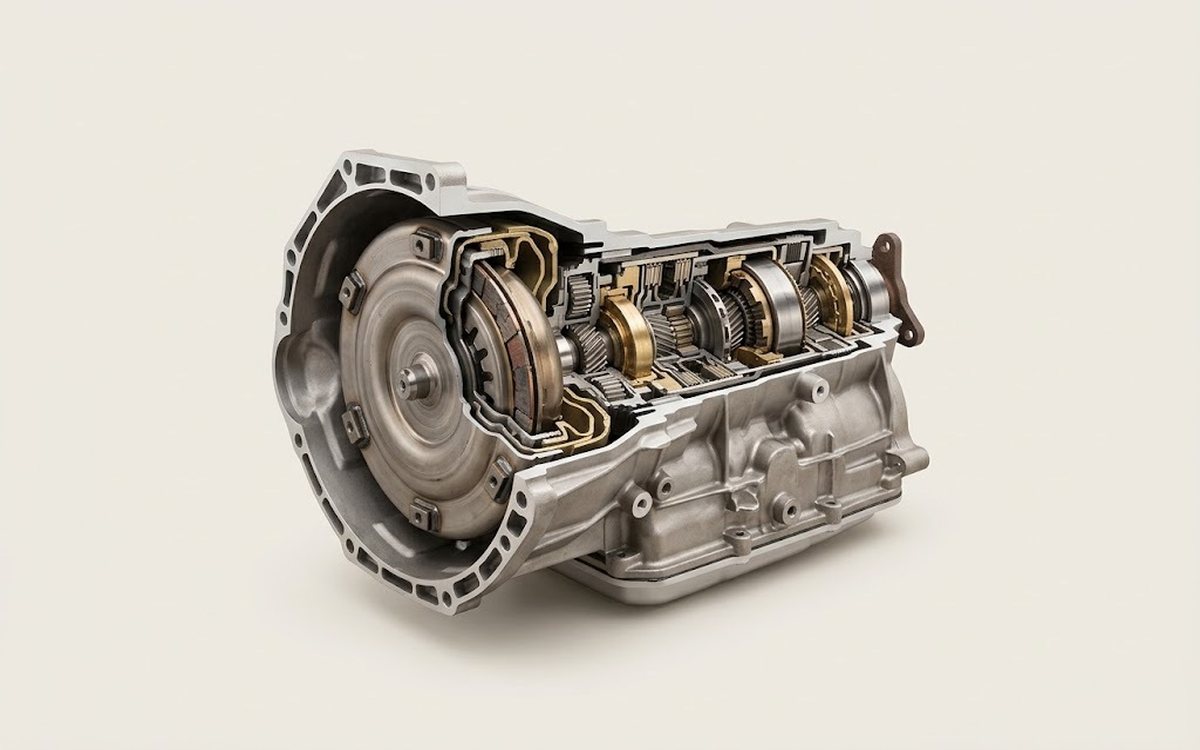 How it works · 3D
How an Automatic Transmission Works
How the part you're working on actually works — in plain English, on a 3D model.
Open in 3D →