Car care & driving
How to Deep Clean Your Car's Interior Yourself
Autopapyrus
There comes a day when you realize your four-wheeled friend needs a serious cleaning. Many car owners try to clean the interior with whatever is at hand, and it usually ends badly: the interior looks even worse afterward, and the materials wear out faster. Many drivers don't know how to clean an interior properly and often work by guesswork, which only damages the upholstery and trim. Few people realize that deep cleaning isn't just about getting things clean. It also means treating the interior with protective products to shield it from changing weather, UV rays, excess moisture and the like. Proper treatment with the right chemical products helps prevent cracks and loss of sheen, and keeps the interior looking good for longer.
Where to start with deep cleaning?
First, understand that deep cleaning a car's interior and tidying it up are very different jobs, both in the products used and in the time required. What counts as tidying up? It's best thought of as the preparation stage for deep cleaning. It includes dry vacuuming, cleaning the windows, dashboard, glove box, floor mats and door sills, and dry cleaning of the trunk.
Deep cleaning, on the other hand, takes much more time and some additional equipment. It's a kind of full-scale spring cleaning done with special equipment and chemical products. Let's go through the stages of a deep interior cleaning:
Preliminary cleaning. This stage uses a wet/dry vacuum. It removes not only all the dry debris and dust but also many kinds of stains. The main goal is to get rid of dust and dirt, which makes the following steps much easier.
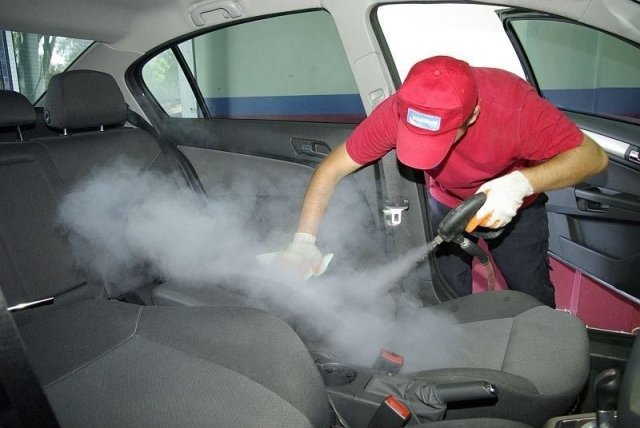
Spot cleaning. The main goal here is to remove grease, oil and food stains. Spot cleaning is done by hand with a stain remover and a sponge. Steam cleaning. This step is very useful in many situations, because the temperature of a steam cleaner can be adjusted, which is what you need to remove old, set-in dirt. No chemicals are used at this stage.
Cleaning the seats and upholstery is done by hand with special cleaning products. After 10 minutes, everything is extracted with a wet/dry vacuum (carpet extractor).
Rinsing with clean water. This is a very important stage, in which the wet/dry vacuum is used in spray-and-suction mode.
Drying the interior. This is the second-to-last stage, needed to remove any remaining moisture. Fresh airflow is essential here, since it speeds up drying. You can also use a fan heater to speed things up.
Polishing. This is the final stage: wiping down all interior parts with refreshing and scenting products.
The whole process usually takes about 12 hours, and most of that is drying time. If you deep clean the interior at least once every few months, you'll keep the air and conditions inside your car at their best.
What next