Car care & driving
What Is a Differential and How Does It Work?
Autopapyrus
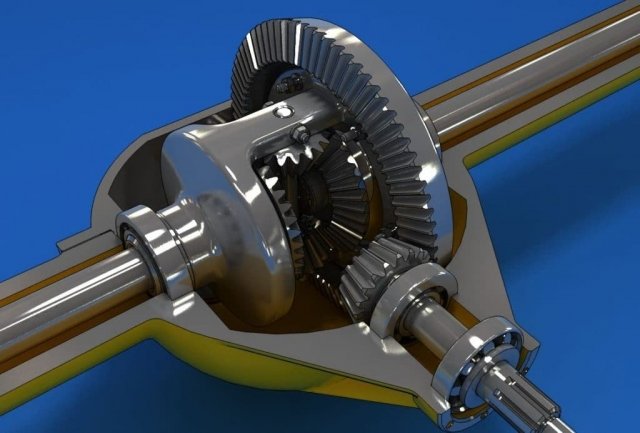
The automotive differential was invented nearly two hundred years ago. Its design has changed over time, but its core features and operating principles remain the same. Let's look at what a differential is and what it does in a car.
1. What is a differential?
The differential plays an important role in a car's drivetrain. This mechanism lets the wheels turn at different speeds by splitting the flow of power that comes from the transmission. As a result, the wheels on one axle can receive power in different proportions and, in turn, rotate at different speeds. In other words, the differential takes 100 percent of the power coming from the transmission and divides it into two streams, one for each wheel on the axle. The power, and therefore the rotation, can be split anywhere from 50:50 to 100:0.
2. What is a differential for?
This mechanism is needed so that the wheels on one axle can turn at different speeds while torque keeps flowing to them without interruption. This matters most in corners. When a car goes around a curve, the wheels on the outside of the turn travel a longer path than the wheels on the inside. To keep the car stable, the outer wheels have to spin faster. If the wheels on an axle were rigidly connected, the inner wheel would slip. In that situation, a rear-wheel-drive car could swing out, and a front-wheel-drive car could lose control in the corner.
That is why, back in the early days of the auto industry, engineers faced a critical challenge: letting the wheels on one axle turn freely while still delivering torque from the powertrain to both of them. A solution to this difficult problem was soon found.
3. How does a differential work?
This mechanism works on the principle of a planetary gear set. It consists of four gears that pass torque to a fifth gear. That fifth gear is the final drive ring gear (the driven gear), and the differential case attached to it acts as the carrier. The final drive itself consists of a pair of gears. One is the drive pinion, which receives rotation from the transmission. The other is the ring gear, which receives rotation from the pinion. The ring gear then passes the rotation through the case to the spider (pinion) gears. These small gears do real work too: they mesh with the side gears, which are firmly fixed to the wheel axle shafts.
When the car drives in a straight line, both wheels turn at the same speed. The spider gears do not rotate on their own, and the ring gear turns at the same rate as the side gears. In a turn, though, the spider gears come into play. Their rotation creates a speed difference between the side gears, so the wheels on the outside and inside of the turn spin at different speeds.
4. Does a differential have any drawbacks?
As is sometimes the case, a mechanism's main advantage can also be its weakness. For the differential, it is the ability to send up to 100 percent of the power to a single wheel. As a result, if one wheel has poor traction, it gets most of the power. Even if one wheel has good grip and the other does not, the car may be unable to move at all.
This problem is well known and is solved in several ways. For example, limited-slip differentials have higher internal friction, and there are also locking differentials, which can be engaged manually or automatically. Differentials of various designs can send power to the wheel with good traction or force both wheels on the axle to turn at the same speed.
What next