Car care & driving
European Car Classification: What Do All Those Letters Mean?
Autopapyrus
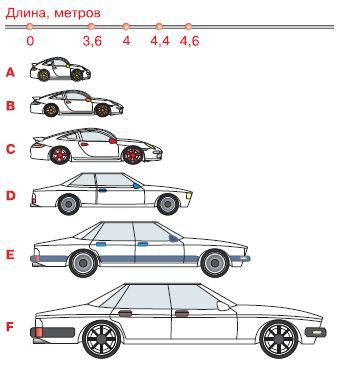
Letters are commonly used to describe a car's class, but even today not everyone fully understands what a given letter actually means. In a fast-moving auto industry, knowing this is increasingly important, because it helps you work out more quickly and accurately which car suits your needs.
This class is often called "mini cars." It mostly covers the smallest cars, with dimensions of up to about 3.6 m (11.8 ft) in length and 1.6 m (5.2 ft) in width. Most cars in this class are built as three- or five-door hatchbacks. Their key traits are compact size, fuel economy and agility. Getting those qualities means giving up power, so these cars are best suited to short trips around town.
Cars in this class traditionally measure no more than 3.9 m (12.8 ft) in length and 1.7 m (5.6 ft) in width. The class is quite diverse, with hatchbacks, sedans and even wagons. Class B is considered one of the most popular in Europe: statistics show that one in four cars sold in Europe belongs to it. Unlike the previous class, these cars can easily handle a trip out of town, though their small size limits the number of passengers and the amount of luggage.
Cars up to 4.3 m (14.1 ft) long and 1.7 m (5.6 ft) wide are the most popular in Europe. Almost a third of Europeans prefer Class C hatchbacks, sedans and wagons. They are valued most for their versatility: still fairly compact, they can easily seat up to five people and carry a decent amount of luggage.
Comfortable, roomy and reliable, cars in this class measure up to 4.6 m (15.1 ft) in length and 1.73 m (5.7 ft) in width. Class D includes many models in a wide variety of body styles, including higher-capacity versions. Prices vary widely, from mid-range to premium.
Cars in this class measure up to 4.9 m (16.1 ft) in length and up to 1.82 m (6 ft) in width. What sets Class E apart is not only generous space, a high level of comfort and safety, but also excellent technical performance. These cars come with powerful engines, complex suspension designs and other technical innovations. They are popular with relatively affluent buyers.
Cars in this class are, without exaggeration, the pinnacle of engineering from various manufacturers. At more than 4.9 m (16.1 ft) long and at least 1.82 m (6 ft) wide, they give owners a spacious cabin equipped with the latest technology, powerful engines and other advanced equipment. The audience for this class is small but very wealthy.
To wrap up this overview of the European classification, note that dividing cars into these fairly broad groups is somewhat arbitrary. The auto industry keeps evolving and releasing new models that barely fit within the established class boundaries. So don't be surprised if the owner's manual that came with your car says the model belongs to, for example, Class D+.
Class A
This class is often called "mini cars." It mostly covers the smallest cars, with dimensions of up to about 3.6 m (11.8 ft) in length and 1.6 m (5.2 ft) in width. Most cars in this class are built as three- or five-door hatchbacks. Their key traits are compact size, fuel economy and agility. Getting those qualities means giving up power, so these cars are best suited to short trips around town.
Class B
Cars in this class traditionally measure no more than 3.9 m (12.8 ft) in length and 1.7 m (5.6 ft) in width. The class is quite diverse, with hatchbacks, sedans and even wagons. Class B is considered one of the most popular in Europe: statistics show that one in four cars sold in Europe belongs to it. Unlike the previous class, these cars can easily handle a trip out of town, though their small size limits the number of passengers and the amount of luggage.
Class C
Cars up to 4.3 m (14.1 ft) long and 1.7 m (5.6 ft) wide are the most popular in Europe. Almost a third of Europeans prefer Class C hatchbacks, sedans and wagons. They are valued most for their versatility: still fairly compact, they can easily seat up to five people and carry a decent amount of luggage.
Class D
Comfortable, roomy and reliable, cars in this class measure up to 4.6 m (15.1 ft) in length and 1.73 m (5.7 ft) in width. Class D includes many models in a wide variety of body styles, including higher-capacity versions. Prices vary widely, from mid-range to premium.
Class E
Cars in this class measure up to 4.9 m (16.1 ft) in length and up to 1.82 m (6 ft) in width. What sets Class E apart is not only generous space, a high level of comfort and safety, but also excellent technical performance. These cars come with powerful engines, complex suspension designs and other technical innovations. They are popular with relatively affluent buyers.
Class F
Cars in this class are, without exaggeration, the pinnacle of engineering from various manufacturers. At more than 4.9 m (16.1 ft) long and at least 1.82 m (6 ft) wide, they give owners a spacious cabin equipped with the latest technology, powerful engines and other advanced equipment. The audience for this class is small but very wealthy.
To wrap up this overview of the European classification, note that dividing cars into these fairly broad groups is somewhat arbitrary. The auto industry keeps evolving and releasing new models that barely fit within the established class boundaries. So don't be surprised if the owner's manual that came with your car says the model belongs to, for example, Class D+.
What next