Car news
The New Tesla Roadster Flies: Breaking Down the October 15, 2026 Unveiling
Autopapyrus
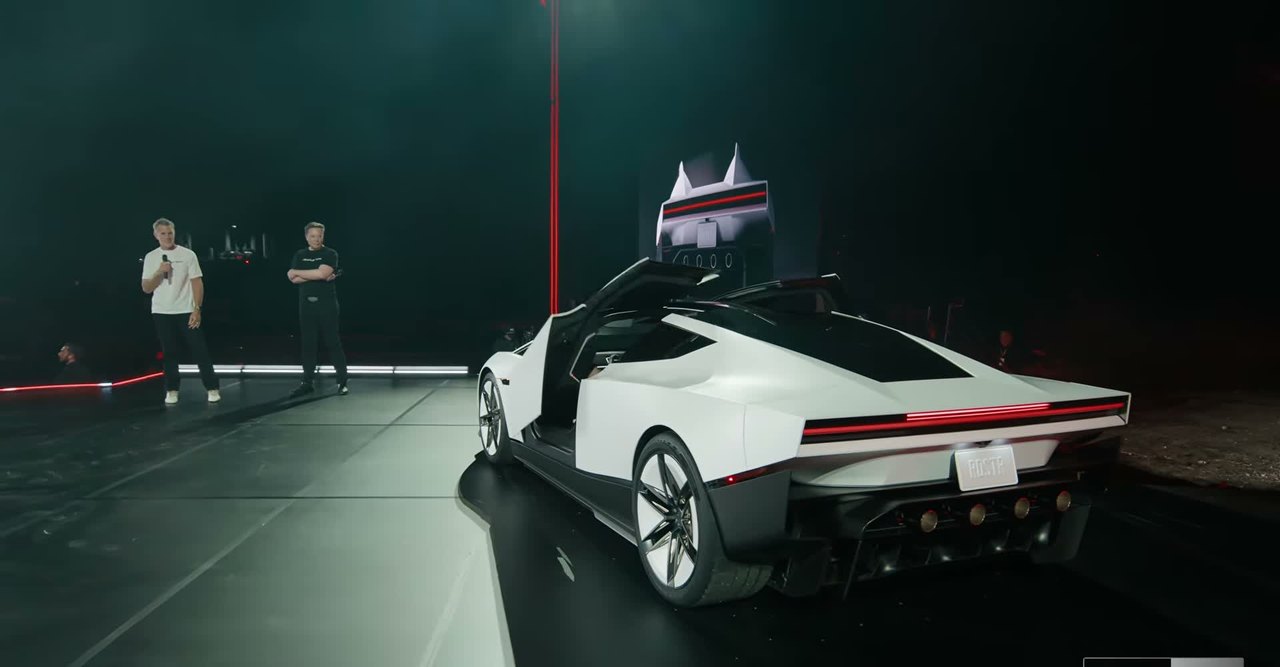
Nine years after its first reveal, Tesla has unveiled the production version of the new Roadster. The electric car accelerates to 60 mph (97 km/h) in under a second, drives upside down along a curved ramp, and briefly takes off using compressed-air thrusters from SpaceX. We look at what was real engineering and what was show, and compare it with the promises made in 2017.
Nine Years of Promises
The second-generation Roadster was first shown in November 2017, at the end of the Tesla Semi truck presentation. Tesla promised 1,000 km (620 miles) of range, a top speed above 400 km/h (250 mph), four seats, and the start of sales in 2020.
- 2018 — Elon Musk first writes that the car could be fitted with rocket thrusters.
- 2020–2024 — The deadlines are pushed back again and again as the project takes a back seat to the Model 3, Model Y, and Cybertruck.
- Spring 2026 — The unveiling is scheduled for April and postponed again.
- October 1, 2026 — Bad weather in Texas disrupts the event.
- October 15, 2026 — The unveiling takes place at SpaceX's test site in McGregor, Texas, where rocket engines are tested.
How the Roadster Drives Upside Down
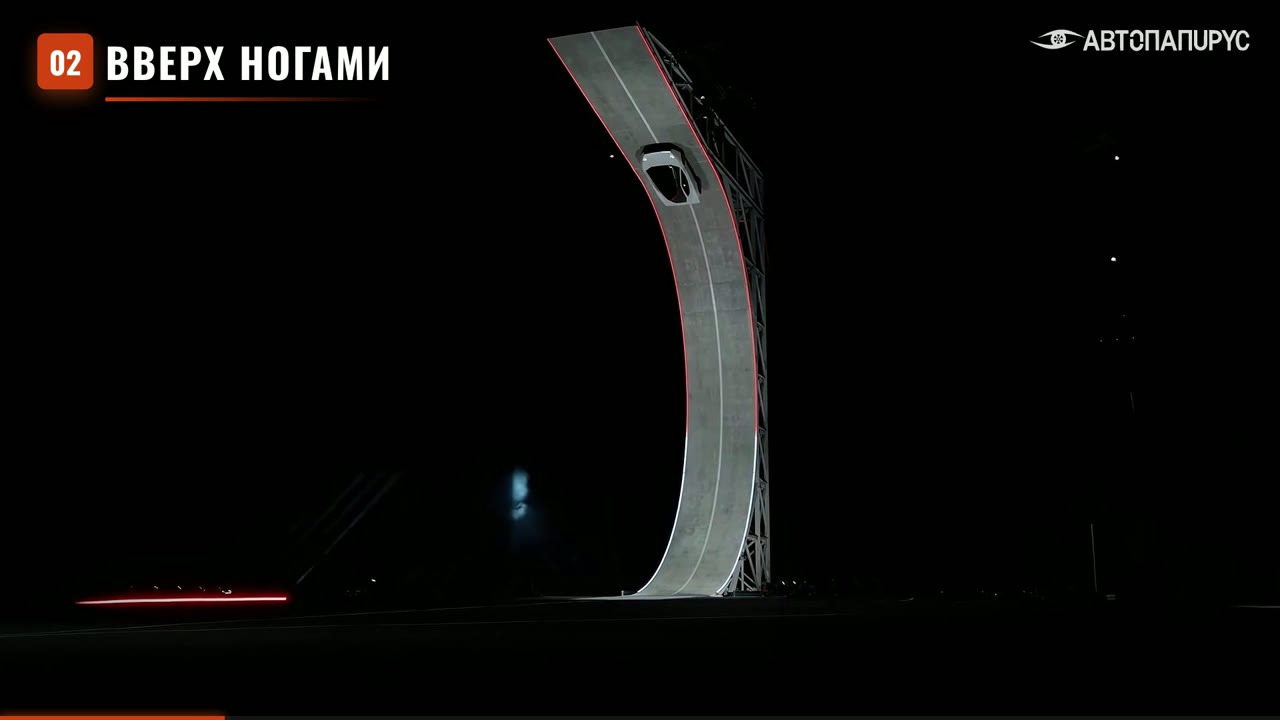
The first stunt came right away: the car accelerates, drives onto a curved ramp, and travels along it with its wheels facing up. It doesn't stay stuck on through speed alone. Powerful fans under the floor pull air out from beneath the body and press the car to the surface with up to 2 g of force, even when it's standing still.
For comparison, ordinary tires hold a car with roughly 1.26 g, and beyond that it starts to slide. The fans have two modes: at low speed they simply suck the body down, and at high speed additional channels open and the airflow under the floor increases. At the rear is a wing with an adjustable angle of attack. Together this gives more than 2 g in a corner, and Musk promises to beat the records at every track.
How It Flies
The Roadster takes off using cold-gas thrusters, the same kind SpaceX uses to maneuver its rockets. There is no fuel here: every free cavity in the body holds carbon-fiber tanks (known as COPV, or composite overwrapped pressure vessels) containing about 600 liters (roughly 21 cubic feet) of air at ultra-high pressure. The car refills them itself, so the stunts can be repeated.
There are ten nozzles around the perimeter of the body: some provide upward thrust, while others rotate and flip the car. At the unveiling, the Roadster lifted off the ramp, flipped in the air, and landed softly on its wheels. The second stunt was a skateboard-style "kickflip": the Roadster jumped over the entire Tesla lineup, including the Cybercab, Cybertruck, Semi tractor, Model Y, and Model 3.
One important detail: nobody was behind the wheel during the demonstration. The car ran in autonomous mode for the show, "so that nobody gets killed," as Musk put it.
0.81 Seconds to 60 mph
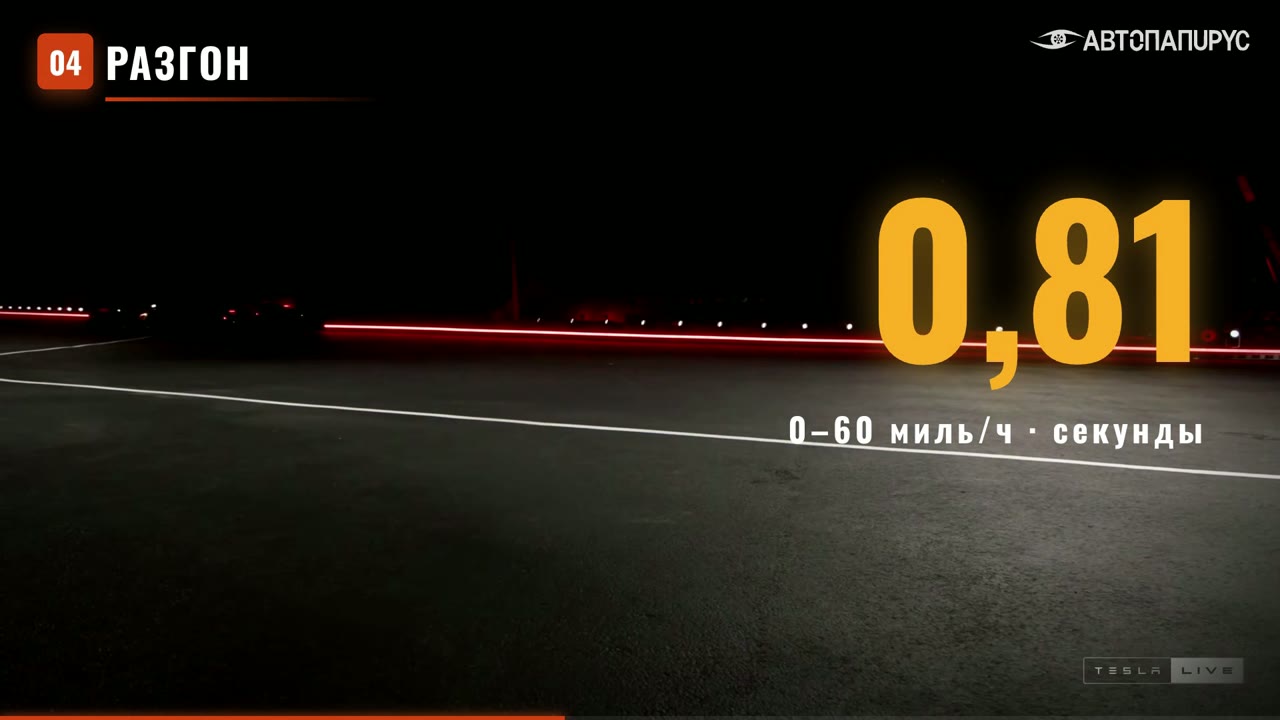
Musk promised 0–60 mph (about 97 km/h) in under one second. The car was launched right on the site: the display first showed an impossible time because the system glitched, and then showed 0.81 seconds. Musk is confident the production Roadster will be even quicker.
| Car | 0–60 mph |
|---|---|
| Tesla Roadster (demo on Oct. 15, 2026) | 0.81 s |
| Rimac Nevera | 1.74 s |
| Tesla Model S Plaid | 1.99 s |
Three Versions
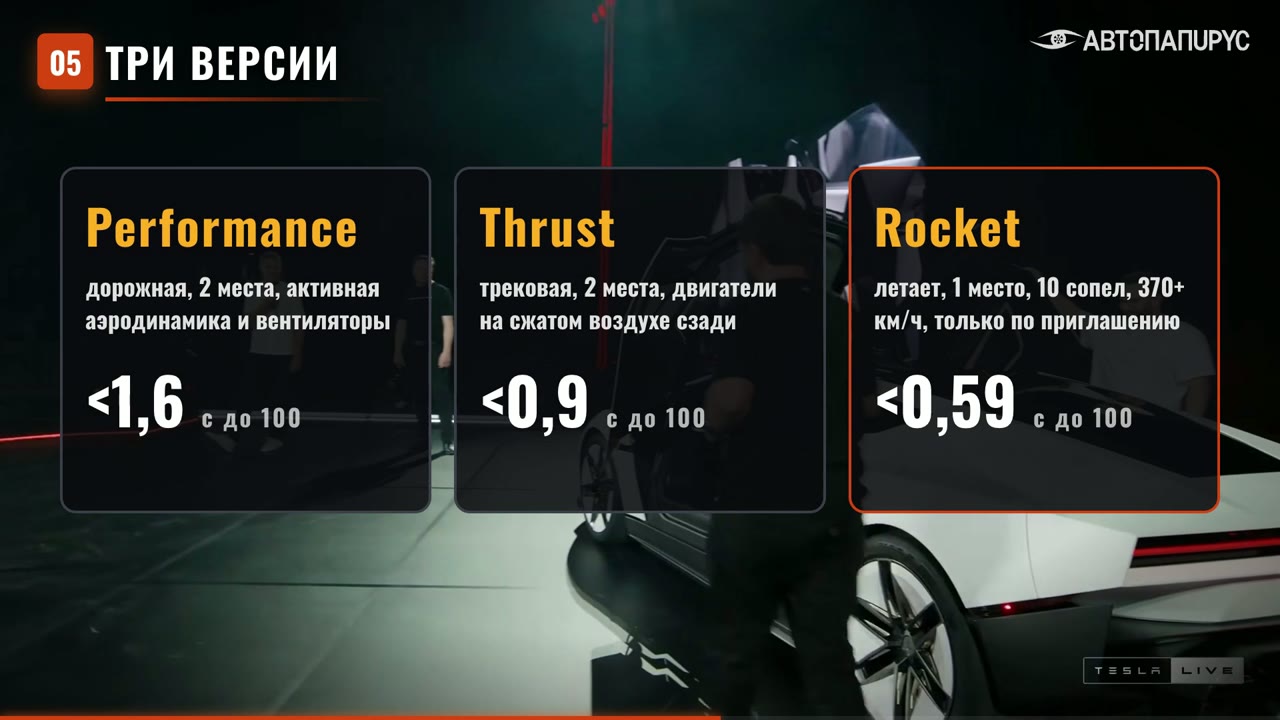
| Performance | Thrust | Rocket | |
|---|---|---|---|
| Purpose | road | track | "flying" |
| Seats | 2 | 2 | 1 |
| What's added | active aerodynamics, fans | compressed-air thrusters at the rear | 10 nozzles around the perimeter |
| 0–60 mph | < 1.6 s | < 0.9 s | < 0.59 s |
| How to buy | pre-order | limited run | invitation only |
All versions have more than 300 miles (about 480 km) of range, and the Rocket's top speed is above 230 mph (about 370 km/h). According to Tesla, the Rocket is not approved for public roads.
Design and Interior
According to Tesla, the exterior is inspired by aircraft, namely the SR-71 reconnaissance plane and the F-35 fighter. The headlights are hidden, the taillight runs across the entire rear, the white paint comes from rocket coatings, and the tinted glass is modeled on the gold visor of a spacesuit.
Inside there are two seats. To save weight, the seats are built right into the body and aren't adjustable. Instead of a steering wheel there is a yoke, and steering, braking, and throttle work by wire, with no mechanical link. The body uses magnesium, titanium, and carbon fiber. The Roadster will be the only Tesla that a person drives themselves, as the company sees all its other models as autonomous.
What Was Promised and What Was Shown
| Promised in 2017 | Shown in 2026 | |
|---|---|---|
| Range | 1,000 km (620 mi) | about 480 km (300 mi) |
| Seats | 4 | 2 (Rocket: 1) |
| Top speed | over 400 km/h (250 mph) | over 370 km/h (230 mph) (Rocket) |
| 0–60 mph | 1.9 s | under 0.59 s (Rocket) |
| Production start | 2020 | 2028 |
Price and Timing
Tesla still hasn't named a price. The pre-order deposit for the Performance is $50,000, and for the Thrust it is $250,000, the same amount charged in 2017. Musk set production for 2028, "for real this time."
Our Verdict
It's impressive engineering: downforce fans, compressed-air thrusters, and this level of acceleration have never before been combined in one car. But the most spectacular versions are for the track and by invitation only, and you can't drive them on ordinary roads. High-pressure tanks and jet nozzles raise questions about safety and certification. Musk himself said it plainly: this is not a car optimized for safety.
In essence, the Roadster is a showcase for Tesla and SpaceX: Musk admits it won't bring the company any significant money. We'll believe it when the car reaches customers. There are just over two years left until 2028.
Sources: Tesla's official livestream of October 15, 2026, Electrek, TechCrunch. Images from the presentation: Tesla.
What next