https://autopapyrus.com/catalog/bmw/x5/guides/diagnosing-engine-misfires-rough-running/
BMW X5 3.0i M54 (2002): Diagnosing Engine Misfires (Rough Running)
Rough running on the M54 is most often caused by vacuum leaks (crankcase ventilation, hoses, the rubber boot after the airflow meter), then by worn spark plugs and ignition coils, and less often by the fuel system. A fault code for one cylinder can "smear" onto neighboring cylinders because of crankshaft speed fluctuations, so start by reading the codes and checking for leaks instead of replacing parts at random.
Parts
9| № | Part | Genuine part no. |
|---|---|---|
| 01 | Ignition coilsone per cylinder, if faultyFind on Amazon → | 12131712219 |
| 12138616153 | ||
| 02 | Spark plugsset of 6, if faultyFind on Amazon → | 12120141871 |
| 12129071003 | ||
| 12120037607 | ||
| 03 | Vacuum hoses and crankcase ventilation (PCV) hosesif faultyFind on Amazon → | |
| 04 | Crankcase vent valveif faultyFind on Amazon → | |
| 05 | Oil separatorif faultyFind on Amazon → | |
| 06 | Valve cover gasketif faultyFind on Amazon → | 11129070990 |
| 11120030496 | ||
| 07 | Mass airflow sensorif faultyFind on Amazon → | 13627567451 |
| 08 | Fuel injectorsif faultyFind on Amazon → | 13537546245 |
| 09 | Fuel pumpif faultyFind on Amazon → | 16116755043 |
| 16116755044 |
Amazon links search by the part name and genuine number; use Amazon's fit check for your car before ordering. We may earn a commission from qualifying purchases.
Part numbers are from the manufacturer's original catalogue. Check them against your VIN before ordering.
Tools
7- BMW-compatible diagnostic scanner (to read DME fault codes and per-cylinder misfire data) Amazon →
- 16 mm spark plug socket with extension Amazon →
- Torx sockets and 10/13 mm sockets (for the coils and covers) Amazon →
- torque wrench Amazon →
- multimeter Amazon →
- smoke machine or a can of throttle body/carb cleaner for finding vacuum leaks Amazon →
- flashlight Amazon →
Read the codes yourself
A scanner plugged into the OBD2 port under the dashboard shows which fault codes the car has stored, before you buy any parts. Cars sold in the US from 1996, and petrol cars in Europe from 2001 (diesels from 2004), have this port.
- Basic code reader, about $20–40: reads and clears engine codes Amazon →
- Bluetooth scanner with a phone app, about $30–100: live sensor data, and on many cars ABS and airbag codes too Amazon →
Check that the scanner lists your make and model year before you buy. We may earn a commission from qualifying purchases.
 There's a full repair manual for this car
Every system, wiring diagrams and torque specs — not just this job. Haynes AutoFix (online) and 3 more.
See manuals →
Step by step
10 steps- Read the fault codes from the engine control unit. Codes such as P0300 indicate misfires in multiple cylinders, while P0301-P0306 point to a specific cylinder. Write them down, clear them, and see which ones return after a drive. If your scanner shows per-cylinder misfire counters, find the cylinder with the highest count.
- Determine the nature of the problem. If it runs rough only at idle and smooths out under load, a vacuum leak or the crankcase ventilation is more likely. If it runs rough under load or during acceleration, spark plugs, coils or fuel are more likely. If it runs rough only on a cold engine, look at vacuum leaks and the crankcase ventilation.
- Inspect the crankcase ventilation system and the intake. Check the crankcase ventilation hoses, the crankcase vent valve (on the M54 it is located at the rear of the intake tract and often cracks), the rubber boot between the airflow meter and the throttle body, the vacuum hoses and the plastic tees. Signs: a whistling sound at idle, fluctuating RPM, oil in the hoses. You can find a leak by carefully spraying cleaner around the joints: the engine speed will change.
- Remove the engine cover and check the coils. Disconnect the connector of the coil on the problem cylinder, remove the fastener and pull the coil out. Inspect the rubber boot and the insulator for cracks, signs of arcing and oil. Swap the problem cylinder's coil with one from a good cylinder: if the fault follows the coil, the coil is bad.
- Remove the spark plugs (first blow out the plug wells with compressed air so debris doesn't fall into the cylinder). Evaluate their condition: heavily worn electrodes, black carbon deposits, oil traces, cracked insulators. If the plugs have more than 60-80 thousand km (about 37-50 thousand miles) on them or are in poor condition, replace the whole set with the plugs recommended for the M54. Check the gap and tightening torque against the plug manufacturer's specifications and the service manual (the torque for the plugs is usually about 23 N·m (17 lb-ft), but verify it against the service manual).
- Check the compression, or at least check for oil in the spark plug wells. Oil in the wells means the valve cover gasket is leaking. This quickly ruins coils and plugs, so if you find it, replace the valve cover gasket and the spark plug well seals.
- If the ignition and vacuum are fine, check the fuel system: fuel pressure at the rail (per the manufacturer's specification), fuel pump operation, the condition of the fuel filter and, if necessary, cleaning and testing the injectors. A common cause at high mileage is a weak fuel pump, in which case the rough running gets worse under load.
- Check the mass airflow sensor and the long-term fuel trim readings. Large positive trim values point to a vacuum leak or insufficient fuel delivery.
- If you find nothing, check the mechanical side: cylinder compression, valve condition, valve timing. This is labor-intensive diagnosis and is best left to a specialist.
- After the repair, clear the fault codes, warm up the engine, take a test drive under load and make sure the misfires don't return. If necessary, perform an adaptation reset in the control unit.
Common mistakes and warnings
- Do not drive for long with misfires: unburned mixture enters the exhaust and overheats the catalytic converters, which destroys them and leads to expensive repairs
- A flashing Check Engine light means you should reduce engine load and stop for diagnosis as soon as possible
- When working on the fuel system, eliminate sparks and open flames and relieve the pressure in the fuel rail; if you lack experience, it is better to go to a repair shop
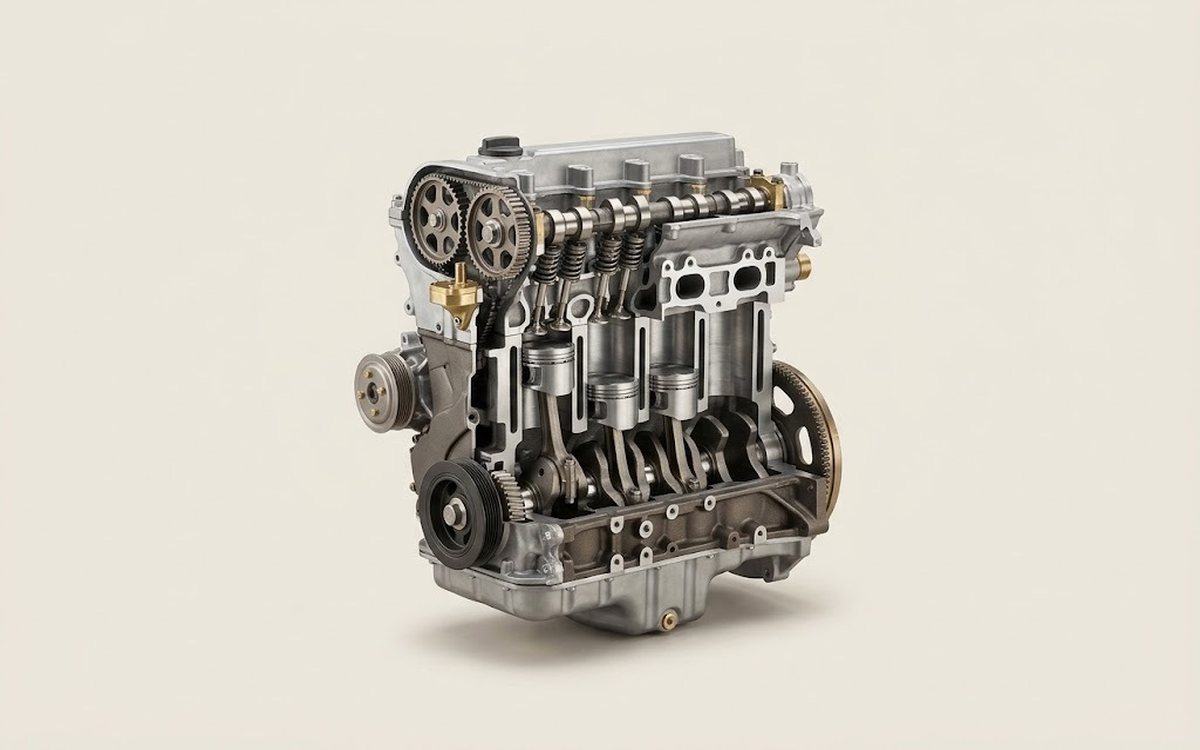 How it works · 3D
How a Car Engine Works
How the part you're working on actually works — in plain English, on a 3D model.
Open in 3D →
Spotted a mistake? Tell us →
Our articles
 Brand stories
The History of BMW
BMW AG stands for Bayerische Motoren Werke, or "Bavarian Motor Works." BMW is a major manufacturer of cars, engines…
Read →
 Garage
Fuel Quality Indicators: What Octane and Cetane Numbers Mean
What is an octane number? What about a cetane number? Which fuel should you choose for a high-compression engine?…
Read →
 Before you buy
How to Pick Up Your Car from the Dealership the Right Way
If you've decided to buy a car from a dealership, it isn't enough to simply choose a model you like, pay for it, and…
Read →