https://autopapyrus.com/catalog/izh/izh-2125-kombi/guides/diagnosing-and-fixing-engine-misfire/
IZH-2125 "Kombi" 1.5 (ZMZ-511, 77 hp) (1998): Diagnosing and Fixing Engine Misfire
A misfire on the ZMZ-511 engine means one or more cylinders are not firing or are firing unevenly. Typical causes are failed spark plugs, breakdown of the high-tension wires, tight valves and low compression. Diagnose from the simple to the complex: first the ignition system, then the valves, then compression.
Parts
5| № | Part |
|---|---|
| 01 | Spark plugs A11 (or A14)Find on Amazon → |
| 02 | High-tension spark plug wiressetFind on Amazon → |
| 03 | Distributor rotor and capFind on Amazon → |
| 04 | Ignition coil B-116for electronic (breakerless) ignitionFind on Amazon → |
| 05 | Ignition coil B-114for breaker-point ignitionFind on Amazon → |
Amazon links search by the part name; use Amazon's fit check for your car before ordering. We may earn a commission from qualifying purchases.
Tools
6Read the codes yourself
A scanner plugged into the OBD2 port under the dashboard shows which fault codes the car has stored, before you buy any parts. Cars sold in the US from 1996, and petrol cars in Europe from 2001 (diesels from 2004), have this port.
- Basic code reader, about $20–40: reads and clears engine codes Amazon →
- Bluetooth scanner with a phone app, about $30–100: live sensor data, and on many cars ABS and airbag codes too Amazon →
Check that the scanner lists your make and model year before you buy. We may earn a commission from qualifying purchases.
Step by step
9 steps- Start the engine and let it idle. Listen to how it runs. A misfire shows up as uneven popping in the exhaust and vibration of the body.
- Find the dead cylinder. Pull the spark plug wire boots off the plugs one at a time. If the engine was running roughly and pulling a wire changes nothing, that cylinder is not firing. If the engine speed drops noticeably, that cylinder is working.
- Remove the spark plugs with a spark plug socket. The ZMZ-511 uses A11 plugs, and A14 is acceptable. Inspect them. Black deposits mean a rich mixture or oil getting in. A white coating means a lean mixture and overheating. Cracks in the insulator mean the spark is leaking through instead of jumping the electrodes. The electrode gap should be 0.7-0.9 mm. Replace worn plugs.
- Check the high-tension wires. In the dark (a garage with the lights off, or in the evening), start the engine and look at the wires, the distributor cap and the rotor for arcing and static discharge. A breakdown shows up as glowing spots or sparks. Plug boots often crack on the inside. If you find a breakdown, replace the wires as a complete set.
- Inspect the distributor cap. Remove it and check the inside surface for burn marks (dark tracks running from the center contact to the side contacts). Check the rotor for signs of burn-through as well. Replace the cap and rotor if you find any defects.
- Measure compression in all cylinders with a compression tester. The throttle must be fully open and the spark plugs removed. The standard for the ZMZ-511 is 7-8 atm (about 100-115 psi), and a drop to 6 atm (about 85 psi) is acceptable in a running engine. If one cylinder reads below 6 atm while the others are normal, you may have a burnt valve, worn piston rings or scoring on the cylinder wall. A difference of more than 1 atm between cylinders also points to problems.
- Check the valve clearances. Tight valves (zero clearance) keep a cylinder from running properly. Adjust the valves on a cold engine. The clearance for both intake and exhaust valves on the ZMZ-511 is 0.25-0.30 mm, and 0.30 mm is the recommended setting. The firing order is 1-5-4-2-6-3-7-8. Adjust the valves according to the procedure for aligning the marks on the crankshaft pulley.
- If the problem persists after replacing the plugs and wires and adjusting the valves, and compression is normal, test the ignition coil with a multimeter. Primary winding resistance should be 0.5-1.5 Ω, and secondary winding resistance 5-15 kΩ, depending on the model. The ZMZ-511 uses the B-116 coil with the electronic (breakerless) system and the B-114 with the breaker-point system.
- Check for vacuum leaks at the intake manifold. With the engine running, spray flammable liquid (carburetor cleaner or gasoline) on the joints between the manifold and the cylinder head and between the manifold and the carburetor. If the engine speed jumps, the gasket is leaking. Tighten the mounting nuts or replace the gasket.
Common mistakes and warnings
- Running the engine for a long time with a dead cylinder lets unburned fuel wash the oil off the cylinder wall
- This speeds up wear of the piston group and thins the engine oil
- Fix the cause of the misfire as soon as possible
- If compression is below 5 atm (about 70 psi), the engine needs a major overhaul
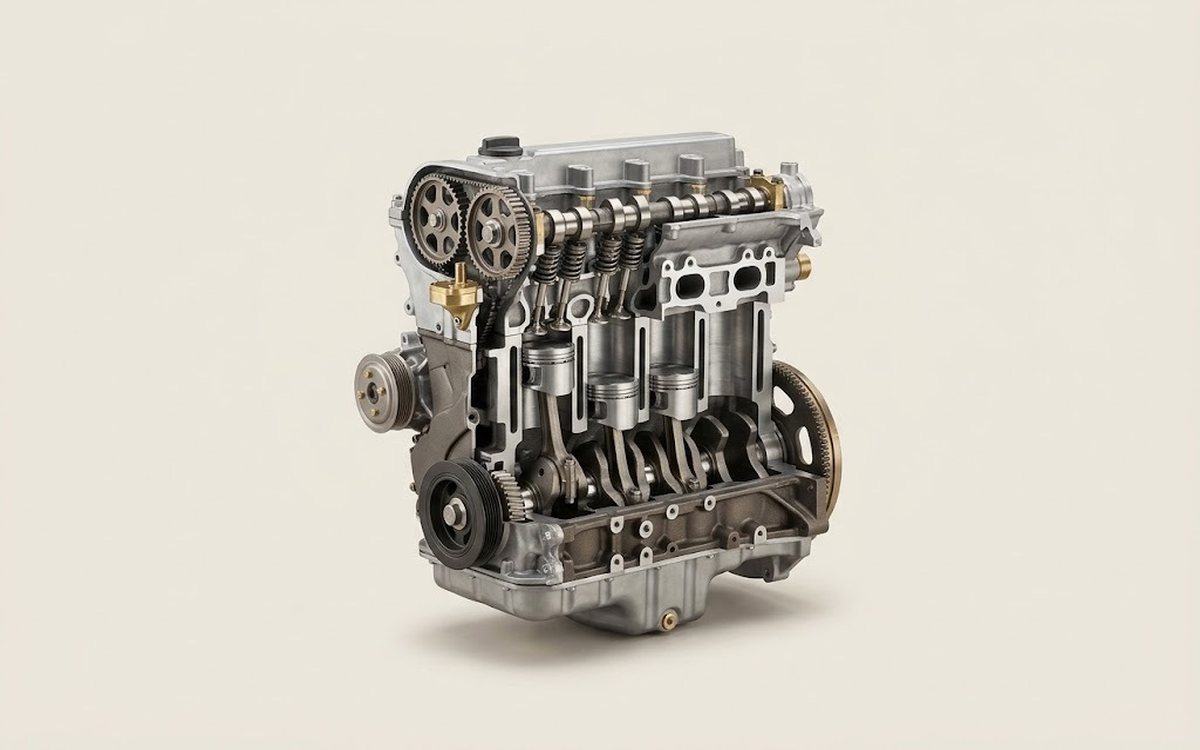 How it works · 3D
How a Car Engine Works
How the part you're working on actually works — in plain English, on a 3D model.
Open in 3D →