https://autopapyrus.com/catalog/kia/sportage/guides/diagnosing-and-fixing-timing-drive-knock/
Kia Sportage 2.0 16V G4KD (2010): Diagnosing and Fixing Timing Drive Knock
Knocking from the timing drive on the G4KD engine is most often caused by a stretched chain or a worn tensioner. Diagnosis involves a visual inspection of the tensioner and a check of the timing marks. The chain's service life is 150,000-200,000 km under normal use, but aggressive driving can cause stretching sooner. If the tensioner is extended almost fully, the chain and related components need to be replaced.
Parts
6| № | Part |
|---|---|
| 01 | Timing chainFind on Amazon → |
| 02 | Chain tensionerFind on Amazon → |
| 03 | Chain guideFind on Amazon → |
| 04 | Chain guideFind on Amazon → |
| 05 | Valve cover gasketFind on Amazon → |
| 06 | Front crankshaft sealFind on Amazon → |
Amazon links search by the part name; use Amazon's fit check for your car before ordering. We may earn a commission from qualifying purchases.
Tools
5Read the codes yourself
A scanner plugged into the OBD2 port under the dashboard shows which fault codes the car has stored, before you buy any parts. Cars sold in the US from 1996, and petrol cars in Europe from 2001 (diesels from 2004), have this port.
- Basic code reader, about $20–40: reads and clears engine codes Amazon →
- Bluetooth scanner with a phone app, about $30–100: live sensor data, and on many cars ABS and airbag codes too Amazon →
Check that the scanner lists your make and model year before you buy. We may earn a commission from qualifying purchases.
 There's a full repair manual for this car
Every system, wiring diagrams and torque specs — not just this job. Haynes AutoFix (online) and 4 more.
See manuals →
Step by step
10 steps- Tensioner diagnosis — remove the valve cover (tighten the bolts to 7.8-9.8 N·m (5.8-7.2 lb-ft) during reassembly) and inspect the timing chain tensioner. If the tensioner plunger is extended to its maximum length (almost all the teeth are visible), the chain is stretched and must be replaced.
- Timing mark check — turn the crankshaft to TDC of cylinder 1 (the mark on the pulley lines up with the mark on the cover) and make sure the colored chain links line up with the marks on the camshaft and crankshaft sprockets. A mark offset of more than 1 link indicates a stretched chain.
- Removing accessories — disconnect the battery terminal, drain the coolant, and remove the air filter, the coolant hoses, and the valve cover.
- Locking the crankshaft — set the cylinder 1 piston at TDC and lock the crankshaft with the special tool (or lock the flywheel through the opening in the bellhousing).
- Removing the crankshaft pulley — loosen the center pulley bolt (reassembly torque 166.6-176.4 N·m (122.9-130.1 lb-ft)), then remove the pulley and the front engine cover.
- Releasing the tensioner — remove the tensioner mounting bolt (reassembly torque 9.8-11.8 N·m (7.2-8.7 lb-ft)) and take off the old tensioner.
- Removing the guides and chain — remove the chain guide bolts (reassembly torque 9.8-11.8 N·m (7.2-8.7 lb-ft)) and take the chain off the sprockets. Inspect the sprocket teeth for wear, and replace the sprockets if they show worn grooves.
- Installing the new chain — fit the new chain onto the crankshaft sprocket, then onto the camshaft sprockets, aligning the colored chain links with the marks on the sprockets (the intake and exhaust camshaft marks must face each other at the same level).
- Installing the guides and tensioner — install the new chain guides and tighten the bolts to 9.8-11.8 N·m (7.2-8.7 lb-ft). Install the new tensioner and tighten its bolt to 9.8-11.8 N·m (7.2-8.7 lb-ft).
- Reassembly and checks — install the front cover with a new crankshaft seal and tighten the crankshaft pulley to 166.6-176.4 N·m (122.9-130.1 lb-ft). Turn the crankshaft two full revolutions by hand and make sure the marks line up. Install the valve cover with a new gasket (tighten the bolts to 7.8-9.8 N·m (5.8-7.2 lb-ft) on the second pass), then refill the coolant and engine oil.
Common mistakes and warnings
- The G4KD engine has a four-row timing chain
- If the chain breaks or jumps teeth, the pistons hit the valves, which leads to expensive repairs
- If the knock is accompanied by a loss of power or rough running, stop driving the car immediately and have it towed
- Putting off the repair can lead to a broken chain and cylinder head damage
- When replacing the chain, always replace the tensioner and both guides at the same time
- Replacing them separately is ineffective
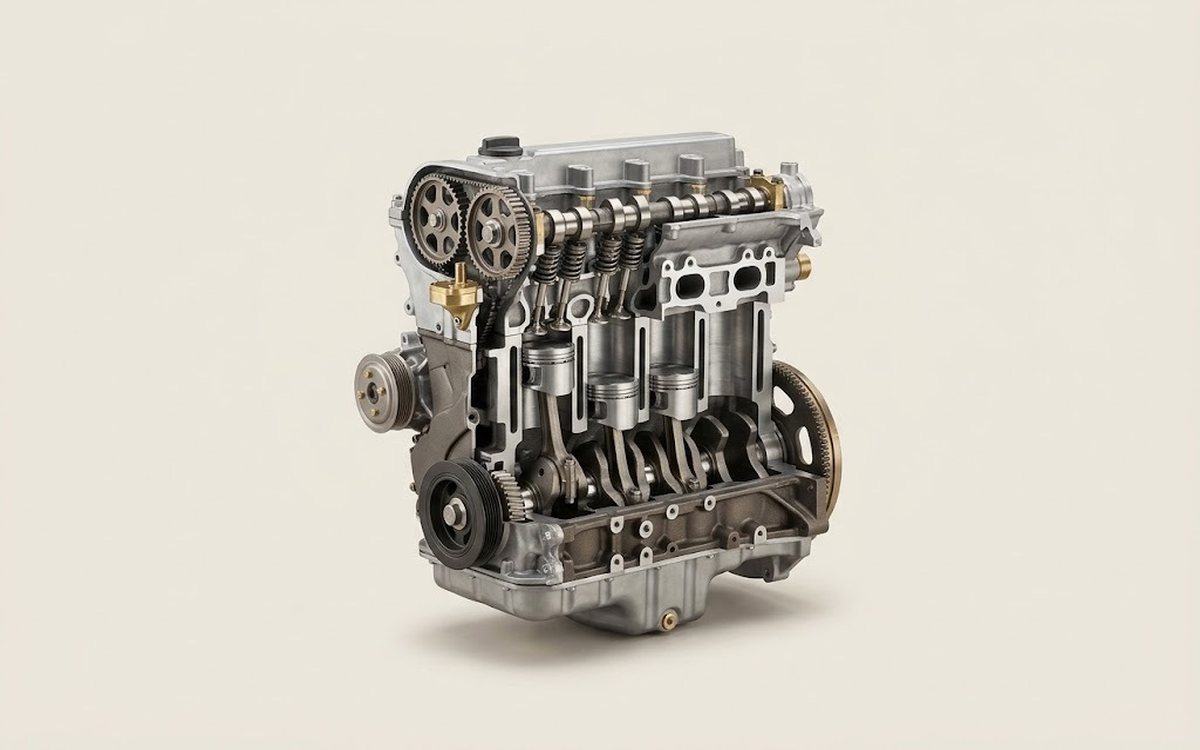 How it works · 3D
How a Car Engine Works
How the part you're working on actually works — in plain English, on a 3D model.
Open in 3D →