https://autopapyrus.com/catalog/van-hool/tx-ex/guides/diagnosing-a-front-suspension-knock/
Van Hool TX/EX: Diagnosing a Front Suspension Knock
On TX/EX buses with air suspension, a knock from the front is most often caused by worn rubber-metal bushings in the rods and shock absorbers, play in the steering joints, or loose fasteners. The exact procedure and torque values for this model are not described in open sources, so the general diagnostic approach is given below. Check specific torque values against the manufacturer's service manual.
Parts
8| № | Part |
|---|---|
| 01 | Front suspension air springs (bellows)Find on Amazon → |
| 02 | Front suspension shock absorbersFind on Amazon → |
| 03 | Torque rod and radius arm bushingsFind on Amazon → |
| 04 | Ball jointsFind on Amazon → |
| 05 | Steering jointsFind on Amazon → |
| 06 | Tie rod (track rod)Find on Amazon → |
| 07 | Stabilizer bar (sway bar) pins and bushingsFind on Amazon → |
| 08 | Wheel hub bearingsFind on Amazon → |
Amazon links search by the part name; use Amazon's fit check for your car before ordering. We may earn a commission from qualifying purchases.
Tools
7Read the codes yourself
A scanner plugged into the OBD2 port under the dashboard shows which fault codes the car has stored, before you buy any parts. Cars sold in the US from 1996, and petrol cars in Europe from 2001 (diesels from 2004), have this port.
- Basic code reader, about $20–40: reads and clears engine codes Amazon →
- Bluetooth scanner with a phone app, about $30–100: live sensor data, and on many cars ABS and airbag codes too Amazon →
Check that the scanner lists your make and model year before you buy. We may earn a commission from qualifying purchases.
Step by step
9 steps- Park the bus on level ground, apply the parking brake, and place wheel chocks. Release the air from the suspension or raise the bus on a lift, then place axle stands under the axle. Never work under a bus that is supported only by its air suspension.
- Check the air system pressure and the body ride height. Make sure the air springs do not rub against neighboring components and have no cracks, and that the sensors and the level valve linkages are not loose. A knock often comes from a bellows rubbing against something or from a worn sensor link.
- Inspect the shock absorber mounts: the upper and lower bushings, pins, and bolts. Check the body for oil leaks. Any play or leak means the shock absorber must be replaced, and shocks must always be replaced in pairs on an axle.
- Check the torque rods and radius arms. Use a pry bar to try to move each rod at its mounting point to reveal bushing wear: torn rubber, shifted metal, or play. Check the tightness of the mounting bolts.
- Check the steering joints and the tie rod. Have a helper rock the steering wheel while you watch and touch the joints with your hand: any noticeable play means replacement. Permissible play in the steering system is defined by the manufacturer's service manual.
- Rock the wheel of the raised axle vertically and horizontally. Vertical play points to the kingpin or ball joint assemblies, while horizontal play points to the wheel hub bearings or the tie rod. If necessary, measure the play with a dial indicator.
- Check the stabilizer bar: the links, bushings, and clamps. They usually knock when driving over bumps at low speed.
- Inspect the steering knuckles and their supports for cracks. For Van Hool buses of this generation, service campaigns (recalls) are known for cracks in the front axle steering knuckle supports, so if you suspect a crack, stop operating the bus.
- After replacing worn parts, tighten the fasteners to the torque values in the manufacturer's service manual, and do the final tightening of the suspension bushings with the bus standing on its wheels at normal ride height. Then take a test drive and, if necessary, check the wheel alignment.
Common mistakes and warnings
- The bus's front suspension and steering are safety-critical systems, and working under an air suspension is dangerous
- If you have no experience working on passenger vehicles, leave the diagnosis and replacement to a certified repair shop
- If you find cracks in the knuckle, tie rods, or load-bearing parts, do not operate the bus any further
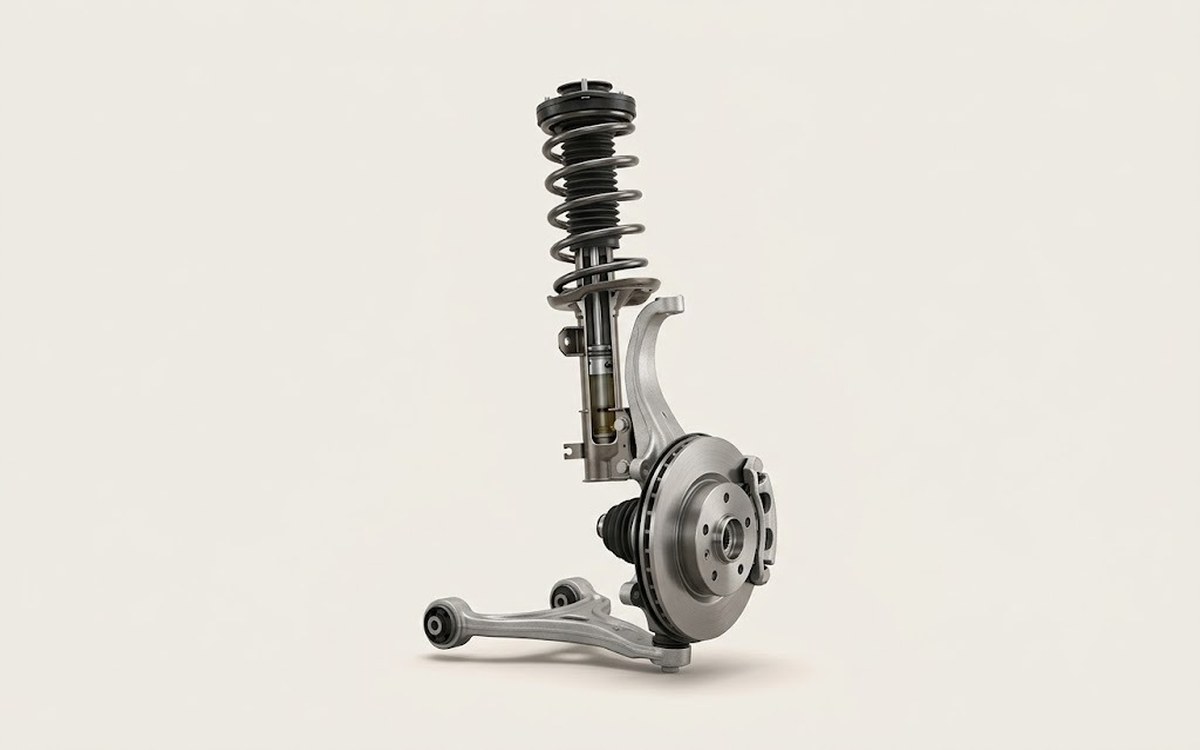 How it works · 3D
How Car Suspension Works
How the part you're working on actually works — in plain English, on a 3D model.
Open in 3D →