Autopapyrus · Kia Sportage 2.0 MPI G4NA (2015)
https://autopapyrus.com/guides/kia/sportage/misfire-diagnosis-rough-running-engine/
https://autopapyrus.com/guides/kia/sportage/misfire-diagnosis-rough-running-engine/
Compiled automatically from service literature and owner experience. Specs are for the typical configuration — check them against your exact car before you start.
Kia Sportage 2.0 MPI G4NA (2015): Misfire Diagnosis (Rough-Running Engine)
A rough-running G4NA is most often caused by worn spark plugs, a failed ignition coil, dirty fuel injectors, or an air leak. Less often the cause is mechanical: valves, compression, or valve timing. Work from the simple to the complex: first read the codes and identify the cylinder, then check the spark plugs and coil, and only then the fuel, air and mechanical systems.
Parts
4| № | Part | Genuine part no. |
|---|---|---|
| 01 | Spark plugs for G4NA, iridium4 pcs | 18846-08070 |
| 18846-11070 | ||
| 02 | Ignition coil for G4NAif faulty, per cylinder | 27300-2E000 |
| 03 | Air filterif needed | 28113-D3300 |
| 04 | Valve cover gasketif needed |
Part numbers are from the manufacturer's original catalogue. Check them against your VIN before ordering.
Tools
7- OBD scanner
- socket set with extension and universal joint
- 16 mm spark plug socket with rubber insert
- torque wrench
- feeler gauge
- screwdriver
- compression tester
 There's a full repair manual for this car
Every system, wiring diagrams and torque specs — not just this job. Haynes AutoFix (online) and 4 more.
See manuals →
Step by step
12 steps- Connect the OBD scanner and read the codes. Codes P0301-P0304 point to the specific cylinder that is misfiring, and P0300 means random misfires across several cylinders. Also check codes for the oxygen sensors, MAF sensor, intake pressure and valve timing. Write down the codes and clear them.
- Determine when the engine runs rough. Is it on a cold engine, under load, or only at idle? If it happens only when cold and goes away after warm-up, suspect the injectors or an air leak. If it happens under load, suspect the spark plugs and coils.
- Shut off the engine and let it cool down. Remove the decorative engine cover. Disconnect the connector of the coil on the problem cylinder, remove the coil mounting bolt (10 mm) and carefully pull the coil out. Inspect it for cracks, signs of arcing and oil in the spark plug well.
- Remove the spark plugs with a 16 mm socket. Compare them: carbon deposits, a wet plug, a melted electrode, cracks in the insulator. A suspicious color or condition on one plug points to a problem in that cylinder. If oil has flooded the spark plug well, the valve cover gasket needs to be replaced.
- Check the spark plug gap with a feeler gauge. For the G4NA the gap is usually about 1.0-1.1 mm (check against the specification on the plug packaging). Replace worn plugs (over 60,000-90,000 km (about 37,000-56,000 miles) for iridium) as a full set, not one at a time.
- To test a coil, swap it from the problem cylinder to a neighboring one. Start the engine, clear the codes and crank the engine. If the misfire code "moved" with the coil, replace the coil. If it stayed on the same cylinder, check the spark plug, injector and compression.
- When installing the spark plugs, tighten them carefully with a torque wrench: target 15-25 N·m (11-18 lb-ft), no more. The threads in the aluminum head are delicate. Secure the coil with its bolt to about 8-12 N·m (6-9 lb-ft) and plug in the connector until it clicks.
- If the spark plugs and coils are fine, check for an air leak: inspect the intake tract and hoses for cracks, check the intake manifold mounting and the crankcase ventilation hose. A dirty throttle body or MAF sensor can also cause an unstable idle. Both can be cleaned with a dedicated cleaner.
- Check the injectors: compare the fuel trims (STFT/LTFT) on the scanner. Strongly positive values (more than +10-15%) indicate a lean mixture or an air leak. Injector cleaning or ultrasonic cleaning helps if the cause is contamination.
- If nothing has helped, measure the compression in each cylinder with a compression tester (warm engine, spark plugs removed, throttle fully open). A difference of more than 1-1.5 bar (about 15-22 psi) between cylinders points to a problem with the valves, rings or head gasket. If compression is low, add a little oil to the cylinder and repeat the measurement: if compression rises, the rings are at fault; if not, the valves are.
- If compression is normal but the rough running continues, check the condition of the timing chain and valve timing using scanner data (CVVT angles) and by listening for chain noise on a cold start. A stretched chain or a faulty phaser causes timing codes and uneven running. This job requires removing the valve cover and some experience; if in doubt, take it to a repair shop.
- After fixing the cause, clear the codes, warm up the engine and check for a smooth idle and proper operation under load on a test drive.
Common mistakes and warnings
- Do not drive for long with a misfire: unburned fuel enters the catalytic converter, overheats it and destroys the ceramic, which is an expensive repair
- If the Check Engine light is flashing on the instrument panel, the misfires are dangerous for the catalytic converter: reduce the load and fix the cause as soon as possible
- If you suspect a mechanical fault (low compression, timing chain), take the car to a repair shop
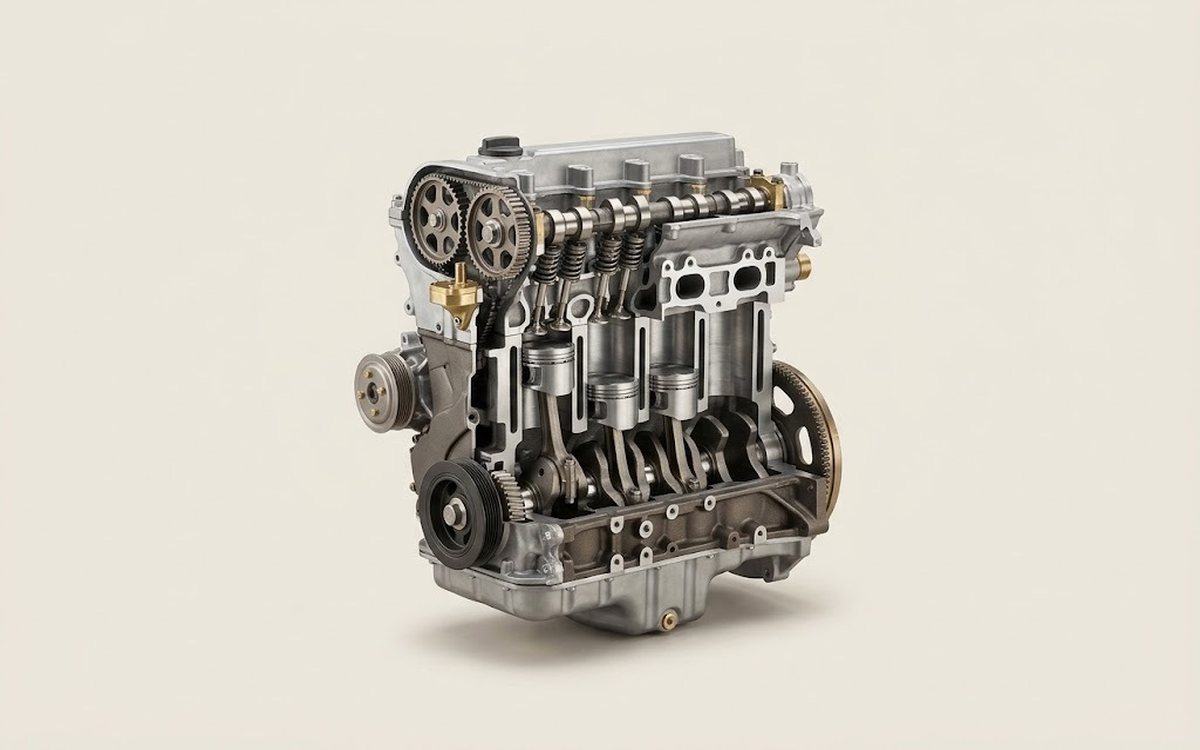 How it works · 3D
How a Car Engine Works
How the part you're working on actually works — in plain English, on a 3D model.
Open in 3D →