Autopapyrus · Mitsubishi Challenger 3.0 6G72 (1996)
https://autopapyrus.com/guides/mitsubishi/challenger/diagnosing-misfires-engine-running-rough/
https://autopapyrus.com/guides/mitsubishi/challenger/diagnosing-misfires-engine-running-rough/
Compiled automatically from service literature and owner experience. Specs are for the typical configuration — check them against your exact car before you start.
Mitsubishi Challenger 3.0 6G72 (1996): Diagnosing Misfires (Engine Running Rough)
A rough-running, misfiring 6G72 is most often caused by spark plugs and plug wires. Less often the cause is the coils, dirty or flooded injectors, a vacuum leak, low fuel pressure or loss of compression. Work from the simple to the complex: first find out which cylinder is not firing, then check spark, fuel and compression.
Parts
6| № | Part | Genuine part no. | Alternatives |
|---|---|---|---|
| 01 | Spark plugs for 6G72 SOHC (14 mm thread, 16 mm hex, heat range about 6) | MS851336 | NGK, Denso |
| MS851502 | |||
| 02 | Spark plug wire set | MD338249 | |
| 03 | Ignition coils (modules) | MD314582 | |
| 04 | Fuel injectorsif needed | MD332733 | |
| 05 | Air filter | MD620472 | |
| 06 | Fuel filter | MR239580 |
Part numbers are from the manufacturer's original catalogue. Check them against your VIN before ordering.
Tools
9- 16 mm spark plug socket with extension and universal joint
- torque wrench
- compression tester
- fuel pressure gauge
- multimeter
- OBD scanner or test light
- screwdrivers
- 10-14 mm socket set
- can of throttle body cleaner
Step by step
13 steps- Determine the pattern: does it misfire when the engine is cold or hot, at idle or under load, in rain or damp weather? Misfires only in damp weather point to arcing through the wires, caps or coils. Check whether the Check Engine light is on: if it is, read the codes with a scanner. A flashing light means misfires severe enough to damage the catalytic converter.
- Inspect the engine bay. Check the wire connectors, vacuum hoses, the intake boot after the airflow meter and the ducts for cracks. A vacuum leak causes unstable idle and misfires at idle.
- Identify the dead cylinder. With the engine running, unplug the injector connectors one at a time and listen for a change in engine speed. If the RPM does not change after you disable a cylinder, that cylinder is already not firing. You can also connect a multimeter or test light to the injector circuit. After shutting the engine off, feel the exhaust manifold pipes: a cold pipe points to the misfiring cylinder.
- Remove the spark plugs (with the engine off and cool). The front bank is easy to reach. The rear bank sits under the intake manifold, so you need to remove the air duct and any hoses and connectors in the way. Label the wires by cylinder. Read the plugs: dry black soot means a rich mixture or weak spark; oily plugs mean valve stem seals or piston rings; whitish plugs mean a lean mixture or a vacuum leak; a cracked insulator or a melted electrode means the plug must be replaced.
- Replace the plugs if their mileage is unknown or they are old. Check the gap against the specification (about 1.0-1.1 mm for the 6G72). Apply a thin coat of anti-seize to the threads only if the plug manufacturer allows it. Thread the plugs in by hand and tighten with a torque wrench to 20-30 N·m (15-22 lb-ft); check the exact value in the specification for your engine. Do not overtighten: threads in an aluminum head strip easily.
- Check the spark plug wires: measure the resistance of each wire with a multimeter (as a guideline, a few to a few tens of kΩ; a large difference between wires indicates a fault), and check the insulation and the cleanliness of the terminals. In the dark, start the engine and look for sparks arcing along the wires. Replace the whole set if the wires are old.
- Check the ignition coils (this engine has two, each serving three cylinders, plus a power module). Measure the primary and secondary winding resistance against the specified values. If the misfire moves after you swap a coil or wire, that part is the culprit. Inspect the coils for cracks and signs of arcing.
- Check the fuel system. Connect a gauge to the fuel rail: the pressure should be steady and match the specification (at idle with the regulator vacuum hose connected, a guideline is about 2.5-3.5 bar; the pressure should hold after the engine is shut off). A pressure drop points to a weak fuel pump, a clogged fuel filter or a faulty regulator. Replace the fuel filter if its mileage is unknown.
- Check the injectors: listen for the clicks of each one with a stethoscope or a screwdriver, and measure the winding resistance against the specification. Clogged or leaking injectors are fixed by bench cleaning or replacement.
- Clean the throttle body and the idle air passage (idle air control valve), and check the throttle position sensor and the coolant temperature sensor. A dirty idle air control valve and faulty sensors cause a fluctuating idle and rough running when cold.
- Measure compression on a warm engine with the spark plugs removed and the throttle fully open. The difference between cylinders should not exceed 10-15 percent. If one cylinder is low, pour 15-20 ml of oil into it and repeat the test: a rise in the reading points to worn rings, while no rise points to the valves or the head gasket.
- If compression is normal but a cylinder still does not fire, check the valve timing: a jumped timing belt tooth causes power loss and rough running. Check the condition of the hydraulic lash adjusters (a tapping noise when cold that disappears after warm-up indicates wear) and the valve stem seals.
- After fixing the cause, clear the error codes, take a 15-20 minute test drive under varying loads, and read the codes again.
Common mistakes and warnings
- Do not drive for long with a misfire and a flashing Check Engine light: unburned fuel enters the catalytic converter and destroys it, and it also washes oil off the cylinder walls
- Work only on a cool engine, relieve the fuel system pressure before loosening any fuel lines, and keep gasoline away from open flames
- If compression is low in all cylinders, or you suspect the head gasket or the timing belt, it is better to leave the job to a repair shop experienced with the 6G72 engine
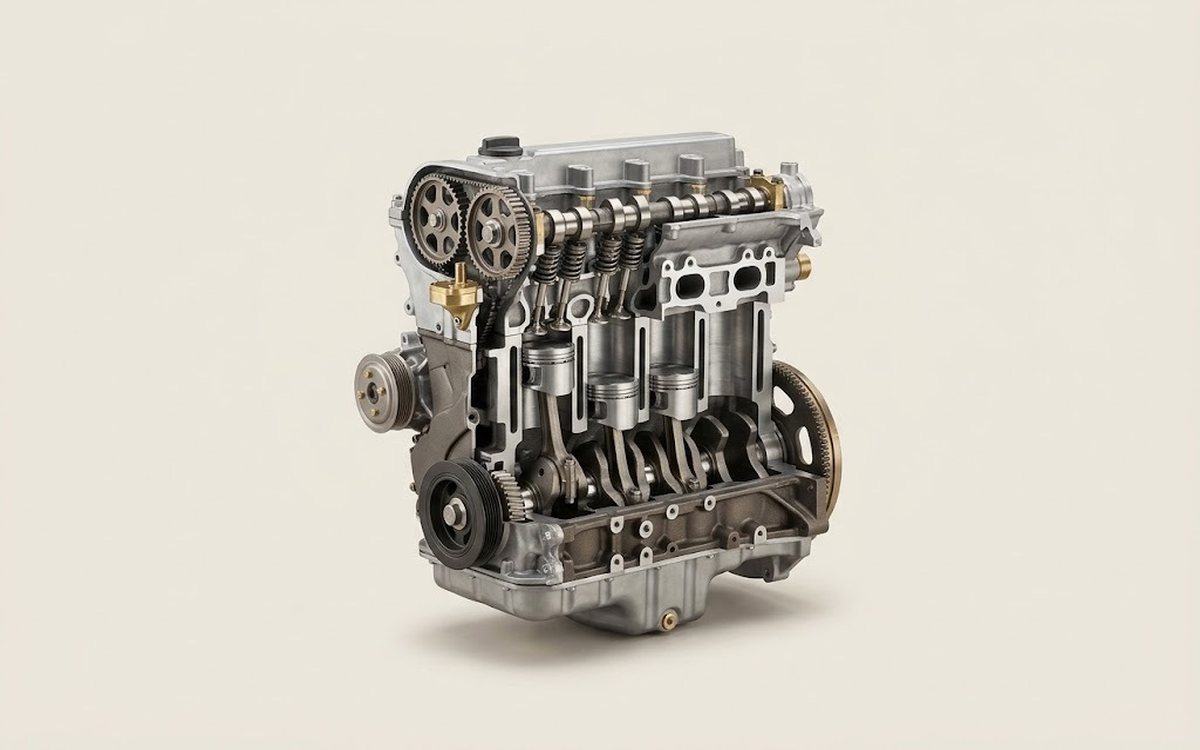 How it works · 3D
How a Car Engine Works
How the part you're working on actually works — in plain English, on a 3D model.
Open in 3D →