Autopapyrus · Nissan Skyline
https://autopapyrus.com/guides/nissan/skyline/automatic-transmission-troubleshooting/
https://autopapyrus.com/guides/nissan/skyline/automatic-transmission-troubleshooting/
Compiled automatically from service literature and owner experience. Specs are for the typical configuration — check them against your exact car before you start.
Automatic Transmission Troubleshooting
The Nissan Maxima/Cefiro (V35) with the VQ25DD engine uses an automatic transmission from the Nissan RE5R05A family (5-speed). Its typical weak points are contaminated or worn-out fluid, and wear of the valve body, solenoids and speed sensors. Diagnosis goes from simple to complex: ATF level and condition, trouble codes, a road test, then a pressure test.
Parts
8| № | Part | Genuine part no. |
|---|---|---|
| 01 | Nissan Matic ATF | |
| 02 | Transmission filter with pan gasket | |
| 03 | Output shaft speed sensorif faulty | 31935-90X02 |
| 04 | Input shaft speed sensorif faulty | 31935-90X02 |
| 05 | Transmission solenoidsif faulty | 31705-90X11 |
| 31705-90X73 | ||
| 06 | Valve body assemblyif faulty | 31705-90X11 |
| 31705-90X73 | ||
| 07 | ATF temperature sensorif faulty | 31705-90X11 |
| 31705-90X73 | ||
| 08 | Transmission wiring harnessif faulty | 31943-90X00 |
Part numbers are from the manufacturer's original catalogue. Check them against your VIN before ordering.
Tools
7- Scan tool with Nissan Consult support (or an OBD-II scan tool that can read transmission codes)
- pressure gauge for measuring line pressure
- jack and jack stands
- wrenches for the drain and fill/check plugs
- syringe or pump for filling ATF
- clean white cloth
- flashlight
Step by step
12 steps- Describe the symptom: harsh shifts, RPM flare between gears (especially 3-4), slipping in 4th-5th gear, shudder when the torque converter lockup engages, delayed engagement into D or R, fail-safe mode (limp mode), an illuminated O/D OFF light, or a flashing transmission light. The symptom determines where to look next.
- Check the ATF level and condition. Warm the transmission to operating temperature (drive for 10-15 minutes), park the vehicle on level ground with the engine idling, shift the selector through all positions, and return it to P. Check the level on the dipstick, paying attention to the HOT and COLD marks. This transmission is sensitive to fluid level: overfilling and underfilling produce the same symptoms (slipping, foaming, harsh shifts).
- Evaluate the fluid on a white cloth. Light red, clear fluid with no odor is normal. Dark fluid with a burnt smell, metal dust or friction material particles means the clutch packs are worn. Pink, milky fluid indicates coolant is leaking in from the radiator's heat exchanger. In that case, the transmission must not be operated until the cause is fixed.
- Read the trouble codes with the scan tool. Common codes for this transmission relate to speed sensors (for example P0720 for the output shaft), input shaft speed, the linear solenoids and the torque converter lockup solenoid, the ATF temperature sensor, and gear slippage. Record the codes and the freeze frame data, then clear the codes and repeat the test. If a code returns immediately, the fault is permanent.
- In the scan tool's live data, look at the transmission's speed sensor reading, input shaft speed, ATF temperature, selector position and solenoid currents. A mismatch between this speed and the speedometer reading points to the sensor or its wiring.
- Inspect the transmission and the harness: leaks at the seals, pan and dipstick tube, dirt and corrosion in the transmission connector, the ATF cooler lines, and the condition and mounting of the ground connection. A poor connection in the connector often mimics solenoid failure.
- Perform a road test with the transmission warmed up. Note in which gears and at what RPM the problem occurs, whether there is an RPM flare (slipping), any clunks on upshifts and downshifts, and the response to kickdown. For comparison, check operation in manual mode, if equipped.
- Perform a stall test only if you are sure the brakes and braking system are in good condition, for no longer than 5 seconds per attempt, with a pause of at least one minute between attempts. It shows slipping of the torque converter and clutches. Compare the RPM values with the manufacturer's specification.
- Measure line pressure with a gauge through the transmission's test port at idle and under load in different selector positions. Low pressure points to pump wear, a clogged filter, valve body problems or internal leaks. Take the pressure specifications for the various conditions from the manufacturer's service manual for your transmission.
- If the fluid is old but there is little metal dust, replace the ATF and filter: drain the fluid, remove the pan, and inspect the magnet and sediment. Fine dust is acceptable, while large particles and shavings mean internal wear. Refill with fluid of the recommended type to the correct level. Check the tightening torque of the pan bolts and plugs against the service manual (for small pan bolts, typically around 5-8 N·m (4-6 lb-ft), for plugs around 20-35 N·m (15-26 lb-ft)).
- If the codes and pressure point to the solenoids, valve body or internal wear, further diagnosis requires removing the pan and valve body, and in the case of clutch pack slipping and pump wear, removing the transmission from the vehicle. This work is best done at a specialized transmission shop.
- After any intervention, clear the codes, perform the adaptation (relearn) procedure per the service manual (warm-up, several shift cycles under different loads), and repeat the road test.
Common mistakes and warnings
- Do not keep driving with heavy slipping, a burnt smell or pink emulsion in the ATF: this quickly destroys the transmission
- Do not check the level when the transmission is cold or the vehicle is not on level ground
- Work under the vehicle only on sturdy jack stands
- If you have no experience with pressure testing and transmission disassembly, take the vehicle to a specialized transmission shop
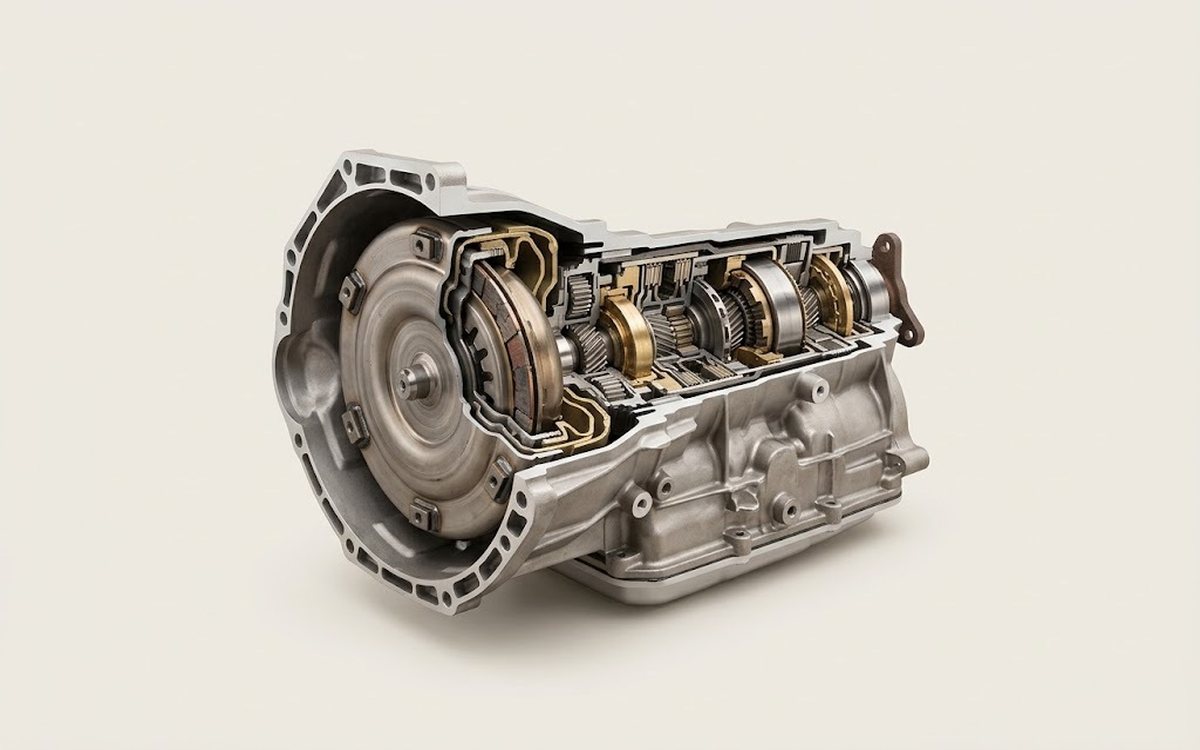 How it works · 3D
How an Automatic Transmission Works
How the part you're working on actually works — in plain English, on a 3D model.
Open in 3D →