Autopapyrus · Renault Kaptur 2.0 16V F4R (2020)
https://autopapyrus.com/guides/renault/kaptur/timing-belt-and-water-pump-replacement/
https://autopapyrus.com/guides/renault/kaptur/timing-belt-and-water-pump-replacement/
Compiled automatically from service literature and owner experience. Specs are for the typical configuration — check them against your exact car before you start.
Renault Kaptur 2.0 16V F4R (2020): Timing Belt and Water Pump Replacement
The timing belt on the F4R should be replaced every 60,000 km or 4 years. Since 2016, Renault has extended the service interval to 90,000 km, but experience shows it is better to follow the old schedule. Always replace the water pump together with the belt. Even if it looks fine, its service life matches that of the belt, and having to take everything apart again when the pump starts leaking 10,000-20,000 km later costs more.
Part
- 🔩 Renault timing belt kit 130C11551R or 117209732R (belt + 2 pulleys + camshaft plugs), Renault water pump 7701479043, accessory drive belt (optional). Camshaft plugs 1104800QAA, 1104800QAC. Alternatives: GATES, INA, Dayco
Step by step
13 steps- Raise the front right side of the vehicle with a jack, remove the wheel and the inner fender liner to access the crankshaft pulley.
- Remove the upper right engine mount (it blocks access to the belt). Support the engine from below with an engine support.
- Remove the accessory drive belt (alternator, power steering, A/C). Remove the crankshaft pulley bolt, holding the shaft with the locking pin through the hole in the bellhousing (access from below, 8 mm hole behind the flywheel).
- Set the No. 1 piston to TDC on the compression stroke: the mark on the flywheel lines up with the pointer in the housing window. Turn the crankshaft with a special wrench or a socket on the pulley bolt.
- Install the camshaft locking tools. The plugs go in at the rear of the cylinder head (replacing the factory plastic caps). The camshafts must sit exactly level, below their axes of rotation. Alternative: a homemade bracket made from polypropylene pipe that locks both shafts through the existing holes.
- Loosen the tensioner pulley nut, move the pulley in the direction that releases belt tension, and remove the old belt. Mark the position of the pulleys before removing them.
- Inspect the idler pulley and the tensioner pulley. If there is play or noise when they are rotated, replace them (they usually come in the kit). Unbolt and remove the water pump (4 bolts, 13 mm) and install the new one with a new gasket. Do not use sealant. Use only the gasket supplied with the pump.
- Install the new idler pulley, then the tensioner pulley (do not fully tighten it yet. The 27-28 N·m (20-21 lb-ft) torque is applied after the belt is tensioned).
- Fit the new belt in this order: crankshaft pulley → water pump → tensioner pulley → exhaust camshaft → idler pulley → intake camshaft. The belt must run straight without twisting, with the teeth seated exactly in the pulley grooves.
- Tension the belt by turning the tensioner pulley eccentric counterclockwise until the mark on the pulley lines up with the pointer on the housing. CAUTION: do not overtighten. Overtightening shortens the life of the belt and bearings. Tighten the tensioner pulley nut to 27-28 N·m (20-21 lb-ft).
- Remove the camshaft and crankshaft locking tools. Turn the crankshaft by hand through 2 full revolutions (720°) and bring it back to TDC. Make sure the marks line up and the camshaft locking tools go in without force. If the marks are off, reinstall the belt from the beginning.
- Reassemble in reverse order: crankshaft pulley (bolt torque 20 N·m (15 lb-ft), then turn an additional 115° ± 10°), accessory drive belt, right engine mount, inner fender liner, wheel.
- Start the engine and warm it up to operating temperature. Check for pump leaks, knocking and vibration. Check the belt tension again after 500-1,000 km, as the belt can settle.
Common mistakes and warnings
- The F4R is an interference engine. If the belt breaks, the pistons hit the valves, which leads to expensive repairs (bent valves, damaged pistons, cylinder head replacement). Do not put off belt replacement. The tensioner pulley torque is 27-28 N·m (20-21 lb-ft), NOT 7 N·m as incorrectly stated in some unofficial sources. Use a torque wrench for critical fasteners (camshafts 30 N·m (22 lb-ft) + 90° additional turn, crankshaft 20 N·m (15 lb-ft) + 115° ± 10° additional turn). If you replace the belt without the pump, you risk having to take the assembly apart again after 10,000-20,000 km when the pump leaks. Saving money on the pump now means paying twice for labor later.
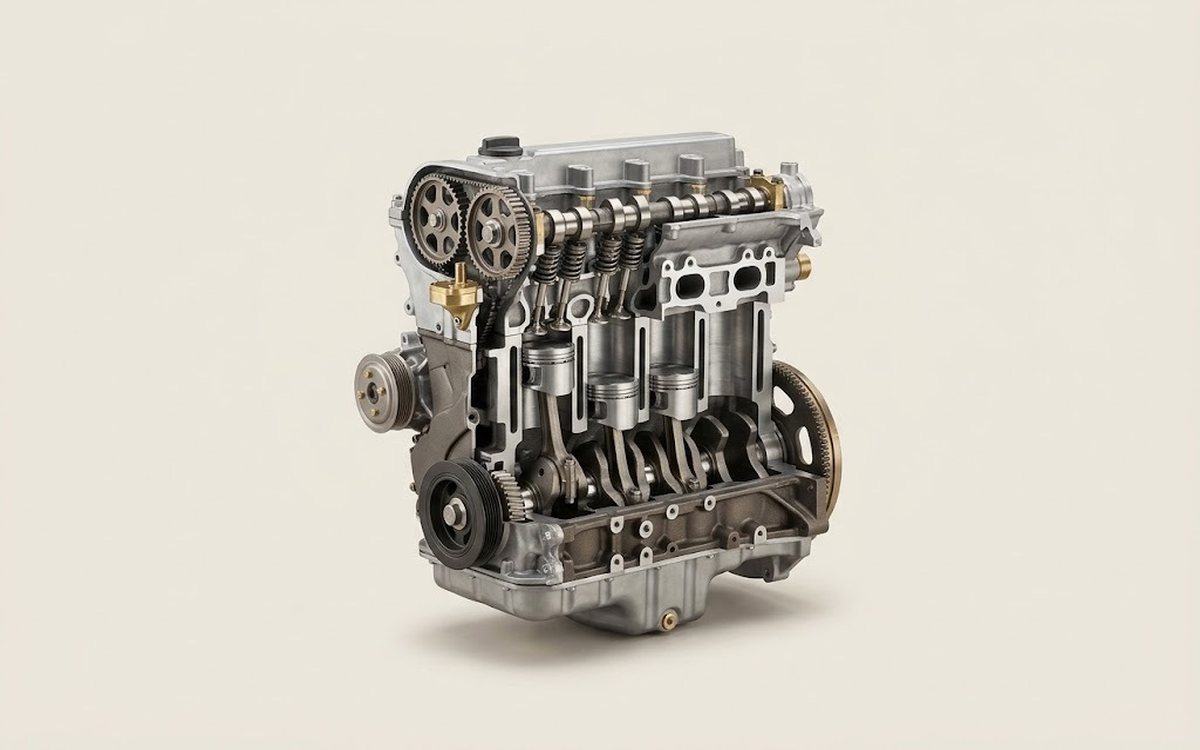 How it works · 3D
How a Car Engine Works
How the part you're working on actually works — in plain English, on a 3D model.
Open in 3D →