Autopapyrus · Renault Logan (2018)
https://autopapyrus.com/guides/renault/logan/timing-belt-replacement/
https://autopapyrus.com/guides/renault/logan/timing-belt-replacement/
Compiled automatically from service literature and owner experience. Specs are for the typical configuration — check them against your exact car before you start.
Renault Logan (2018): Timing Belt Replacement
The timing belt on the Renault Logan must be replaced every 60,000 km or every 4 years, whichever comes first. In severe operating conditions, it is advisable to shorten the interval to 45,000-50,000 km. If the timing belt fails, the valves hit the pistons, which leads to an expensive engine overhaul. The procedure requires setting the TDC marks precisely and tensioning the belt correctly.
Part
- 🔩 Depends on the installed engine. For 8-valve K7J/K7M (1.4/1.6): belt and roller kit part number 7701472725 or 130C17480R (belt 7700273279, roller 7700273277). For 16-valve K4M (1.6): kit 130C17529R or 7701477014 (belt 7700101248, tensioner pulley 7700108117, idler pulley 7700107150). The tensioner pulley must be replaced whenever the belt is replaced, and replacing the water pump is recommended (part numbers 7700861686 for 8V or 7700105176 for 16V)
 There's a full repair manual for this car
Every system, wiring diagrams and torque specs — not just this job. Haynes AutoFix (online).
See manuals →
Step by step
34 steps- Raise the front right side of the vehicle with a jack and support it on jack stands. Remove the right front wheel.
- Remove the right engine compartment splash shield (the plastic fender liner).
- Remove the engine undercover (skid plate), if installed.
- Remove the accessory drive belt (alternator, power steering, A/C).
- Place a wooden block between the subframe and the oil pan. Raise the right side of the engine with a jack through the block.
- Insert a wooden wedge between the subframe and the oil pan to hold the engine in the raised position.
- Remove the right engine mount (engine support) as an assembly by unscrewing the mounting nuts and bolts.
- Remove the upper timing belt cover (three bolts and two nuts).
- For the 16-valve engine: also remove the lower timing belt cover. This step is not required for the 8-valve engine.
- Turn the crankshaft clockwise until the No. 1 cylinder piston is at TDC. For 8V: the triangular dimple on the camshaft pulley must line up with the "Dacia" logo on the cylinder head. For 16V: the slots on both camshafts must be positioned horizontally.
- For 16V: remove the two rubber-metal plugs from the service holes in the cylinder head. Insert the locking plate into the camshaft slots (the plate fits into the horizontal slots and locks the shafts).
- Screw the locating pin (M6 bolt, 50-60 mm long) into the threaded service hole in the cylinder block until it stops against the flywheel. This locks the crankshaft at TDC.
- Loosen the tensioner pulley nut with a 13 mm wrench.
- Turn the tensioner pulley (clockwise for 8V, counterclockwise for 16V) to relieve belt tension.
- Remove the timing belt from the crankshaft pulley, camshaft pulley (pulleys), water pump, and rollers. IMPORTANT: after removing the belt, do not turn the crankshaft or camshafts, to avoid the valves hitting the pistons.
- Unscrew the nut and remove the tensioner pulley from its bracket.
- For 16V: unscrew the Torx T-50 screw holding the idler pulley, then remove the pulley and bushing.
- Install the new idler pulley (for 16V) and tighten the Torx screw to 25-30 N·m (18-22 lb-ft).
- Install the new tensioner pulley on the bracket and start the mounting nut by hand (do not tighten it).
- Fit the new timing belt onto the pulleys in this order: crankshaft pulley, water pump pulley, camshaft pulley (for 16V: both camshaft pulleys), tensioner pulley. The arrows on the belt (if present) must point in the direction of rotation, which is clockwise.
- Tension the belt by turning the tensioner pulley. For 8V: when checked by hand, the belt between the pulleys must not twist more than 60-70 degrees. For 16V: the movable pointer on the tensioner must line up with the notch on the fixed pointer.
- Tighten the tensioner pulley nut to 25-30 N·m (18-22 lb-ft).
- Remove the locating pin from the cylinder block. For 16V: remove the locking plate from the camshaft slots.
- Turn the crankshaft by hand clockwise 2 full turns (720 degrees).
- Reinstall the locking plate in the camshaft slots (for 16V) and screw the locating pin into the block hole. If the plate and pin go in freely, the marks are aligned correctly. If they do not, repeat the belt installation procedure starting from step 20.
- Check the belt tension (the pointers on the tensioner pulley must line up). Adjust if necessary.
- For 16V: install new rubber-metal plugs in the service holes of the cylinder head, tapping them in lightly with a hammer through a plastic drift.
- Install the timing belt covers (lower and upper for 16V, upper only for 8V).
- Install the right engine mount. Tightening torque for the bolts to the body: 45-50 N·m (33-37 lb-ft); to the engine: 60-65 N·m (44-48 lb-ft).
- Remove the wooden wedge and block, then lower the engine.
- Install the accessory drive belt. Tightening torque for the accessory drive pulley bolt (for 16V): 30 N·m (22 lb-ft) plus an additional 80 degrees (plus or minus 5 degrees).
- Install the engine undercover, the splash shield, and the wheel.
- Lower the vehicle off the jack stands.
- Start the engine and listen for unusual noises. Check for coolant leaks (if you replaced the water pump).
Common mistakes and warnings
- If the timing belt on the Renault Logan breaks, the valves hit the pistons and damage the valves and valve guides. In severe cases the pistons and cylinder head are damaged as well. The cost of repair is many times higher than the cost of replacing the belt on time. Do not drive the vehicle with the old belt after 60,000 km, even if there is no visible damage. If oil gets on the timing belt (oil traces on the inner surface of the belt), you must not only replace the belt but also fix the source of the leak, which is usually a worn crankshaft or camshaft seal. Installing the belt with incorrect marks will keep the engine from starting or will damage it on the first start. Use only quality parts from reputable manufacturers (Gates, Contitech, SNR, Dayco) or genuine Renault parts. Cheap belts of unknown origin may break long before the scheduled mileage.
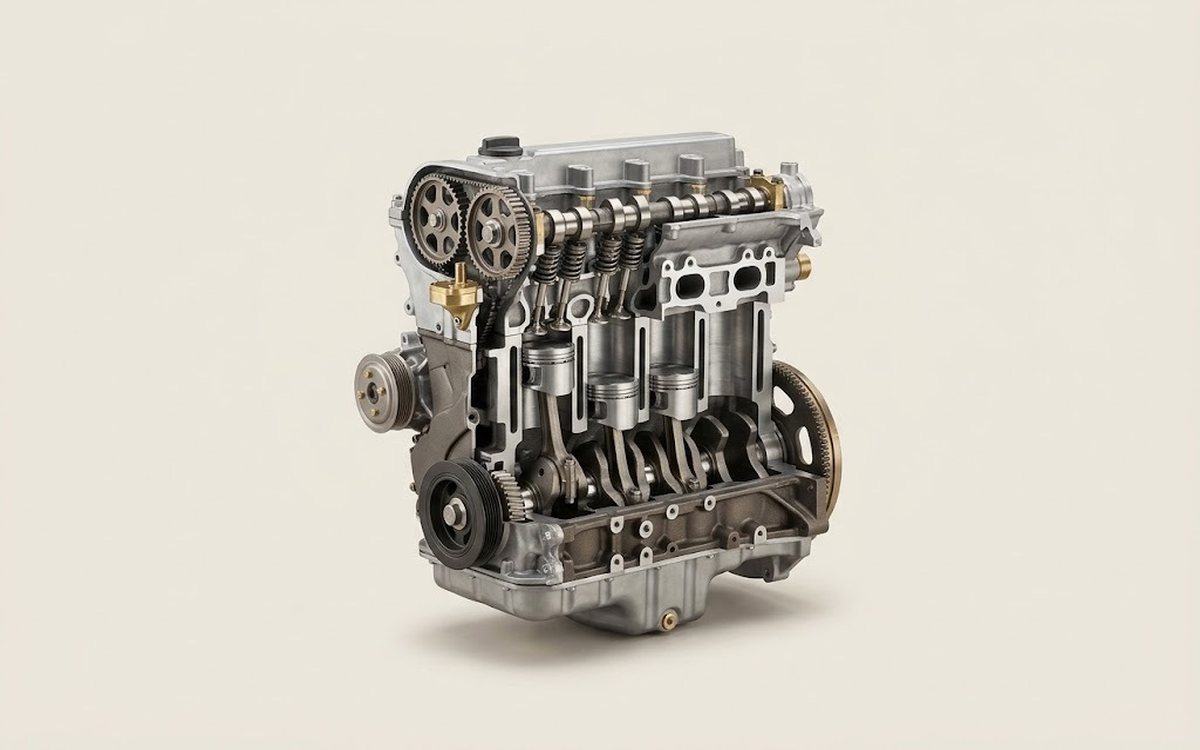 How it works · 3D
How a Car Engine Works
How the part you're working on actually works — in plain English, on a 3D model.
Open in 3D →