Autopapyrus · Toyota Corolla E210
https://autopapyrus.com/guides/toyota/corolla/diagnosing-a-front-suspension-knock/
https://autopapyrus.com/guides/toyota/corolla/diagnosing-a-front-suspension-knock/
Compiled automatically from service literature and owner experience. Specs are for the typical configuration — check them against your exact car before you start.
Toyota Corolla E210: Diagnosing a Front Suspension Knock
On the Corolla E210, a knock from the front suspension is most often caused by worn sway bar end links, sway bar bushings, or ball joints. On early 2019-2020 models, the sway bar end links wore out as early as 30,000-50,000 km. The sway bar bushings on hatchbacks and wagons tend to wear out prematurely. Diagnosis involves a visual inspection and a check for play with a pry bar while the wheels are off the ground.
Part
- 🔩 sway bar end links (48820-20010 or equivalents), sway bar bushings, lower control arm ball joints, strut top mount bearings
 There's a full repair manual for this car
Every system, wiring diagrams and torque specs — not just this job. Haynes and 16 more.
See manuals →
Step by step
8 steps- Raise the front of the vehicle with a lift or jack and support it on jack stands. Remove the front wheels for better access.
- Visually inspect the sway bar end links, which are vertical links with ball-joint ends on either side of the sway bar. Shake each one up and down by hand. There should be no play. A distinct knock over bumps points to wear in the ball joints inside the link.
- Check the rubber bushings that mount the sway bar to the subframe by squeezing them with your fingers. Cracks, separation, or hardened rubber mean they need replacement. A knock when you rock the body may come from worn bushings.
- Check the lower control arm ball joints. Insert a pry bar between the steering knuckle and the lower control arm and push up. Play of more than 1 mm indicates a worn ball joint. A knock when driving over bumps at low speed is a typical symptom.
- Check the front strut top mount bearings. With the wheels off the ground, have a helper turn the steering wheel left and right. Crunching or clicking from the top of the strut indicates a worn top mount bearing.
- Inspect the ball joint boots and tie rod end boots for tears. Water and dirt inside a boot quickly destroy the joint.
- Lower the vehicle and bounce the body by pushing sharply down on each corner. The shock absorbers should damp the motion within 1-2 cycles. Prolonged bouncing indicates worn shock absorbers, but they usually don't cause a knock. Instead, they degrade handling.
- If you haven't found the source of the knock, check the mounting of the steering rack to the subframe. Loose bolts can cause a metallic knock when turning the steering wheel with the car stationary or when driving over bumps.
Common mistakes and warnings
- Worn ball joints and tie rod ends are critical to safety, because their failure leads to loss of control. If you find play of more than 1 mm, replace the parts immediately. The tightening torque for the ball joint nut to the steering knuckle is 65-75 N·m (48-55 lb-ft), and the tightening torque for the sway bar end link mounting bolts is 40-50 N·m (30-37 lb-ft). After replacing suspension components, a wheel alignment check and adjustment is required.
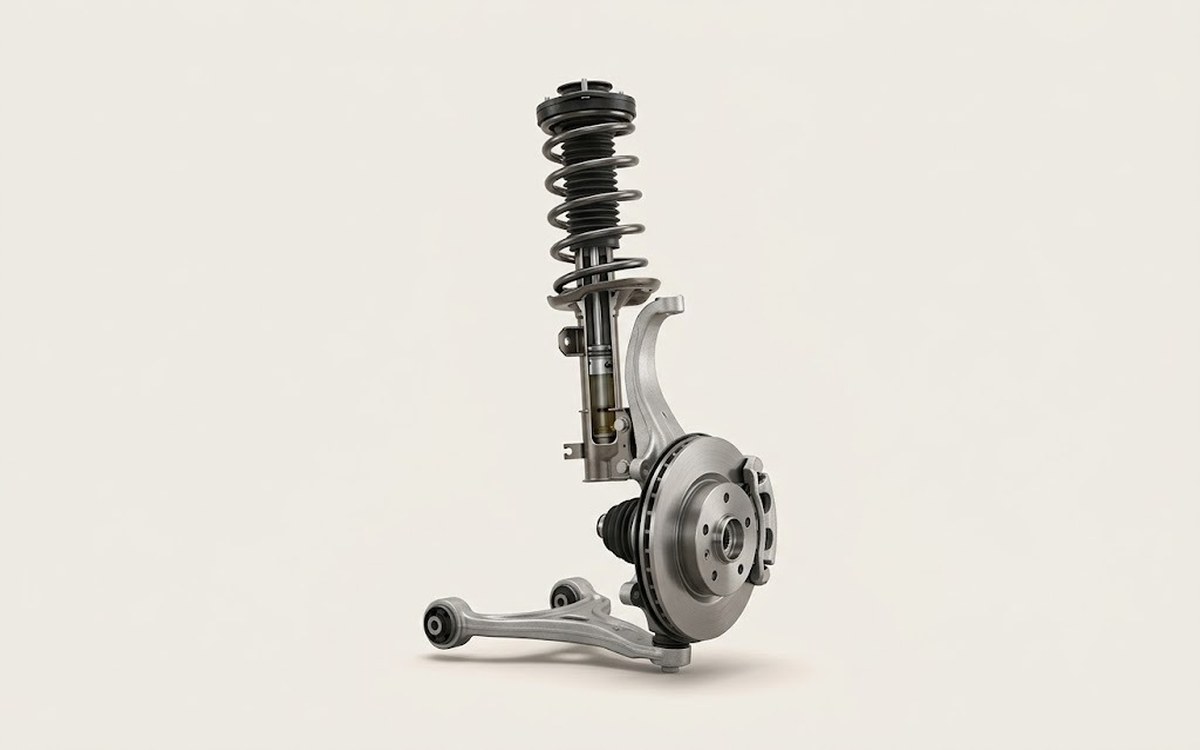 How it works · 3D
How Car Suspension Works
How the part you're working on actually works — in plain English, on a 3D model.
Open in 3D →