https://autopapyrus.com/catalog/gaz/valdai-next/guides/cooling-system-diagnostics/
GAZ Valdai Next Cummins ISF 3.8 (2021): Cooling System Diagnostics
Overheating, slow warm-up, or a falling coolant level on the Cummins ISF 3.8 diesel is most often caused by the drive belt, the tank cap, the radiator, the thermostat, the fan clutch, or a leak. This guide goes from simple checks to instrument-based tests. The truck is a cab-over design, and the engine is accessed by tilting the cab, so before starting work make sure the cab latch and support strut are in good condition.
Key figures
- Pressure for the system leak testpump it up with the tester through the tank on a warm engine and see whether the pressure holds (step 11)138 kPa (1.38 bar)
- Tank cap toleranceotherwise replace the cap (step 10)within 14 kPa of the value stamped on the cap
- Thermostat start-to-open temperaturewhen tested in water; fully open at about 94 °C (step 15)79-83 °C
- Permissible leakage through a closed thermostatmore means the thermostat should be replaced (step 14)up to 100 cm³ per minute
- Water pump bolt torquefor all 8 bolts, evenly, using a socket and torque wrench (step 18)8 N·m (6 lb-ft)
- Thermostat outlet connection bolt torquelight, so as not to break the housing (step 16)7 N·m (5 lb-ft)
Check these values against the manufacturer’s specification for your vehicle before you start.
Parts
8| № | Part | Alternatives |
|---|---|---|
| 01 | Thermostat for Cummins ISF 3.8, complete with sealif faultyFind on Amazon → | |
| 02 | Expansion tank cap with valve rated for system pressureif faultyFind on Amazon → | |
| 03 | Drive beltif wornFind on Amazon → | |
| 04 | Drive belt tensionerif faultyFind on Amazon → | |
| 05 | Coolant pumpif faultyFind on Amazon → | |
| 06 | Viscous fan clutchif faultyFind on Amazon → | |
| 07 | Radiator hosesif wornFind on Amazon → | |
| 08 | AntifreezeFind on Amazon → | AlternativesLukoilSintecFelix |
Amazon links search by the part name; use Amazon's fit check for your car before ordering. We may earn a commission from qualifying purchases.
Tools
9Read the codes yourself
A scanner plugged into the OBD2 port under the dashboard shows which fault codes the car has stored, before you buy any parts. Cars sold in the US from 1996, and petrol cars in Europe from 2001 (diesels from 2004), have this port.
- Basic code reader, about $20–40: reads and clears engine codes Amazon →
- Bluetooth scanner with a phone app, about $30–100: live sensor data, and on many cars ABS and airbag codes too Amazon →
Check that the scanner lists your make and model year before you buy. We may earn a commission from qualifying purchases.
Step by step
21 steps · 6 stagesStage 1 of 6 Preparation and visual inspection 4 steps
- Park the vehicle on level ground, shut off the engine, and let it cool down. Do not open the expansion tank cap on a hot engine: the system is under elevated pressure and you could be burned.
- Tilt the cab using the standard procedure. Inspect the engine bay, hoses, clamps, radiator, tank, water pump, and fan drive for leaks and for white or colored coolant residue.
- Check the coolant level in the tank with the engine cold. It should be at the upper mark. Evaluate the color of the coolant: a rusty tint, an oily film, or flakes mean the coolant needs to be replaced, and oil in the system points to a head gasket problem.
- Inspect the drive belt for cracks, oil contamination, and wear. Check that the tensioner works and that the pulleys are aligned in the same plane. A belt that has come off or is slipping reduces the speed of the water pump and fan.
Stage 2 of 6 Radiator and fan 5 steps
- Inspect the radiator core from the front and the back for dirt, lint, and bent or broken fins. Blow it out with compressed air at a pressure of about 5.5 bar (552 kPa) from a distance of at least 15 cm, so you don't bend the fins.
- Check the fan shroud and the clearance to the blades. The blades must not be bent. A bent fan is not straightened; it is replaced with an identical one. Do not grab the fan by the blades.
- Check the fan hub play and the pulley bearings by rocking and spinning them. The permissible axial play of the hub is up to 0.15 mm.
- Check the viscous fan clutch. On a hot engine it should engage: per Cummins' recommendation, engagement occurs at about 96 °C, and with the engine cold the fan turns easily. If the fan spins freely by hand on a hot engine after shutdown while the engine is overheating, replace the clutch. Keep your hands away from the fan while the engine is running.
- Check the radiator winter covers, if fitted. They should cover only part of the radiator. Remove any homemade cardboard blockers.
Stage 3 of 6 Pressure testing 3 steps
- Test the expansion tank cap with the tester: pump at about one stroke per second. The valve must open, and the cap must hold pressure within 14 kPa of the value stamped on it. Replace a cap with a lower opening pressure. Install only a cap with a valve designed for this system; a regular cap from another vehicle will not work.
- Fill the system to the proper level, warm up the engine, shut it off, and connect the tester to the tank. Build up a pressure of 138 kPa (1.38 bar) and watch it. A pressure drop means a leak: check the hoses, radiator, water pump (weep hole), heater core, and gaskets.
- If the pressure does not drop but the level still keeps falling, suspect an internal leak. Signs include white smoke, coolant in the oil, and bubbles in the tank with the engine running.
Stage 4 of 6 Thermostat and temperature 4 steps
- Connect the scan tool and monitor the coolant temperature during warm-up. The engine should reach operating temperature in a reasonable time. A warm-up that takes too long means the thermostat is stuck open, while fast overheating with a cold lower radiator hose means it is stuck closed.
- On-vehicle thermostat test: disconnect the upper radiator hose from the outlet connection, slip it back on with the clamp, and put the free end into a measuring container. Start the engine and hold rated speed for 1 minute. If more than 100 cm³ collects while the coolant temperature is below 38 °C, the thermostat is leaking and must be replaced. If the thermostat opened during the test, repeat the test.
- For a test in water, use the values for this engine: starts to open at 79-83 °C, fully open at about 94 °C. The thermostat is located in a housing that is part of the intake manifold. A damaged housing means replacing the manifold, so do not use force.
- If you are replacing the thermostat, drain the coolant, disconnect the negative battery terminal, and remove the transfer tube bolt (with its O-ring), the upper radiator hose, and the outlet connection. Take out the thermostat. Install in reverse order: tighten the outlet connection bolts to 7 N·m (5 lb-ft), tighten the transfer tube bolt to 24 N·m (18 lb-ft), and use a new O-ring.
Stage 5 of 6 Water pump and drive 2 steps
- Check the water pump: rock the pulley to check for play, listen for bearing rumble, and look at the weep hole. A constant leak, a damaged impeller, or a bad seal means the pump must be replaced. Traces of dried coolant at the hole are not a reason to replace it.
- To replace the pump, drain the coolant, remove the drive belt, and remove the 8 mounting bolts. Install in reverse order, tightening the bolts evenly to 8 N·m (6 lb-ft).
Stage 6 of 6 Finishing up and verification 3 steps
- Reassemble everything in reverse order, reconnect the battery, and fill with coolant to the upper mark on the tank. Check the type and amount of fill against the manufacturer's specification. Do not mix different types of coolant.
- Start the engine, warm it up until the fan engages, top off the coolant if needed, and make sure the air has been bled out: the heater should be hot, and the upper and lower radiator hoses should both be warm.
- Take a test drive under load, watching the temperature on the scan tool. After the engine cools, check the level and look for leaks. Lower and secure the cab.
Common mistakes and warnings
- Do not open the tank cap on a hot engine: a release of hot coolant under pressure causes severe burns
- If the engine overheats, do not shut it off right away at full load; let it run at idle
- When working under a tilted cab, make sure it is securely held by the support strut
- If there are signs of a blown head gasket (coolant in the oil, white smoke, bubbles in the tank), further operation is not acceptable
- If you lack experience, it is better to leave this diagnostic work to a repair shop
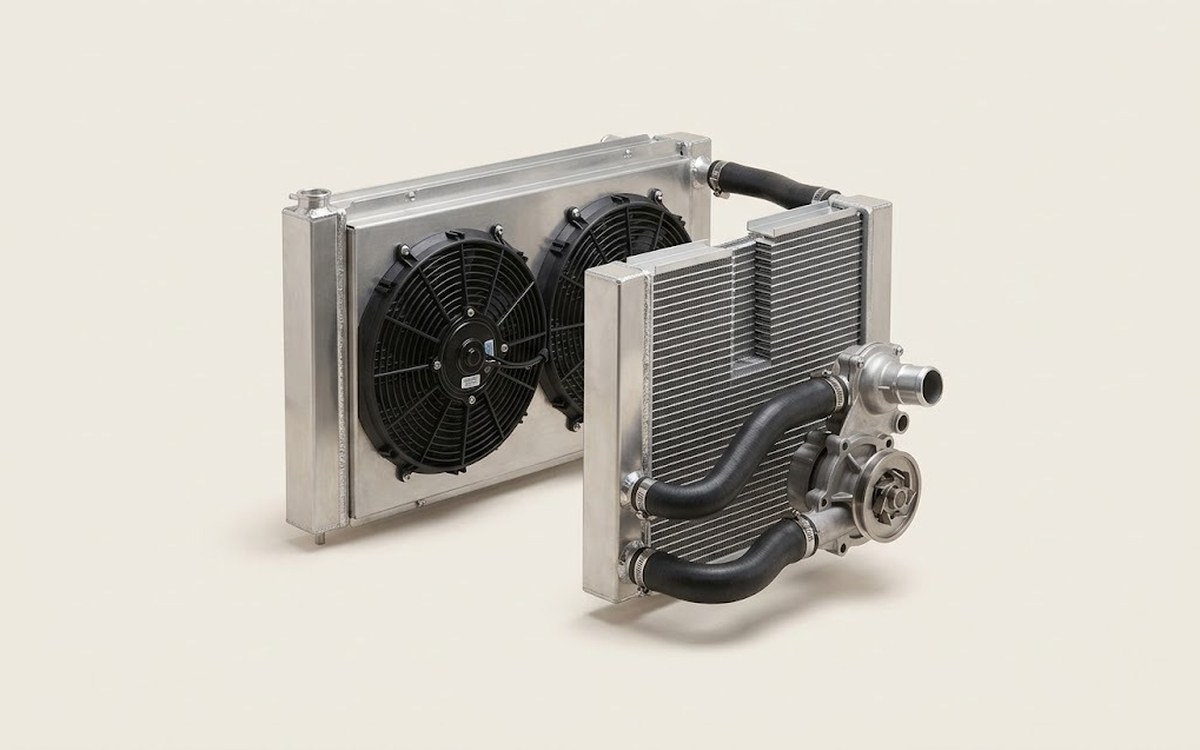 How it works · 3D
How the Engine Cooling System Works
How the part you're working on actually works — in plain English, on a 3D model.
Open in 3D →