https://autopapyrus.com/catalog/hyundai/solaris/guides/diagnosing-a-suspension-knock/
Hyundai Solaris (Accent) 1.6 G4FC (2013): Diagnosing a Suspension Knock
A suspension knock on the first-generation Solaris (2010-2017) most often comes from the front: worn sway bar links, ball joints, or play in the control arm mounts. On a car of this age (2013), this is normal wear. Diagnosis requires an inspection over a pit or on a lift and a check for play in the components.
Parts
5| № | Part | Genuine part no. |
|---|---|---|
| 01 | Sway bar linksif wornFind on Amazon → | |
| 02 | Lower control arm ball jointsif wornFind on Amazon → | |
| 03 | Strut mount bearingsif wornFind on Amazon → | 54612-3S000 |
| 04 | Control arm bushingsif wornFind on Amazon → | 55274-A6000 |
| 55275-A6000 | ||
| 55215-A6100 | ||
| 05 | Shock absorbersif wornFind on Amazon → | 55300-A6500 |
| 55300-A6410 | ||
| 55300-A6700 |
Amazon links search by the part name and genuine number; use Amazon's fit check for your car before ordering. We may earn a commission from qualifying purchases.
Part numbers are from the manufacturer's original catalogue. Check them against your VIN before ordering.
Tools
4Read the codes yourself
A scanner plugged into the OBD2 port under the dashboard shows which fault codes the car has stored, before you buy any parts. Cars sold in the US from 1996, and petrol cars in Europe from 2001 (diesels from 2004), have this port.
- Basic code reader, about $20–40: reads and clears engine codes Amazon →
- Bluetooth scanner with a phone app, about $30–100: live sensor data, and on many cars ABS and airbag codes too Amazon →
Check that the scanner lists your make and model year before you buy. We may earn a commission from qualifying purchases.
Step by step
7 steps- Drive the car onto a pit or lift and raise the front wheels so the suspension hangs fully extended (fully unloaded).
- Inspect the lower control arm ball joint boots (at the front, underneath, on each side) for tears, dirt, or leaked grease. A torn boot means play in the ball joint is imminent.
- Check the ball joint for play: place a pry bar between the lower control arm and the steering knuckle and slowly pry up and down. More than 2-3 mm of play means the ball joint is worn out.
- Check the sway bar link (the thin rod connecting the sway bar to the lower control arm): move it by hand in different directions. A knock means the bushing is worn or the joint has fallen apart.
- Check the lower control arm bushings (where the arm mounts to the subframe): press lightly on the arm with a pry bar. It should feel springy, with no hard knocking.
- Lower the car and bounce the body by hand at each corner. It should rebound firmly, without repeated oscillations (a sign of a worn-out shock absorber).
- On the road (in a safe place), drive slowly over a wavy surface or a speed bump and listen for where the knock comes from and under what conditions (only on compression, only on rebound, or always). Locating the knock: — A knock heard under the driver's pedals or at the front over bumps = front suspension, lower control arms, ball joints. — A knock heard from the side when entering a turn = sway bar link or outer ball joint (in a turn the body rolls and loads the outer side). — A knock heard at the rear, under the rear seats = rear suspension (the Solaris 1 has a semi-independent torsion beam, with frequent problems with mounts and shock absorbers). — A sharp, clearly localized metallic knock = usually a ball joint or a sway bar link bushing. — A dull, muffled knock = a control arm bushing or a shock absorber.
Common mistakes and warnings
- Do not ignore play in the suspension
- It affects handling and progresses quickly
- If you replace a ball joint or sway bar link yourself, use a puller (universal, M16-M20)
- Knocking it out with a pry bar is risky and can damage the arm
- Noisy rear shock absorbers are fairly common on the Solaris 1, so if the knock is at the rear, first check their rebound from the wheel well
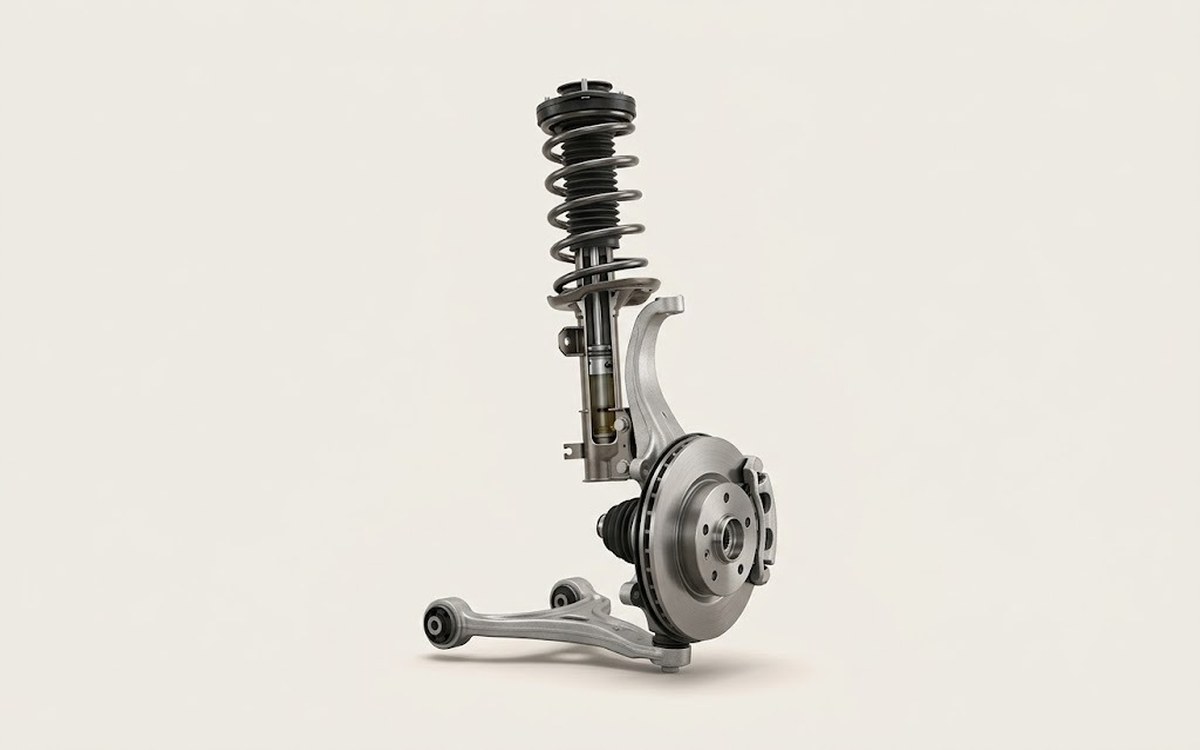 How it works · 3D
How Car Suspension Works
How the part you're working on actually works — in plain English, on a 3D model.
Open in 3D →
Spotted a mistake? Tell us →
Our articles
 Brand stories
The History of Hyundai
Hyundai Motor Company, whose name means "modernity" in Korean, is South Korea's largest automaker and one of the top…
Read →
 Garage
Fuel Quality Indicators: What Octane and Cetane Numbers Mean
What is an octane number? What about a cetane number? Which fuel should you choose for a high-compression engine?…
Read →
 Before you buy
How to Pick Up Your Car from the Dealership the Right Way
If you've decided to buy a car from a dealership, it isn't enough to simply choose a model you like, pay for it, and…
Read →