https://autopapyrus.com/catalog/nissan/micra/guides/parking-brake-adjustment/
Nissan Micra (K13, 4th generation): Parking Brake Adjustment
The parking brake on the Micra K13 with the 1.2 (HR12DE) is mechanical. The lever between the seats pulls two cables that run to the rear drums. You adjust it with the cable tension nut, which you reach through the opening in the lever or near its base. If the lever rises too high, the cable has stretched or the shoes are worn. In that case, adjusting will only help for a short time. The general procedure below was checked against the factory Nissan procedure for a similar Micra model. Check the lever travel figures against the service manual for your exact car.
Key figures
- Parking brake lever travelabout 11-12 clicks. This is the reference for normal travel, so check it in steps 2 and 8. If you get noticeably more clicks, the cable has stretched and needs tightening.
- Force on the lever during the checkabout 20 kgf (about 196 N). Use this force when you count clicks in steps 2 and 8.
- Brake pedal presses before adjusting2-3 firm presses. They seat the shoes in their working position (step 5).
Check these values against the manufacturer’s specification for your vehicle before you start.
Parts
2| № | Part | Genuine part no. |
|---|---|---|
| 01 | Parking brake cablesif faultyFind on Amazon → | 36402-1HD0A |
| 36530-1HE0A | ||
| 36531-1HE0A | ||
| 02 | Rear drum brake shoesif faultyFind on Amazon → | D4060-1HD3E |
Amazon links search by the part name and genuine number; use Amazon's fit check for your car before ordering. We may earn a commission from qualifying purchases.
Part numbers are from the manufacturer's original catalogue. Check them against your VIN before ordering.
Tools
4 There's a full repair manual for this car
Every system, wiring diagrams and torque specs — not just this job. Haynes and 7 more.
See manuals →
Step by step
10 steps- Park the car on level ground, chock the front wheels, and put the car in first gear. The parking brake should be released at this point.
- Check the starting lever travel. Pull the lever up with a force of about 20 kgf (about 196 N) and count the ratchet clicks. The reference is about 11-12 clicks until the brake is fully applied. If you get noticeably more clicks, the cable has slackened. If the lever engages in 1-3 clicks, the brake is binding.
- Get access to the adjuster nut. It is at the base of the lever, where the cable attaches to the equalizer. If needed, carefully remove or move aside the boot or console around the lever. Don't break the plastic clips.
- Fully release the cable. Insert the socket through the opening in the lever or in the lower part, find the adjuster nut, and loosen it. Return the lever to the down position.
- Press the brake pedal firmly several times (2-3, ideally up to 10). This seats the rear shoes in their working position. This step is required: without it, the cable adjustment will be inaccurate.
- Lift the rear axle and turn the wheels by hand to make sure the brake doesn't drag. A light scraping sound is acceptable, but braking is not.
- Tighten the cable. Raise the lever to the position where you can reach the nut, and turn the nut until you get the correct lever travel. There is no torque spec for the nut. Tighten it by hand with the socket until you reach 11-12 clicks of travel.
- Pull the lever firmly 3-4 times with the same force, then count the clicks again. The travel should stay within the normal range.
- Lower the lever fully and turn each rear wheel again to make sure there is no braking on either the left or the right side. If a wheel drags, loosen the nut half a turn and check again.
- Reinstall the boot or console and lower the car. Test the brake on a gentle slope: the car should hold securely on the parking brake, and the dash light should come on when the lever is raised.
Common mistakes and warnings
- The parking brake is a safety component
- Don't leave the car on a slope relying only on the adjustment if the shoes are worn or the cable is damaged
- Tightening can't fix that
- Don't overtighten the nut: overtightened cables make the shoes drag constantly, and the brake overheats
- If you don't have experience working on brakes, take the car to a repair shop
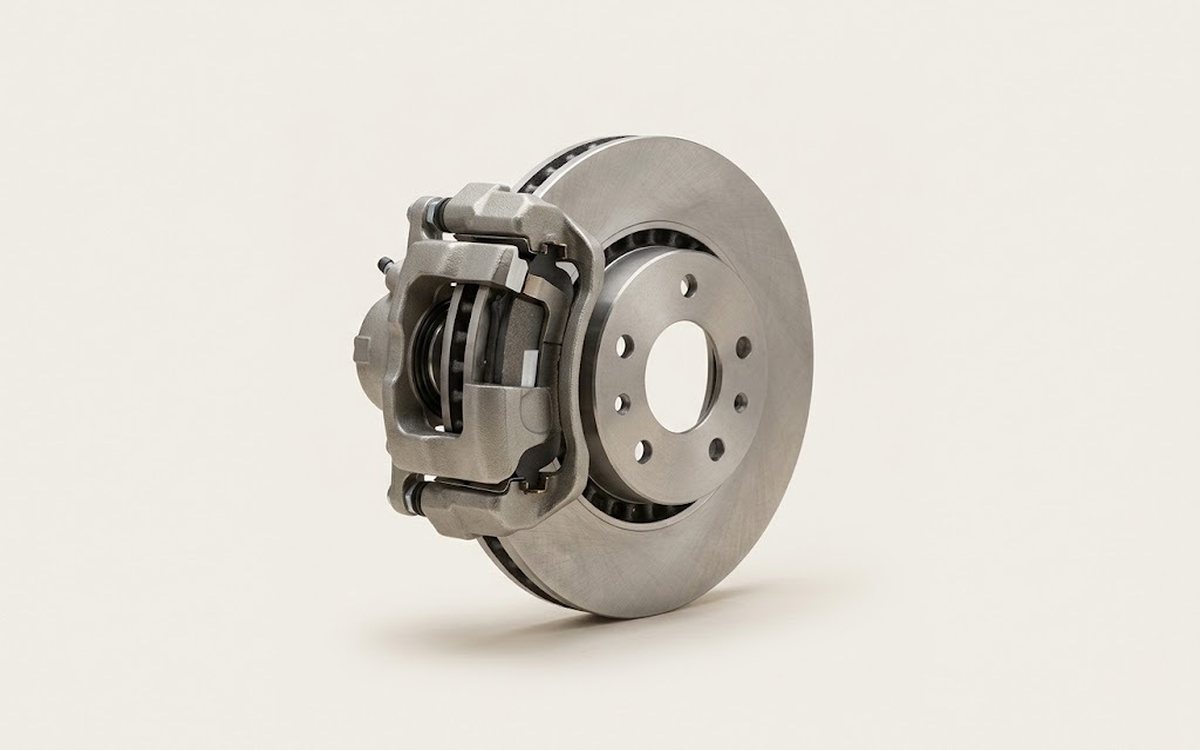 How it works · 3D
How Car Brakes Work
How the part you're working on actually works — in plain English, on a 3D model.
Open in 3D →
Spotted a mistake? Tell us →
Our articles
 Brand stories
The History of Nissan
Over the course of 80 years, this Japanese automaker has come a long way and risen to become a leader of the global…
Read →
 Garage
Fuel Quality Indicators: What Octane and Cetane Numbers Mean
What is an octane number? What about a cetane number? Which fuel should you choose for a high-compression engine?…
Read →
 Before you buy
How to Pick Up Your Car from the Dealership the Right Way
If you've decided to buy a car from a dealership, it isn't enough to simply choose a model you like, pay for it, and…
Read →