https://autopapyrus.com/catalog/skoda/octavia/guides/cooling-system-diagnostics/
Skoda Octavia 1.6 MPI CWVA (2015): Cooling System Diagnostics
On the CWVA (EA211 family, 1.6 MPI), the water pump is driven by the timing belt, and the thermostat sits in a housing on the block or cylinder head. Diagnostics therefore go from simple to complex: coolant level and condition, pressure leak test, thermostat operation, fan and sensors, then a check of the pump and belt. Exact pressure and temperature values for this model are not confirmed in public sources, so rely on the markings on the expansion tank cap and the manufacturer's service data.
Parts
8| № | Part |
|---|---|
| 01 | Purple coolant G12evo / G13 (VW TL 774-J)Find on Amazon → |
| 02 | Thermostat with housing, CWVA engineif faultyFind on Amazon → |
| 03 | Coolant pump (timing belt driven)if faultyFind on Amazon → |
| 04 | Coolant temperature sensorif faultyFind on Amazon → |
| 05 | Expansion tank with capif faultyFind on Amazon → |
| 06 | Cooling system hosesif faultyFind on Amazon → |
| 07 | Radiatorif faultyFind on Amazon → |
| 08 | Radiator fanif faultyFind on Amazon → |
Amazon links search by the part name; use Amazon's fit check for your car before ordering. We may earn a commission from qualifying purchases.
Tools
9- flashlight Amazon →
- wrenches and screwdrivers for removing the underbody shield Amazon →
- cooling system pressure tester with adapter set Amazon →
- coolant hydrometer or refractometer Amazon →
- OBD diagnostic scanner Amazon →
- multimeter Amazon →
- infrared thermometer Amazon →
- shop rags Amazon →
- drain pan Amazon →
Read the codes yourself
A scanner plugged into the OBD2 port under the dashboard shows which fault codes the car has stored, before you buy any parts. Cars sold in the US from 1996, and petrol cars in Europe from 2001 (diesels from 2004), have this port.
- Basic code reader, about $20–40: reads and clears engine codes Amazon →
- Bluetooth scanner with a phone app, about $30–100: live sensor data, and on many cars ABS and airbag codes too Amazon →
Check that the scanner lists your make and model year before you buy. We may earn a commission from qualifying purchases.
 There's a full repair manual for this car
Every system, wiring diagrams and torque specs — not just this job. Haynes and 7 more.
See manuals →
Step by step
14 steps- Define the symptom: overheating, slow warm-up, no cabin heat, coolant level dropping, or a coolant level or temperature warning light. This narrows down the suspects right away. For example, overheating in traffic with a normal temperature on the highway points to the fan, while a long warm-up with a cold heater points to a thermostat stuck open.
- Perform the checks on a completely cold engine. Do not open a hot system: it is under pressure, and sprayed coolant causes burns. Park the car on level ground.
- Check the level in the expansion tank: it should be between the MIN and MAX marks. Assess the color and clarity. Rusty, cloudy or oily coolant, or a film or emulsion on the tank cap, indicates a problem: suspect the head gasket or serious wear. Brown sediment indicates coolant that has gone unchanged for a long time.
- Check the tank cap: the seal must not be cracked, and the valve must move freely. The opening pressure is printed on the cap itself. A weak cap causes coolant loss and overheating. It is convenient to test it with the pressure tester.
- Inspect the hoses, radiator, thermostat housing, connections and the ground under the car. Look for leaks, white or colored traces of dried coolant, and swollen or cracking hoses. Remove the underbody shield to inspect the bottom of the radiator and the pump area on the timing belt side. Plastic flanges and housings on this engine crack over time, and leaks most often occur along the plastic seams.
- Connect the pressure tester to the tank filler neck and build pressure up to the value on the cap (do not exceed it). Hold it for 10-15 minutes. A pressure drop means a leak: find the spot by drips or fogging. If there are no external leaks but the pressure drops, there may be an internal leak (head gasket, oil emulsion in the oil).
- Check the coolant quality with a hydrometer or refractometer: the freezing point must suit winter conditions in your region. Do not mix coolants of different specifications. If you need to top up, use only coolant approved by VW (G12evo/G13 are compatible with each other).
- Connect the scanner. Read the fault codes and live data: coolant temperature, load, fan status. A cold engine should show a temperature close to ambient, and the readings should not jump around. If the "cold" sensor shows a strange value, it is faulty.
- Warm the engine up at idle and watch the temperature on the scanner. Normal operating temperature is about 90 degrees C. The upper radiator hose is hot, and the lower one should stay noticeably cooler until the thermostat opens. When it opens, the lower hose heats up sharply. If both hoses heat up at the same time from the start, the thermostat is stuck open. If the temperature rises above normal while the lower hose stays cold, the thermostat is stuck closed or the radiator is clogged.
- Check the fan: when the temperature threshold is reached (or when the A/C is switched on), the fan should turn on. If it does not, check the fuse, relay, connector and the motor itself, and use a multimeter to verify power. Turn on the A/C with the engine running: the fan should start.
- Assess the pump: look for leaks from under it, squealing or humming, and play in the pulley or shaft. The pump is driven by the timing belt, so checking it together with the condition of the belt is mandatory. Replace the timing belt according to the service schedule together with the pump if you have any doubts.
- Check the heater: with the engine warm, both heater hoses should be hot. If one is cold, the heater core or hoses are clogged with air or debris. Remove the air lock when filling the coolant, following the service procedure.
- If you suspect a head gasket: there is no white smoke, but coolant is disappearing. Look for bubbles and surges in the tank while the engine runs, pressure in the system rising right after startup, oil turning lighter, and emulsion on the dipstick. The check is done with a quick combustion gas test of the coolant. If confirmed, further work is a repair for a repair shop.
- After fixing the fault, top up the coolant to the correct level, warm up the engine, let it cool and recheck the level. Tighten threaded fasteners (hose clamps, sensors, thermostat housing) according to the manufacturer's specifications: values for small fasteners are generally low (on the order of 5-10 N·m (4-7 lb-ft)), but verify the exact figures.
Common mistakes and warnings
- Do not open the tank cap on a hot engine: you may be burned by boiling coolant
- Coolant is toxic, so keep it out of reach of children and animals and dispose of it properly
- Do not keep driving if the engine is overheating: it is easy to damage the engine, and a warped cylinder head costs more than the whole diagnosis
- If you suspect a head gasket problem or wear of the timing belt and pump and you lack experience, contact a repair shop
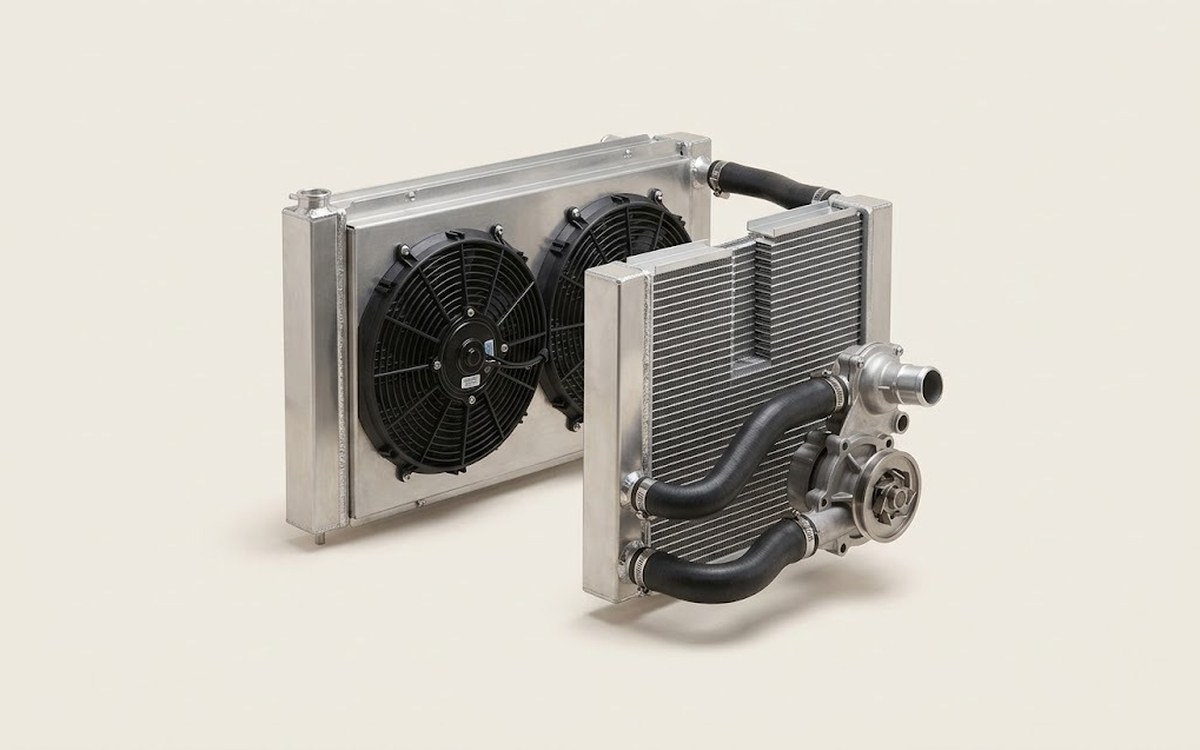 How it works · 3D
How the Engine Cooling System Works
How the part you're working on actually works — in plain English, on a 3D model.
Open in 3D →
Spotted a mistake? Tell us →
Our articles
 Brand stories
The History of Skoda
A detailed look at how the Škoda automotive brand came to be.
Read →
 Garage
Fuel Quality Indicators: What Octane and Cetane Numbers Mean
What is an octane number? What about a cetane number? Which fuel should you choose for a high-compression engine?…
Read →
 Before you buy
How to Pick Up Your Car from the Dealership the Right Way
If you've decided to buy a car from a dealership, it isn't enough to simply choose a model you like, pay for it, and…
Read →