Autopapyrus · Suzuki Ignis 1.3 M13A (2008)
https://autopapyrus.com/guides/suzuki/ignis/checking-the-level-and-replacing-the-automatic-transmission-fluid/
https://autopapyrus.com/guides/suzuki/ignis/checking-the-level-and-replacing-the-automatic-transmission-fluid/
Compiled automatically from service literature and owner experience. Specs are for the typical configuration — check them against your exact car before you start.
Suzuki Ignis 1.3 M13A (2008): Checking the Level and Replacing the Automatic Transmission Fluid
The automatic transmission on the Suzuki Ignis 1.3 M13A has a dipstick for checking the fluid level and needs a fluid change every 30,000 km or 24 months. The total system capacity is 5-5.5 L (5.3-5.8 qt). A partial change through the pan drains 3.5-4 L (3.7-4.2 qt).
Part
- 🔩 ATF Dexron II or Dexron III fluid (4-5 L (4.2-5.3 qt)). Recommended: Suzuki ATF 3317, Mobil ATF 3309, Aisin AWF+
 There's a full repair manual for this car
Every system, wiring diagrams and torque specs — not just this job. Haynes AutoFix (online) and 2 more.
See manuals →
Step by step
11 steps- Checking the level: Warm the transmission up to operating temperature (70-80°C) by driving for 10-15 minutes or letting the engine idle. Park the car on a level surface.
- The engine must be idling. Shift the selector through all positions in sequence (P-R-N-D-M), pausing 2-3 seconds in each, then return it to P.
- Pull out the transmission dipstick (usually on the right side of the engine, next to the engine oil dipstick). Wipe it with a rag, push it back in all the way, pull it out again and check the level against the FULL HOT and LOW HOT marks. The fluid should be between these marks and reddish or light brown in color. Dark, opaque fluid with a burnt smell is a sign that it needs to be replaced.
- Changing the fluid by draining through the pan: Raise the car on a lift or drive it over an inspection pit. Remove the engine undercover and, if necessary, any exhaust components blocking access to the transmission pan.
- Place the drain pan underneath. Remove the drain plug on the pan (tightening torque for installation 15-20 N·m (11-15 lb-ft)). Drain the fluid (3.5-4 L (3.7-4.2 qt) will come out) and wait until the flow stops completely.
- Remove the transmission pan bolts in a crisscross pattern (tightening torque for installation 10-12 N·m (7-9 lb-ft)). Remove the pan together with the old gasket. Clean the mating surface of old gasket material and deposits.
- Remove the transmission filter bolts (tightening torque for installation 8-10 N·m (6-7 lb-ft)) and take off the old filter. Install a new filter with a new sealing ring (lubricate the ring with fresh ATF first).
- Fit a new pan gasket and install the pan. Tighten the bolts in a crisscross pattern in two or three passes, evenly, to a final torque of 10-12 N·m (7-9 lb-ft). Install the drain plug with a new washer.
- Through the dipstick tube, pour in exactly as much fluid as you drained (3.5-4 L (3.7-4.2 qt)). Use a funnel with a long hose. Pour slowly to avoid overfilling.
- Start the engine and let it idle for 2-3 minutes. Shift the selector through all positions, pausing 2-3 seconds in each, then return it to P. Check the level with the dipstick; it should be between the marks. If it is low, add fluid in portions of 100-150 mL, checking the level after each addition.
- Drive 10-15 km, then check the level again with the transmission hot. If the fluid is above the FULL HOT mark, remove the excess with a syringe and hose through the dipstick tube.
Common mistakes and warnings
- If the old fluid is black and opaque, a two-stage change with an interval of 500-1000 km is recommended. The aggressive detergent properties of fresh ATF can dislodge old deposits and clog the valve body or solenoids. Underfilling or overfilling ATF causes slipping, jerking or complete transmission failure. Never mix different fluid types (Dexron and CVT fluids are not compatible).
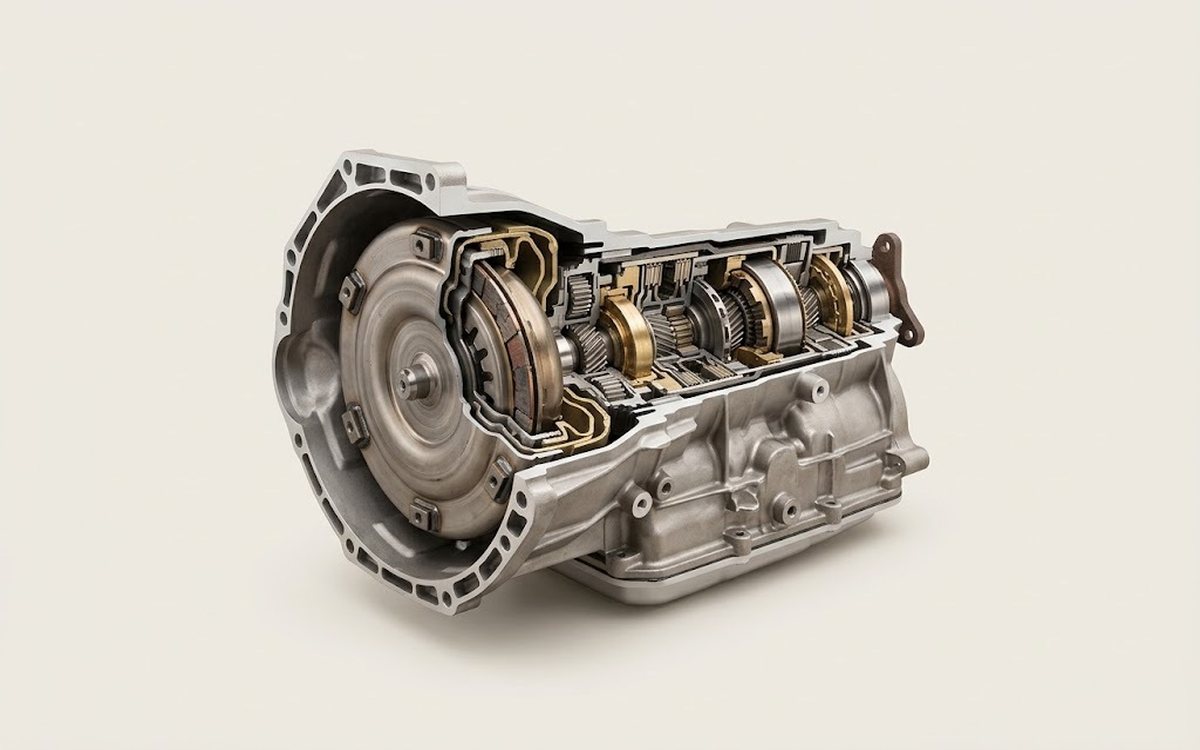 How it works · 3D
How an Automatic Transmission Works
How the part you're working on actually works — in plain English, on a 3D model.
Open in 3D →