Autopapyrus · Toyota Alphard (2nd generation, 2008-2014)
https://autopapyrus.com/guides/toyota/alphard/full-machine-assisted-atf-exchange/
https://autopapyrus.com/guides/toyota/alphard/full-machine-assisted-atf-exchange/
Compiled automatically from service literature and owner experience. Specs are for the typical configuration — check them against your exact car before you start.
Toyota Alphard (2nd generation, 2008-2014): Full Machine-Assisted ATF Exchange
The 2013 Alphard is equipped with either the 6-speed U660E automatic transmission (3.5L V6 engine) or the U241E (2.4L engine). Both require ATF WS fluid. A full machine-assisted exchange replaces up to 95-100% of the old fluid by flushing it through the transmission cooler circuit, compared with a partial pan drain, which renews only 40-50%. The procedure uses a dedicated machine that connects to the transmission cooler lines and pumps in new fluid under pressure, displacing the old fluid. The recommended service interval is every 40,000-60,000 km (25,000-37,000 mi).
Part
- 🔩 10-12 liters (10.6-12.7 qt) of Toyota ATF WS (OE 00289-ATFWS or 08886-02505). If replacing the filter as well: strainer 35330-33050, pan gasket 35168-08010
Step by step
14 steps- Warm the transmission to operating temperature by driving 10-15 km (6-9 mi) in mixed conditions. The fluid temperature should reach 40-60°C before you begin.
- Raise the vehicle on a lift, or park it on a level surface. Make sure the vehicle is perfectly level.
- Connect the diagnostic scan tool to the OBD-II port to monitor ATF temperature in real time (keep it within 40-60°C throughout the procedure).
- Disconnect the supply and return hoses from the transmission cooler (located at the front of the transmission, accessed from below). Plug the factory lines to prevent leaks.
- Connect the exchange machine hoses to the disconnected cooler lines. One hose feeds fresh fluid into the transmission, and the other carries used fluid out to the machine's waste tank.
- Fill the machine's tank with 10-12 liters (10.6-12.7 qt) of fresh ATF WS. Install the filters on the machine's inlet and outlet.
- Start the engine and let it idle. Move the selector through all positions in sequence (P-R-N-D-L), pausing 3-5 seconds in each, then return it to P.
- Switch on the machine. The pump begins feeding new fluid into the transmission through the supply line while pushing the old fluid out through the return line into the waste tank. The process runs at a controlled pressure matching the transmission's operating pump pressure.
- Watch the fluid color in the transparent tubes on the machine's panel. When the discharged fluid takes on the color of new fluid (light red, clear), the procedure is complete. This usually takes 8-12 minutes of engine running time.
- Switch off the machine and shut off the engine. Disconnect the machine hoses and restore the factory cooler line connections. Tighten the line clamps to 3-5 N·m (27-44 lb-in).
- Check the ATF level through the overflow plug (located on the right side of the transmission case). Remove the overflow plug with a 24 mm wrench. Start the engine with the selector in P and the fluid temperature at 40-60°C. If fluid does not run out of the overflow hole in a thin stream, add fluid through the fill port until a thin stream appears.
- Tighten the overflow plug to 40-42 N·m (30-31 lb-ft). Lower the vehicle.
- Take a 5-10 km (3-6 mi) test drive, shifting the selector through all modes. Make sure there is no jerking, slipping or unusual noise.
- After the transmission cools down (30-60 minutes), check again for leaks at the cooler line connections and the overflow plug.
Common mistakes and warnings
- A machine-assisted exchange requires specialized equipment and skill, and doing it yourself without experience is not recommended. Using a fluid that does not meet the ATF WS specification will cause premature wear of the clutches and valve body valves. Letting the fluid temperature exceed 60°C during the procedure can cause foaming and an inaccurate level check. If metal particles or dark, burnt-looking old fluid are found during the exchange, it is recommended to also remove the pan, replace the strainer and inspect the magnets for clutch wear debris. Do not use "universal" ATF: the U660E is sensitive to viscosity (ATF WS has a viscosity of 7.3-7.6 cSt at 100°C), and fluids with a viscosity below 7.0 shorten transmission life.
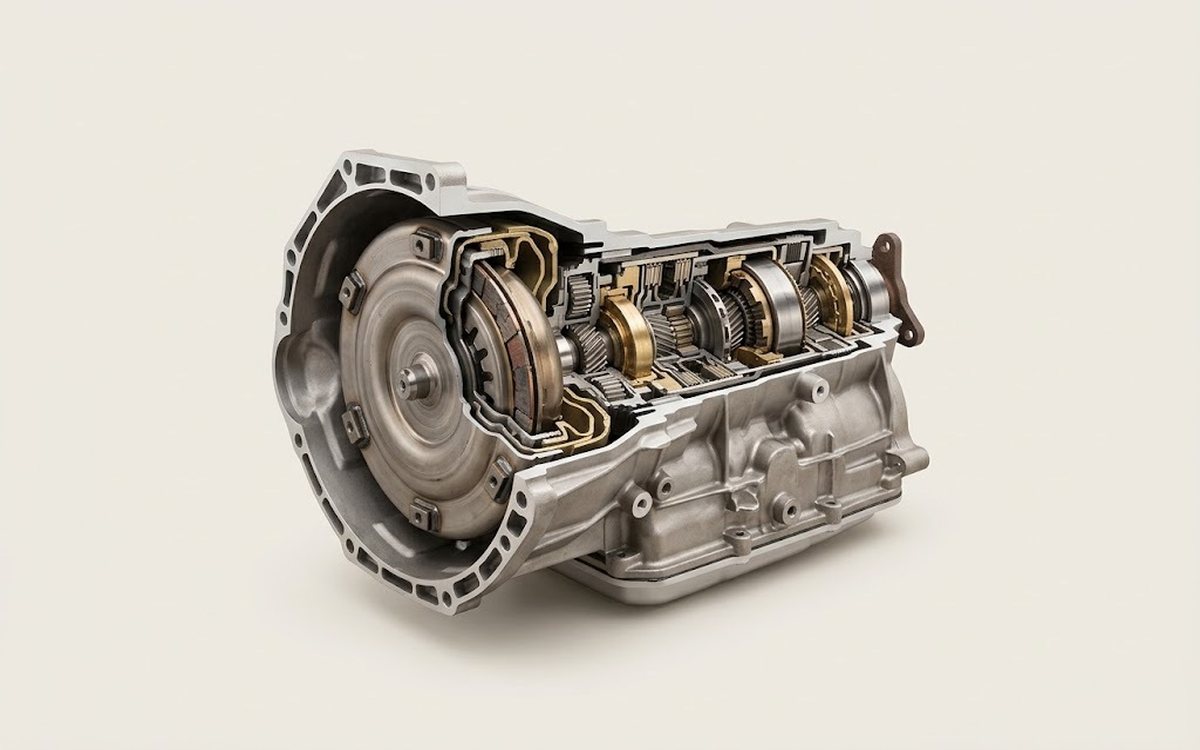 How it works · 3D
How an Automatic Transmission Works
How the part you're working on actually works — in plain English, on a 3D model.
Open in 3D →