Car care & driving
All-Wheel-Drive Systems: Differences and Advantages
Autopapyrus
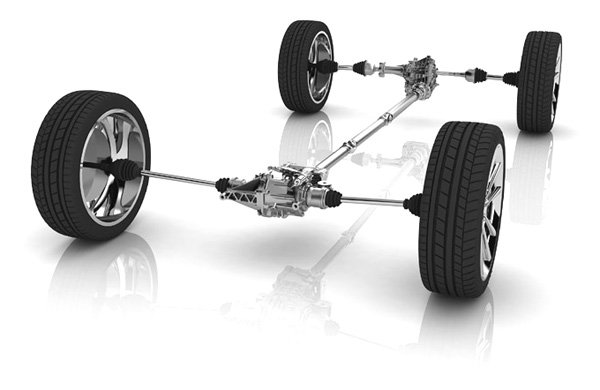
Virtually all four-wheel-drive and all-wheel-drive vehicles fall into three main types: those with automatically engaged drive (On Demand Full Time), those with permanent drive (Full Time), and those with temporarily engaged drive (Part Time).
Let's start with the simplest option: part-time four-wheel drive. Part Time mode doesn't allow a vehicle to run in four-wheel drive for long periods. This type of system has no center differential to compensate for the difference in rotation speed between the front and rear axles. That's why the service manuals for vehicles of this class all warn that driving in four-wheel drive on normal pavement significantly shortens the life of the drivetrain.
Part-time 4WD should be engaged only at low speeds, to get through difficult sections and obstacles on the road. This is usually done with a transfer case lever. On some models, though, the front axle is engaged by turning a special knob on each front wheel hub. The driver has to get out of the vehicle and turn it by hand. Usually only true off-roaders have this kind of system, and they're often said to have "locking hubs." The makers of these models are in no hurry to hand control of the drive system over to electronics. The Nissan Patrol and Jeep Wrangler are classic examples. These vehicles can be used fully as intended.
Part-time four-wheel drive is also found on Chinese copies of 1990s off-roaders. Looking at current models, modern electronic AWD systems are gradually replacing these classic part-time setups.
Among models with permanent all-wheel drive, most manufacturers have dropped the option of manually engaging one of the axles. Because Full Time transmissions have a center differential, the vehicle can drive in all-wheel drive in any road conditions.
This "smart" differential can split torque not only 50/50 but in other ratios, depending on driving conditions. If one axle starts to slip, the electronics automatically send most of the torque to the axle with better grip. In the most advanced systems, torque can be sent to individual wheels with the most traction.
This is the most successful form of 4x4 system. It lets the vehicle adapt to the surface it's on, whether gravel or asphalt. Audi's Quattro cars and Subarus with Symmetrical All-Wheel Drive are the best-known examples of this class.
Automatically engaged all-wheel drive is the most advanced system and is used on most new models. At the slightest slip of one axle, On Demand Full Time engages all-wheel drive automatically. The torque split between the wheels can vary widely, too. Vehicles with automatic AWD are most often equipped with electronic stability control (ESC) to help prevent loss of control when the system shifts between two-wheel and all-wheel drive.
Vehicles with the most refined versions of automatic AWD also offer forced torque distribution. Special buttons let you lock the split at 50/50. Once you reach 40-50 km/h (25-30 mph), the system goes back to variable torque distribution.
You can also easily switch a vehicle with automatic AWD to two-wheel drive, or back, just by pressing the 2WD or 4WD button. In the city, all-wheel drive is usually unnecessary, so being able to switch it off can noticeably cut fuel consumption. Although automatically engaged AWD is the newest of these designs, vehicles with it have already firmly claimed their place in the market. Today almost all crossovers come with a system like this.
All this raises an obvious question: which type of all-wheel drive is best? There's no single answer. Each has clear strengths and weaknesses. For serious backcountry off-roading, a vehicle with part-time 4WD, a full set of differentials and hard locks is the best choice. But driving one in the city is far from comfortable. Crossovers, which have grown so popular lately, are nearly helpless off-road. They lack the ground clearance for serious obstacles, and their all-wheel drive can't get them through deep water crossings. In the city, though, a crossover is a pleasure to drive.
A good compromise is a vehicle with permanent all-wheel drive. Such a system works very well off-road and is just as capable on the highway. Keep in mind, though, that you can't intervene in how a permanent system works, so you won't save any fuel.
Part-Time Four-Wheel Drive
Let's start with the simplest option: part-time four-wheel drive. Part Time mode doesn't allow a vehicle to run in four-wheel drive for long periods. This type of system has no center differential to compensate for the difference in rotation speed between the front and rear axles. That's why the service manuals for vehicles of this class all warn that driving in four-wheel drive on normal pavement significantly shortens the life of the drivetrain.
Part-time 4WD should be engaged only at low speeds, to get through difficult sections and obstacles on the road. This is usually done with a transfer case lever. On some models, though, the front axle is engaged by turning a special knob on each front wheel hub. The driver has to get out of the vehicle and turn it by hand. Usually only true off-roaders have this kind of system, and they're often said to have "locking hubs." The makers of these models are in no hurry to hand control of the drive system over to electronics. The Nissan Patrol and Jeep Wrangler are classic examples. These vehicles can be used fully as intended.
Part-time four-wheel drive is also found on Chinese copies of 1990s off-roaders. Looking at current models, modern electronic AWD systems are gradually replacing these classic part-time setups.
Permanent All-Wheel Drive
Among models with permanent all-wheel drive, most manufacturers have dropped the option of manually engaging one of the axles. Because Full Time transmissions have a center differential, the vehicle can drive in all-wheel drive in any road conditions.
This "smart" differential can split torque not only 50/50 but in other ratios, depending on driving conditions. If one axle starts to slip, the electronics automatically send most of the torque to the axle with better grip. In the most advanced systems, torque can be sent to individual wheels with the most traction.
This is the most successful form of 4x4 system. It lets the vehicle adapt to the surface it's on, whether gravel or asphalt. Audi's Quattro cars and Subarus with Symmetrical All-Wheel Drive are the best-known examples of this class.
Automatically Engaged Drive
Automatically engaged all-wheel drive is the most advanced system and is used on most new models. At the slightest slip of one axle, On Demand Full Time engages all-wheel drive automatically. The torque split between the wheels can vary widely, too. Vehicles with automatic AWD are most often equipped with electronic stability control (ESC) to help prevent loss of control when the system shifts between two-wheel and all-wheel drive.
Vehicles with the most refined versions of automatic AWD also offer forced torque distribution. Special buttons let you lock the split at 50/50. Once you reach 40-50 km/h (25-30 mph), the system goes back to variable torque distribution.
You can also easily switch a vehicle with automatic AWD to two-wheel drive, or back, just by pressing the 2WD or 4WD button. In the city, all-wheel drive is usually unnecessary, so being able to switch it off can noticeably cut fuel consumption. Although automatically engaged AWD is the newest of these designs, vehicles with it have already firmly claimed their place in the market. Today almost all crossovers come with a system like this.
All this raises an obvious question: which type of all-wheel drive is best? There's no single answer. Each has clear strengths and weaknesses. For serious backcountry off-roading, a vehicle with part-time 4WD, a full set of differentials and hard locks is the best choice. But driving one in the city is far from comfortable. Crossovers, which have grown so popular lately, are nearly helpless off-road. They lack the ground clearance for serious obstacles, and their all-wheel drive can't get them through deep water crossings. In the city, though, a crossover is a pleasure to drive.
A good compromise is a vehicle with permanent all-wheel drive. Such a system works very well off-road and is just as capable on the highway. Keep in mind, though, that you can't intervene in how a permanent system works, so you won't save any fuel.
What next