Autopapyrus · Chery Tiggo 7 (2nd generation)
https://autopapyrus.com/catalog/chery/tiggo-7/guides/rear-control-arm-and-bushing-replacement/
https://autopapyrus.com/catalog/chery/tiggo-7/guides/rear-control-arm-and-bushing-replacement/
Compiled automatically from service literature and owner experience. Specs are for the typical configuration — check them against your exact car before you start.
Chery Tiggo 7 (2nd generation): Rear Control Arm and Bushing Replacement
The Tiggo 7 rear suspension is multi-link, with several lateral arms mounted on a subframe. Worn bushings cause knocking, a "floating" rear axle and uneven tire wear. The job can be done in a home garage, but it requires carefully marking the position of the adjusting bolts and a mandatory wheel alignment afterward. The exact procedure for this model is not documented in publicly available service materials, so what follows is the general principle for a multi-link rear suspension. Check torque specs against the manufacturer's service manual.
Parts
3| № | Part |
|---|---|
| 01 | Rear lateral control arm (upper/lower, depending on design)if worn, eachFind on Amazon → |
| 02 | Rear control arm bushingif worn, eachFind on Amazon → |
| 03 | Self-locking nuts and boltsif single-useFind on Amazon → |
Amazon links search by the part name; use Amazon's fit check for your car before ordering. We may earn a commission from qualifying purchases.
Tools
8Step by step
12 steps- Park the car on level ground and chock the wheels. Loosen the lug nuts on the rear wheel. Raise the rear of the car, support it on jack stands and remove the wheel.
- Inspect the suspension: find the faulty arm, and use a pry bar to check for play in the bushings and in the mounts at the subframe and hub. Decide which arms you are replacing.
- Apply penetrating oil to the threaded connections and wait 10-15 minutes.
- If the arm has an adjusting cam or bolt (camber/toe), mark its position relative to the body or subframe with a marker so you can restore it.
- Support the hub or lower arm with a jack so the spring and shock absorber cannot extend suddenly. If the arm is under spring load, do not undo it until the suspension is unloaded.
- Remove the nut and drive out the arm mounting bolt on the hub side, then on the subframe side. If a bolt is seized, apply heat and drive it out carefully without damaging the threads.
- Remove the arm. Compare it with the new one: the shape, length and hole positions must match.
- If you are replacing only the bushing, press it out with a puller or on a press, clean rust from the seat and install the new one all the way in, without tilting. Heating the bushing or hitting the rubber with a hammer is not allowed.
- Install the arm, insert the bolts and tighten them by hand. Do the final tightening with the suspension loaded: wheel on the ground, or hub under load with a jack. Tightening with the suspension hanging twists the rubber and quickly destroys the bushing.
- Tighten the nuts with a torque wrench to the manufacturer's specification (for arms like these it is usually around 60-150 N·m (44-111 lb-ft), but check the service documentation for the exact value for each bolt).
- Install the wheel, tighten the lug nuts in a crisscross pattern, lower the car and fully tighten the lug nuts to specification.
- Take a test drive and check for knocking and pulling. Be sure to have the wheel alignment done on an alignment rack.
Common mistakes and warnings
- The suspension is a safety-critical system: errors in tightening or seating the arms affect handling
- If you lack experience, leave the job to a repair shop
- Do not tighten the bushings with the wheel hanging
- After replacing any arm, camber and toe are thrown off, and without an alignment on a rack the tires wear out quickly
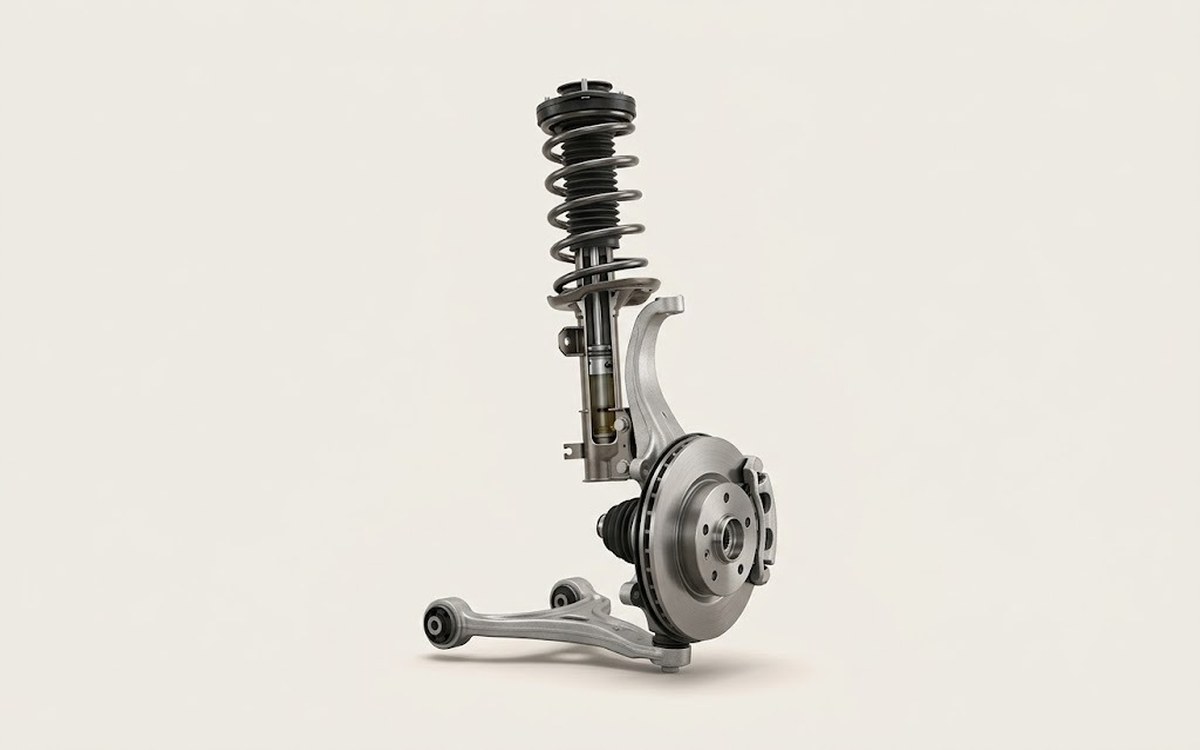 How it works · 3D
How Car Suspension Works
How the part you're working on actually works — in plain English, on a 3D model.
Open in 3D →
Spotted a mistake? Tell us →
Our articles
 Before you buy
Which Used Chinese Crossover to Buy: Haval Jolion, Chery Tiggo 7 Pro, Geely Coolray or Monjaro
Engine and gearbox life of four used Chinese crossovers and what to check before buying: the pre-2023 Coolray's timing…
Read →
 Before you buy
What Actually Breaks: Engines and Transmissions in Popular Chinese Cars, a Reliability Breakdown
How long the engine and transmission last in the Haval Jolion and F7, Chery Tiggo 7 Pro, and Geely Coolray and Monjaro.…
Read →
 Before you buy
German Turbo Engines vs. Chinese Ones: Which Lasts Longer? An Honest Look at Engine Life
Volkswagen 1.4 and 2.0 TSI, BMW N20 and Mercedes M274 versus Haval, Chery and Geely engines: lifespan benchmarks…
Read →