https://autopapyrus.com/catalog/renault/talisman/guides/diagnosing-a-suspension-knock/
Renault Talisman 1.5 dCi K9K (2019): Diagnosing a Suspension Knock
On the first-generation Talisman (2015-2020), a suspension knock most often comes from the front axle. The usual causes are worn strut mount bearings (the most common), worn sway bar links, worn lower control arm ball joints, or damaged bushings. Diagnosis requires a visual inspection over a pit or on a lift, along with play checks.
Parts
5| № | Part |
|---|---|
| 01 | Strut mount bearingsif wornFind on Amazon → |
| 02 | Sway bar linksif wornFind on Amazon → |
| 03 | Control arm bushingsif wornFind on Amazon → |
| 04 | Ball jointsif wornFind on Amazon → |
| 05 | Shock absorbersif wornFind on Amazon → |
Amazon links search by the part name; use Amazon's fit check for your car before ordering. We may earn a commission from qualifying purchases.
Tools
5Read the codes yourself
A scanner plugged into the OBD2 port under the dashboard shows which fault codes the car has stored, before you buy any parts. Cars sold in the US from 1996, and petrol cars in Europe from 2001 (diesels from 2004), have this port.
- Basic code reader, about $20–40: reads and clears engine codes Amazon →
- Bluetooth scanner with a phone app, about $30–100: live sensor data, and on many cars ABS and airbag codes too Amazon →
Check that the scanner lists your make and model year before you buy. We may earn a commission from qualifying purchases.
 There's a full repair manual for this car
Every system, wiring diagrams and torque specs — not just this job. Haynes AutoFix (online).
See manuals →
Step by step
8 steps- Drive the Talisman onto a pit or lift and raise the front wheels so they hang freely.
- Inspect the lower control arm ball joint boots (at the front and rear of the engine). They should have no tears. If a boot is torn, the grease has washed out and the ball joint is worn.
- Check the sway bar links (thin rods with joints at both ends, running from the sway bar to the lower control arms). Shake each link by hand in different directions. There should be no play. Play means the joints or mounts are worn.
- Wheel hub bearings (the most common culprits). To check: grab the wheel at the top and bottom (12 and 6 o'clock) and try to rock it in the vertical plane. If the wheel rocks at the top (near the fender) and you hear grinding or knocking as you rock it, the left-side hub bearing is worn. Repeat the same check on the right wheel.
- Ball joint play: use a pry bar between the lower control arm and the steering knuckle (the gap at the bottom). Play of more than 2-3 mm means the ball joint needs replacement.
- Shock absorbers: lower the car to the ground and bounce the body by hand at each corner. If the body settles after 1-2 oscillations, the shock absorber is good. If the body keeps bouncing 5 or more times, the shock absorber is dead.
- Control arm bushings (at the front and rear of the arm, at the body mounting points). Inspect them visually. If the rubber is black, bulging, or cracked, or the metal sleeve is visible, the bushings are worn out.
- With the car loaded (under its own weight), bounce the body again. The knock may be more audible because the load on the suspension components is higher.
Common mistakes and warnings
- If the diagnosis confirms a worn strut mount bearing, ball joint, or shock absorbers, it is best to have the replacement done at a repair shop
- It requires special tools (ball joint puller, bearing press) and a wheel alignment after replacing control arms
- Sway bar links and bushings can be replaced at home if you have a lift and the right tools
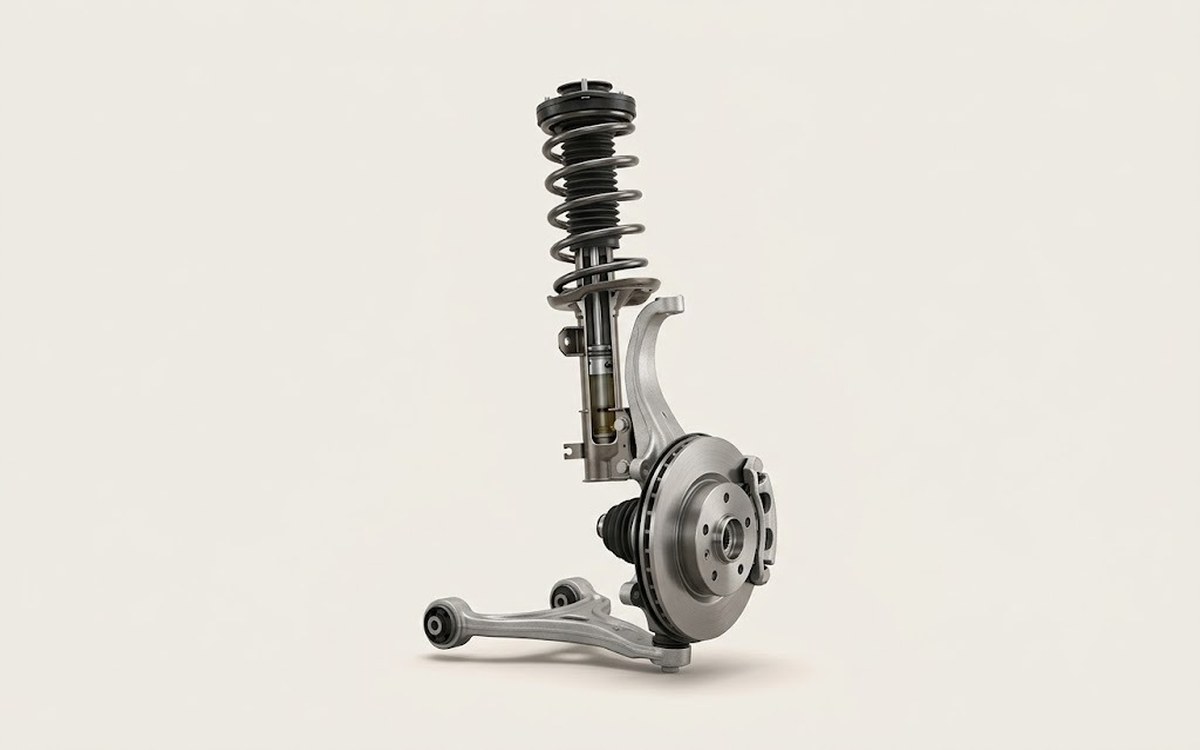 How it works · 3D
How Car Suspension Works
How the part you're working on actually works — in plain English, on a 3D model.
Open in 3D →
Spotted a mistake? Tell us →
Our articles
 Brand stories
The History of Renault
Louis Renault (1877–1944) was interested in electricity and mechanics from an early age, and he was destined to become…
Read →
 Garage
Fuel Quality Indicators: What Octane and Cetane Numbers Mean
What is an octane number? What about a cetane number? Which fuel should you choose for a high-compression engine?…
Read →
 Before you buy
How to Pick Up Your Car from the Dealership the Right Way
If you've decided to buy a car from a dealership, it isn't enough to simply choose a model you like, pay for it, and…
Read →