Autopapyrus · Chery Tiggo 4 (2nd generation)
https://autopapyrus.com/guides/chery/tiggo-4/diagnosing-a-front-suspension-knock/
https://autopapyrus.com/guides/chery/tiggo-4/diagnosing-a-front-suspension-knock/
Compiled automatically from service literature and owner experience. Specs are for the typical configuration — check them against your exact car before you start.
Chery Tiggo 4 (2nd generation): Diagnosing a Front Suspension Knock
The Tiggo 4 front suspension is a MacPherson strut design. A knock over bumps and when turning the steering wheel is most often caused by the upper strut mount with its bearing, followed by the sway bar links, tie rod ends, control arms and wheel bearings. First locate the source of the knock by inspection and play checks, and only then replace the worn part.
Key figures
- Mileage at which a knock from the upper mounts and strut bearings may appearif the knock appeared earlier, start the check with step 9up to 50,000 km
- Suspension inspection intervalto catch wear before knocks appear (steps 2-9)once a year or every 10,000-15,000 km
Check these values against the manufacturer’s specification for your vehicle before you start.
Parts
7| № | Part |
|---|---|
| 01 | Strut bearing |
| 02 | Upper strut mount |
| 03 | Sway bar link |
| 04 | Tie rod end |
| 05 | Control arm ball joint |
| 06 | Control arm bushings |
| 07 | Front wheel bearing |
Tools
6- lift or inspection pit
- jack and jack stands
- pry bar or small crowbar
- flashlight
- set of wrenches and sockets
- torque wrench
Step by step
12 steps- Identify the type of noise. A knock over bumps points to the sway bar links, the shock absorber or the upper mount. A knock or creak when turning the steering wheel while stationary points to the strut bearing and upper strut mount. A hum that rises with speed points to the wheel bearing. A knock when pulling away and braking points to the control arm bushings and ball joint.
- With the hood open, inspect the wheel wells and the engine bay. Check the upper strut mounts for cracked rubber, displacement and signs of impact.
- Raise the car on a lift, secure it, and lift the front wheels off the ground. Remove the wheel if you need access to the control arm and strut.
- Inspect the shock absorber: oil traces on the body, a skewed or torn dust boot, a displaced bump stop.
- Check the sway bar links. Shake each one by hand: there should be no play in the joints. Inspect the joint boots.
- Check the ball joint and the control arm bushings. Place a pry bar between the control arm and the subframe, or between the arm and the steering knuckle, and apply light leverage. Noticeable movement in the joint or torn rubber means the control arm or its joint must be replaced.
- Check the tie rod ends and tie rods. Rock the wheel at the 3 and 9 o'clock positions: play here points to a tie rod end or tie rod. Inspect the steering rack boot.
- Check the wheel bearing. Rock the wheel at the 12 and 6 o'clock positions. Then spin the wheel by hand with the car lifted and listen for a hum or crunching.
- Check the upper strut mount. Have a helper sharply rock the steering wheel back and forth while stationary with the engine running, and press your hand against the strut tower in the wheel well: a click or knock means the mount or bearing is worn.
- Check the tightness of the bolts that secure the struts, control arms and wheels. A loose bolt can also cause a knock. Tighten with a torque wrench. Follow the manufacturer's torque specifications for the Tiggo 4, and look up the exact value for each fastener separately.
- Replace the worn part you found. If you replace a strut or a mount, replace them in pairs on both sides of the axle. After replacing control arms, struts or tie rod ends, have a wheel alignment done.
- Take a test drive over bumps and with the steering wheel turned while stationary. If the knock remains, go back to steps 5-9: there can be more than one source.
Common mistakes and warnings
- The suspension and steering are safety-critical systems
- If you have no experience working under a car, especially removing springs and struts, have the replacement done at a repair shop
- Do not drive at high speed with noticeable play in a ball joint or tie rod end
- Do not disassemble a spring without spring compressors: it is under heavy compression and is dangerous
- The upper mounts and strut bearings on the Tiggo 4 are considered a weak point, and a knock from them can appear even before 50,000 km of mileage
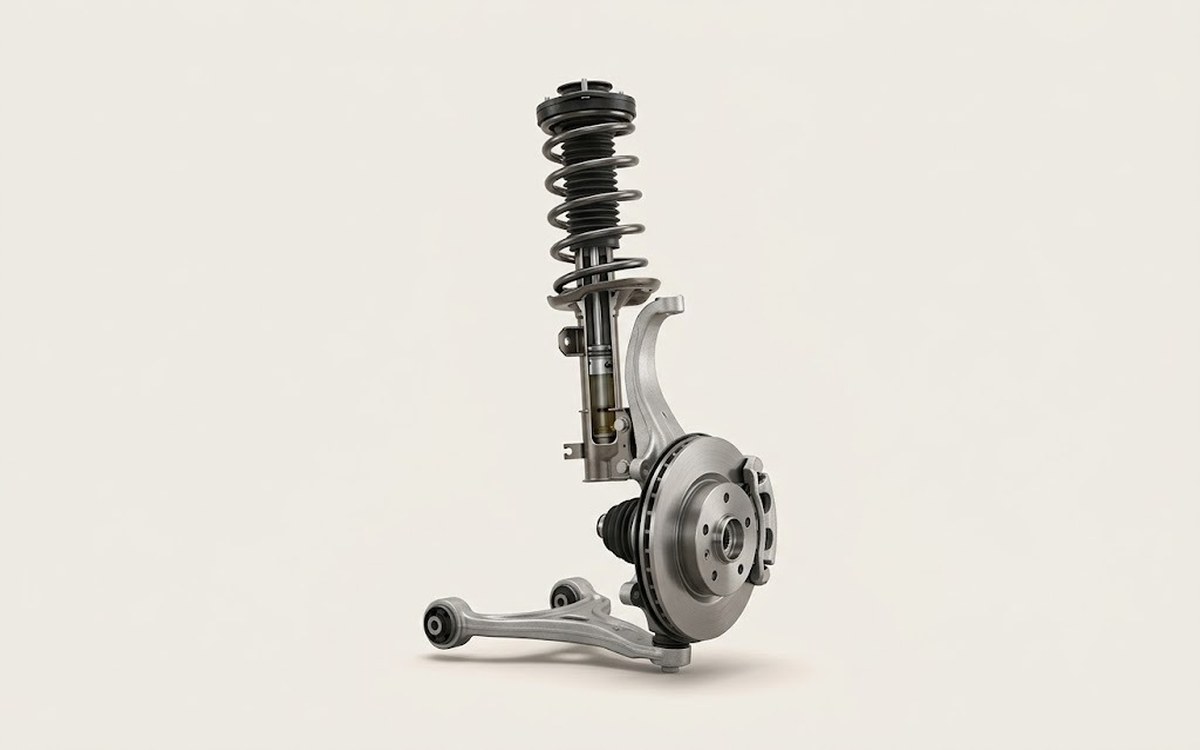 How it works · 3D
How Car Suspension Works
How the part you're working on actually works — in plain English, on a 3D model.
Open in 3D →