Autopapyrus · Ford Focus III 1.6 (M2DA, 2018)
https://autopapyrus.com/guides/ford/focus/engine-management-system-diagnostics/
https://autopapyrus.com/guides/ford/focus/engine-management-system-diagnostics/
Compiled automatically from service literature and owner experience. Specs are for the typical configuration — check them against your exact car before you start.
Ford Focus III 1.6 (M2DA, 2018): Engine Management System Diagnostics
The 1.6 Duratec Ti-VCT engine of the Sigma family is controlled by the PCM. It polls the sensors and controls ignition, fuel injection, the electronic throttle and valve timing. Diagnostics go in order: read the codes, check the live data, check the mechanical side and the power supply, then replace the part.
Part
- 🔩 Determined by the diagnostic results. Typical candidates: ignition coils, spark plugs, mass airflow sensor, oxygen sensors upstream and downstream of the catalytic converter, crankshaft and camshaft position sensors, VCT (variable cam timing) solenoid valves, throttle body, fuel injectors. Price depends on the component, so check with your parts supplier
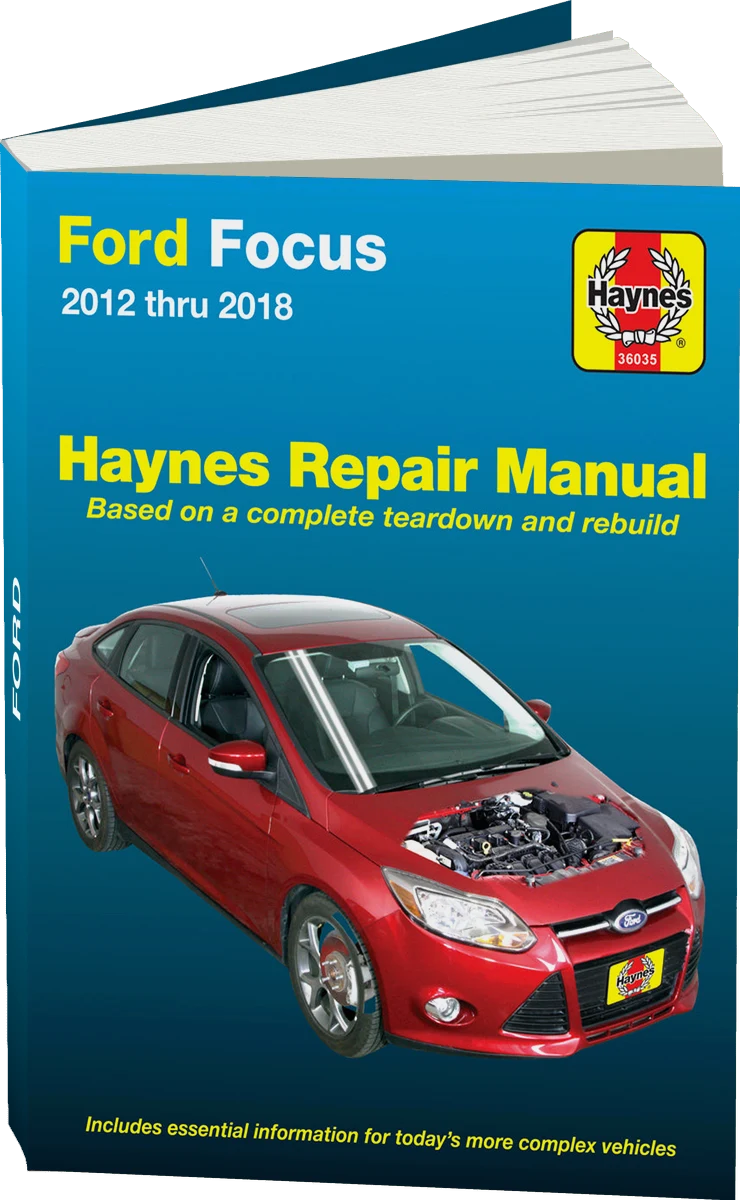 There's a full repair manual for this car
Every system, wiring diagrams and torque specs — not just this job. Haynes and 25 more.
See manuals →
Step by step
15 steps- Preliminary inspection. Check the oil level and condition, the coolant level and the cleanliness of the air filter. Inspect the intake hoses for cracks and loose clamps, the connectors on the engine, and the wiring harnesses for chafing and rodent damage. Many "electronic" faults turn out to be an air leak or an oxidized contact.
- Check the battery. Voltage with the engine off should be about 12.4-12.7 V, and with the engine running 13.8-14.5 V. Low supply voltage causes dozens of false codes and throttle malfunctions. Inspect the terminals and the body-to-engine ground connection.
- Connect the scanner to the OBD-II connector. It is under the dashboard to the left of the driver. Turn the ignition on and read the codes from the PCM. To cover other modules (ABS, TCM, BCM), you need a Ford-compatible scanner. Write down all codes and the freeze-frame data (RPM, temperature, load, fuel trims) before clearing anything.
- Sort the codes into groups. P0300-P0304: misfires. P0171/P0174: lean mixture. P0172: rich mixture. P0130-P0167: oxygen sensors. P0335-P0341: crankshaft and camshaft sensors. P0010-P0025 and P0011/P0012: VCT phasers and cam timing correlation. P0120-P0125, P2135: throttle and pedal. P0420: catalytic converter efficiency. P0100-P0104: mass airflow sensor. Do not replace a part based on a code alone: a code points to a circuit or an operating condition, not to a specific failure.
- Check the ignition if there are misfires. Remove the spark plugs and inspect the electrodes and gap. Swap the coils between cylinders and see whether the fault follows the coil. If it does not, check the spark plug, compression and injector of that cylinder. Take the torque for the spark plugs and coils from the manufacturer's specification for your engine, and do not overtighten: spark plug wells in an aluminum cylinder head are easy to damage.
- Check the air path if you have lean-mixture codes. Listen for and inspect the intake, and check the crankcase ventilation hose and the PCV valve. A smoke machine finds leaks quickly. In the live data, look at the short-term and long-term fuel trims. If the trim rose only at idle, it is an air leak. If it grows with RPM, it is more often the mass airflow sensor or fuel pressure.
- Verify the mass airflow sensor readings. On a warm engine at idle, the value is usually within a few g/s, and it rises smoothly when you open the throttle. Do not clean the sensing element with anything other than a dedicated MAF cleaner, and do not touch it.
- Evaluate the oxygen sensors using live data. The front (wideband) sensor should respond to changes in mixture. The rear sensor, after the catalytic converter, should show a stable voltage with occasional fluctuations. If the rear sensor "mirrors" the front one, the catalytic converter has lost efficiency. Before replacing the converter, rule out misfires and air leaks.
- Check the throttle body. Remove the air duct and inspect the throttle plate for carbon buildup. Clean it only with throttle body cleaner, and do not turn the plate with your finger while the ignition is on: the actuator is electric, so you must switch off the ignition or disconnect the power. After cleaning or replacement, a throttle adaptation may be required, done with a scanner or by several ignition cycles, depending on the software version.
- Check the valve timing system (Ti-VCT). Evaluate the oil level and quality: dirty or low oil is a common cause of VCT phaser codes. Check the resistance and operation of the VCT control solenoids, using the scanner test if available. If you suspect a stretched chain or a worn tensioner, further mechanical diagnostics with the valve cover removed are needed.
- Check the fuel system. Measure the fuel rail pressure with a gauge at the test fitting and compare it with the manufacturer's specification. Listen for the fuel pump when you turn the ignition on. Check the fuel pump fuse and relay, and the fuel filter if it is a separate part.
- Check the crankshaft and camshaft position sensors. Measure the resistance or supply voltage according to the wiring diagram, check the air gap and the condition of the reluctor (tone) wheel, and inspect the connectors. If the sensor throws a code, first test the wiring harness continuity rather than replacing the sensor itself.
- Check the grounds and the PCM power supply. Locate the ground points on the body and engine, and clean any oxidized contacts. Check the fuses and relays that power the PCM. An unstable ground causes intermittent codes.
- After the repair, clear the codes, warm the engine up to operating temperature and take a test drive under varied conditions. Read the codes and data again to make sure the fault has not returned. If the fault returns after the cause has been fixed, look for the problem in the wiring harness or the PCM itself.
- If the scanner cannot see the PCM, there is an immobilizer lockout, or reflashing and pairing of new modules and keys is needed, this is a job for dealer equipment or a specialized shop.
Common mistakes and warnings
- Do not clear the codes before you have recorded them and the freeze-frame data: you will lose part of the diagnostic information. Do not disconnect connectors or measure PCM circuits with the ignition on unless necessary, since an accidental short can damage the module. Do not drive with active misfires: unburned fuel destroys the catalytic converter. If you have no experience working on a pressurized fuel system or on electrical systems, go to a repair shop.