Autopapyrus · Hyundai Tucson 2.0 (2021)
https://autopapyrus.com/guides/hyundai/tucson/selecting-crankshaft-main-bearings/
https://autopapyrus.com/guides/hyundai/tucson/selecting-crankshaft-main-bearings/
Compiled automatically from service literature and owner experience. Specs are for the typical configuration — check them against your exact car before you start.
Hyundai Tucson 2.0 (2021): Selecting Crankshaft Main Bearings
The exact bearing size table for this specific engine is not documented in public sources. So I'm giving the general selection principle, which is the same for modern aluminum Hyundai blocks. Selection is based on three things: the factory markings on the journals and bearing saddles, actual measurements, and the Plastigage clearance check. Before buying bearings, check the figures against the manufacturer's service manual for your engine.
Part
- 🔩 Crankshaft main bearing set (upper and lower halves) in the correct size class or undersize, crankshaft thrust washers, and if needed, main bearing cap bolts (torque-to-angle bolts are usually single-use)
 There's a full repair manual for this car
Every system, wiring diagrams and torque specs — not just this job. Haynes AutoFix (online) and 2 more.
See manuals →
Step by step
9 steps- Decide which kind of selection you need. If the crankshaft and block are in good condition and you are fitting standard bearings, they are selected by the factory markings (size classes). Undersize bearings are needed only after the crankshaft has been ground. On many modern Hyundai engines the crankshaft is not designed to be reground, and catalogs may list only standard classes. Before grinding, ask your supplier whether undersize bearings exist for your engine.
- Find the markings on the crankshaft. These are usually numbers or letters on the webs or the end of the shaft, one for each main journal. Write them down in order, starting from the front journal.
- Find the markings on the block. These are usually a row of numbers or letters on the bottom surface of the block or on the side wall, one character for each saddle. Write them down too. Do not swap the caps: they are matched to their positions and numbered.
- Select the bearings using the manufacturer's table. At the intersection of the block saddle class and the shaft journal class, it gives the bearing color or number. The color is usually painted on the edge of the bearing. Tables differ between engines, so do not use a table from a different engine.
- Verify the markings by measuring. Use a micrometer to measure the diameter of each main journal in two planes and at two sections (to check for out-of-round and taper). Compare the results with the tolerances for your engine. If a measurement is out of tolerance, the shaft must be replaced or ground, not fitted with different bearings.
- Check the clearance with Plastigage. Wipe the journals and bearings dry. Lay a piece of Plastigage along the journal (not over the oil hole), install the cap, and tighten the bolts to specification. Do not turn the shaft while doing this. Remove the cap and compare the width of the flattened strip with the scale on the package. For modern engine bearings, the typical clearance is a few hundredths of a millimeter (a guideline is 0.02-0.05 mm); check the manual for the exact tolerance.
- Adjust the selection. If the clearance is too large, use a bearing one step thicker. If it is too small, use one a step thinner. Change one journal at a time and repeat the measurement each time.
- Final assembly. Lubricate the bearings and journals with clean engine oil. Install the caps in their original order and orientation. Take the torque values, tightening angles, and tightening sequence for the cap bolts from the manual for your engine, and replace torque-to-angle bolts with new ones. After assembly, check that the shaft turns evenly by hand, without binding.
- Check the end play. Use a feeler gauge to check the crankshaft end play at the thrust washer and make sure it is within tolerance.
Common mistakes and warnings
- Wrong bearing selection quickly leads to oil starvation, journal scoring, and a spun bearing. If you don't have a micrometer, a bore gauge, and experience with Plastigage, leave the measuring and selection to an engine machinist with the proper equipment. Do not choose bearings by eye from their color without checking the clearance. Undersize bearings make sense only after the shaft has actually been ground to a specific size.
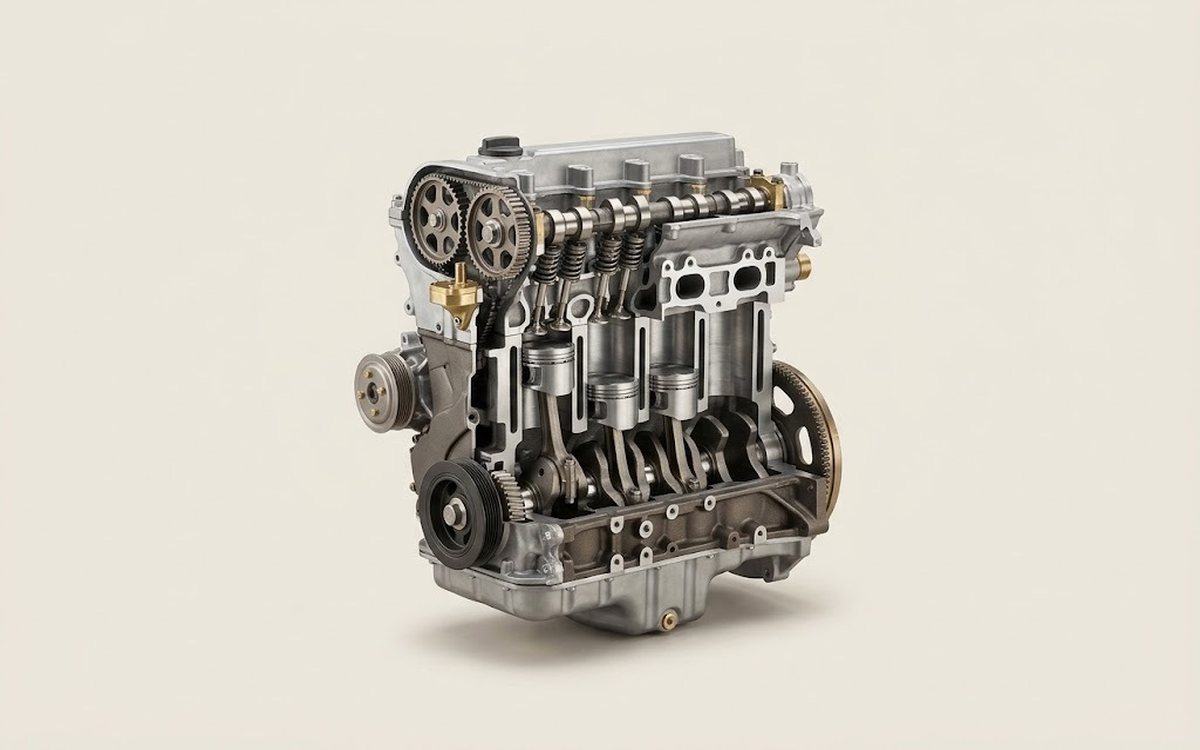 How it works · 3D
How a Car Engine Works
How the part you're working on actually works — in plain English, on a 3D model.
Open in 3D →