Autopapyrus · Nissan Murano 3.5 V6 VQ35DE (2007)
https://autopapyrus.com/guides/nissan/murano/diagnostics-and-engine-overhaul/
https://autopapyrus.com/guides/nissan/murano/diagnostics-and-engine-overhaul/
Compiled automatically from service literature and owner experience. Specs are for the typical configuration — check them against your exact car before you start.
Nissan Murano 3.5 V6 VQ35DE (2007): Diagnostics and Engine Overhaul
The VQ35DE is an aluminum V6 with a timing chain drive, and an "engine overhaul" on it starts with diagnostics, not disassembly. Typical reasons owners come in with the Z50 are high oil consumption, timing chain noise, gasket leaks, and cylinder damage from debris from broken-up catalytic converters. The procedure below goes from diagnostics through a full overhaul and break-in.
Parts
13| № | Part |
|---|---|
| 01 | Full engine gasket set |
| 02 | Timing chain kit (chains, sprockets, tensioners, guides) |
| 03 | Piston rings |
| 04 | Main bearings |
| 05 | Rod bearings |
| 06 | Oil pump |
| 07 | Water pump |
| 08 | Crankshaft seals |
| 09 | Valve covers with gaskets |
| 10 | Oil filter |
| 11 | Engine oil 5W-30, API SM/SN |
| 12 | Coolant |
| 13 | Catalytic convertersif the catalytic converters are breaking up and shedding debris |
Tools
13- socket and wrench set (including long extensions and a universal joint)
- torque wrench
- compression tester
- OBD-II scanner
- borescope (inspection camera)
- bore gauge and micrometers
- feeler gauge
- plastic gauge strip for bearing clearance (Plastigage)
- oil filter wrench
- lift or pit
- engine hoist (engine crane)
- supports for the transmission and jack stands for the body
- engine stand
 There's a full repair manual for this car
Every system, wiring diagrams and torque specs — not just this job. Haynes and 4 more.
See manuals →
Step by step
15 steps- Read the codes with a scanner and look at the freeze-frame data. Codes for valve timing, misfires, fuel trim and catalytic converters will tell you which component is at fault.
- Assess oil consumption. Check the dipstick level after an oil change, then check again after 1,000 km. For this engine, consumption of about 0.5 L (0.53 qt) or more per 1,000 km is a reason to inspect the piston rings and valve stem seals.
- Measure compression on a warm engine. Remove all the spark plugs, disable the fuel supply and ignition, and hold the throttle fully open. The target is about 1300 kPa, the minimum is about 1000 kPa, and the variation between cylinders should be no more than ~100 kPa (exact values are in the Nissan service manual). If compression is low, pour a little oil into the cylinder and measure again: a rise means worn rings, no rise means the valves or the cylinder head.
- Inspect the cylinders with a borescope through the spark plug holes. Scoring on the cylinder walls, light-colored ceramic debris and marks on the pistons are signs that catalyst particles have entered the engine. Also check the catalytic converters themselves (light tapping, rattling sound inside, high exhaust restriction).
- Check the valve timing. Loud chain noise on a cold start and crankshaft/camshaft correlation codes mean worn chains, tensioners and guides. Replacing the chains requires removing the front cover of the engine.
- Find the leaks. Typical places are the valve cover gaskets, front cover, crankshaft seals and oil pan. If the engine is otherwise healthy, limit the job to replacing gaskets and seals without a full overhaul.
- If you decide on an overhaul, prepare the vehicle. Disconnect the battery, drain the oil and coolant, remove the engine undercover, the grille and the bumper if needed, the radiator, air ducts, accessories, and the exhaust manifolds with the catalytic converters, and remove the fuel rail (after relieving fuel pressure). Label or photograph marks and connectors.
- Remove the engine. On the Z50 the engine is mounted transversely together with the CVT. Determine the removal method (up, or down with the subframe) and the attachment points from the Nissan service manual for your trim. Secure the engine with the hoist and the body with jack stands. Work only on a lift.
- Disassemble the engine on the stand. Before removing the chains, mark the position of the links and sprockets using the timing marks (VQ timing chains have colored marks). Remove the covers and cylinder heads in the reverse order of the tightening sequence to avoid warping the sealing surface.
- Inspect and measure the parts. Measure the cylinders with a bore gauge (out-of-round, taper), the crankshaft journals with a micrometer, and bearing clearances with plastic gauge strip. Check the flatness of the cylinder head and block with a straightedge, and check the condition of the valves, guides, lifters and camshafts. If anything is out of tolerance (per the Nissan service manual), have the block bored and honed, the journals ground, and undersize bearings fitted, or replace the cylinder head.
- Replace everything as a set: all gaskets and seals, chains with guides and tensioners, rings, bearings, valve stem seals, the oil pump and the water pump. Wash all parts before assembly, degrease the surfaces, and lubricate the sliding parts with engine oil.
- Assemble the engine in the reverse order. Tighten the cylinder head fasteners, main bearing caps and connecting rod caps strictly in the specified sequence and stages with a torque wrench. The VQ35DE uses a multi-stage procedure; take the N·m values (and lb-ft equivalents) from the Nissan service manual. Do not tighten "by feel" and do not use an air impact wrench.
- Set the timing using the marks. Check that the marks on the chains and sprockets line up by turning the crankshaft by hand through two full revolutions, and make sure the valves do not contact the pistons.
- Install the engine, connect the accessories, fill with fresh oil and a new filter and with coolant, and bleed the air from the cooling system. Before the first start, crank the engine with the starter with the ignition disabled until oil pressure appears.
- Break-in. Make the first start at idle and monitor oil pressure, leaks and temperature. For the first 1,000-1,500 km, avoid high rpm and heavy loads, then change the oil and filter.
Common mistakes and warnings
- If there are signs that the catalytic converters are breaking up, replace them before starting the rebuilt engine, or the debris will get into the cylinders again
- Removing the engine together with the CVT and working with an engine hoist are dangerous; if you lack experience, leave removal and installation to a specialist shop
- Do not work near an open flame close to the fuel system
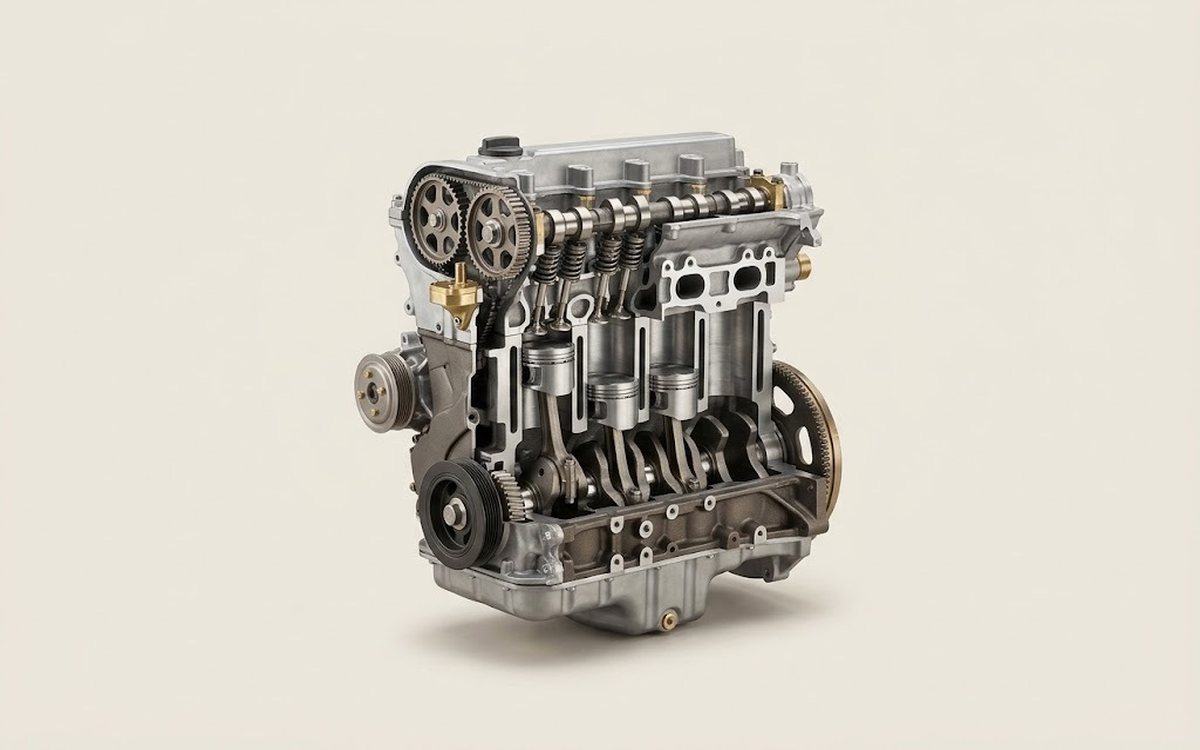 How it works · 3D
How a Car Engine Works
How the part you're working on actually works — in plain English, on a 3D model.
Open in 3D →