Autopapyrus · Toyota Mark II 2.0 (1G-FE) (1996)
https://autopapyrus.com/guides/toyota/mark-ii/timing-belt-replacement/
https://autopapyrus.com/guides/toyota/mark-ii/timing-belt-replacement/
Compiled automatically from service literature and owner experience. Specs are for the typical configuration — check them against your exact car before you start.
Toyota Mark II 2.0 (1G-FE) (1996): Timing Belt Replacement
The 1G-FE uses a timing belt that drives both camshafts and the water pump. The factory replacement interval is about 90,000 km, but in practice it is safer to replace the belt every 60,000-70,000 km or every 5 years. The pulleys, water pump and oil seals are replaced along with the belt, because taking apart the front of the engine for the belt alone is not worth it.
Parts
9| № | Part | Alternatives |
|---|---|---|
| 01 | Timing belt for 1G-FE | Aisin, Gates, Bando |
| 02 | Timing belt tensioner pulley with tensioner | Aisin, Gates, Bando |
| 03 | Timing belt idler pulley | Aisin, Gates, Bando |
| 04 | Water pump (timing belt driven) | Aisin, Gates, Bando |
| 05 | Front crankshaft oil seal | |
| 06 | Front camshaft oil seals | |
| 07 | Water pump gasket or O-ring | |
| 08 | Coolant | |
| 09 | Accessory drive belt | Aisin, Gates, Bando |
Tools
8- socket set and ratchet
- torque wrench
- long breaker bar or impact wrench for the crankshaft pulley bolt
- pulley puller (if needed)
- screwdrivers
- coolant drain pan
- rags
- paint or marker for alignment marks
Step by step
14 steps- Park the car on level ground, shut off the engine and let it cool down. Disconnect the negative battery terminal. Chock the wheels.
- Drain the coolant from the radiator and the engine block. Remove the air duct and hoses that block access to the front of the engine. Remove the fan with its clutch or the electric fan, and the radiator shroud, if they cover the water pump and pulleys.
- Remove the accessory drive belts (alternator, power steering, A/C): loosen the adjuster bolts and move the units aside. Note the belt routing.
- Remove the water pump pulley and, if necessary, the crankshaft pulley. The crankshaft pulley bolt is very tight: lock the crankshaft against rotation and loosen the bolt with a breaker bar, since impact loads on the engine are undesirable. Tightening torque during assembly is about 120-130 N·m (89-96 lb-ft) (check the manufacturer's manual).
- Remove the upper timing belt cover, then the lower one. Keep the rubber seals of the covers and replace them if they are worn.
- Turn the crankshaft clockwise (in its normal direction of rotation) by the pulley bolt until the mark on the crankshaft sprocket lines up with the mark on the block (cylinder 1 piston at TDC on the compression stroke). The marks on both camshaft pulleys must line up with the marks on the cover or cylinder head. If the marks are not visible, mark the belt position on the pulleys with paint.
- Release the tensioner and lock it in the retracted position. Remove the old belt. Do not turn the crankshaft or camshafts while the belt is removed.
- Remove the tensioner pulley, the idler pulley and the water pump. Wipe the mating surfaces clean. Check the crankshaft and camshaft oil seals for oil leaks and replace them. Install the new water pump with a new seal and tighten the bolts evenly (approximately 8-20 N·m (6-15 lb-ft); the exact value depends on the bolt size, so check the manual).
- Install the new pulleys and tensioner. Check that the bearings spin without noise or binding.
- Check that all the marks still line up. Fit the new belt in the order given in the manual: first onto the crankshaft sprocket, then onto the pulleys, the camshaft pulleys, the water pump and the tensioner, keeping the slack on the drive side to a minimum. All marks must stay in place.
- Release the tensioner and let it tension the belt. Turn the crankshaft two full revolutions in its normal direction of rotation and make sure the marks line up again at TDC. If the marks are off, remove the belt and move it by one tooth.
- Install the lower and upper covers, the crankshaft pulley (torque 120-130 N·m (89-96 lb-ft), check the manual), the water pump pulley, the fan and the accessory drive belts with the correct tension (deflection of about 10 mm under a force of about 10 kg).
- Fill with new coolant and bleed the cooling system of air pockets. Warm the engine up until the thermostat opens, then check the temperature, look for leaks and check the coolant level. Top up the coolant as needed.
- Reconnect the battery, start the engine and listen to the belt (there should be no squealing or grinding). Check the timing marks after 500-1,000 km of driving, and also check the condition of the belt and tensioner.
Common mistakes and warnings
- Incorrect timing marks will cause wrong valve timing and possible contact between valves and pistons
- If you are not sure the marks are set accurately, take the car to a repair shop
- Do not use water or coolant of questionable quality: the water pump driven by this belt runs constantly
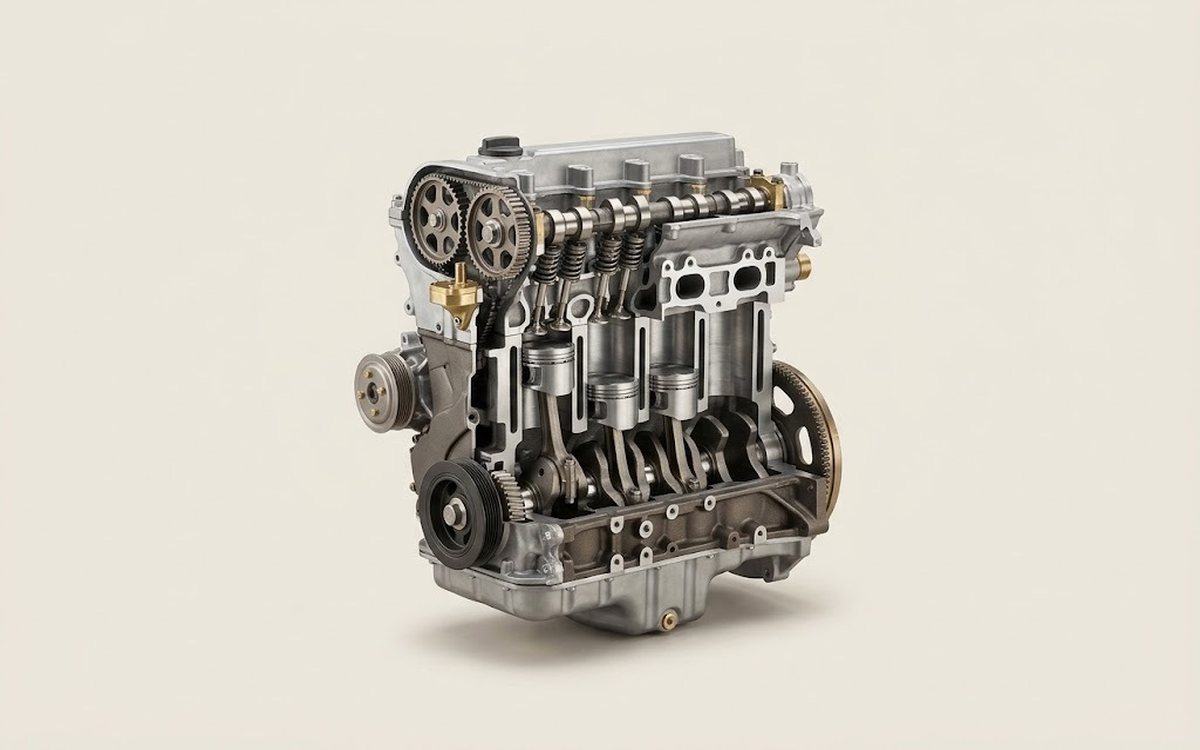 How it works · 3D
How a Car Engine Works
How the part you're working on actually works — in plain English, on a 3D model.
Open in 3D →