https://autopapyrus.com/catalog/nissan/note/guides/partial-cvt-fluid-change/
Nissan Note 1.6 (HR16DE) (2011): Partial CVT Fluid Change
On the Note E11 with the 1.6 engine, the "automatic" is a CVT (continuously variable transmission), not a conventional hydraulic-mechanical automatic. A partial fluid change renews only the portion of fluid that drains out through the plug (roughly 3-4 liters (3.2-4.2 qt) of the total capacity). It is done as maintenance between full changes. Only NS-2 fluid may be used. Other fluids damage the CVT and are not covered by the warranty.
Key figures
- Fluid temperature when checking the levelthis is the temperature at which the level is checked with the dipstick (steps 7-8); cold fluid will give an incorrect reading50-80 °C
- Fluid typeother fluids damage the CVT and void the warranty (step 6)only Nissan CVT NS-2
Check these values against the manufacturer’s specification for your vehicle before you start.
Diagram: where the CVT pan and drain plug are
- 1CVT pan: the black pan to the right of the cast housing. The plug is on it. Remove the engine undercover first if fitted.
- 2CVT drain plug: sticks out of a boss at the lower part of the pan. Place a graduated container, unscrew the plug and let the oil drain. Tighten to about 30-35 Nm, do not overtighten.
- 3New sealing washer: fitted on the plug when tightening. Never reuse the old one.
- 4Engine oil pan: a landmark on the left. It is not the CVT, so do not touch it.
- 5CVT housing: the cast housing between the two pans. A landmark so you do not mix up the units.
Parts
2| № | Part | Genuine part no. |
|---|---|---|
| 01 | Nissan CVT Fluid NS-2Find on Amazon → | |
| 02 | CVT drain plug sealing washernewFind on Amazon → | 11026-01M02 |
Amazon links search by the part name and genuine number; use Amazon's fit check for your car before ordering. We may earn a commission from qualifying purchases.
Part numbers are from the manufacturer's original catalogue. Check them against your VIN before ordering.
Tools
7Read the codes yourself
A scanner plugged into the OBD2 port under the dashboard shows which fault codes the car has stored, before you buy any parts. Cars sold in the US from 1996, and petrol cars in Europe from 2001 (diesels from 2004), have this port.
- Basic code reader, about $20–40: reads and clears engine codes Amazon →
- Bluetooth scanner with a phone app, about $30–100: live sensor data, and on many cars ABS and airbag codes too Amazon →
Check that the scanner lists your make and model year before you buy. We may earn a commission from qualifying purchases.
 There's a full repair manual for this car
Every system, wiring diagrams and torque specs — not just this job. Haynes and 3 more.
See manuals →
Step by step
10 steps- Warm up the car with a short drive so the CVT fluid is warm and drains better. Park the car on a level pit or lift, apply the parking brake, and put the selector in P.
- If you have access to the CVT dipstick, check the level on warm fluid and note it. This helps you judge how much fluid came out and how much to add back. Inspect the fluid: dark fluid, a burnt smell, or metallic particles are grounds for diagnosis, not just a fluid change.
- Remove the underbody skid plate if one is fitted, and locate the drain plug on the CVT pan.
- Place the graduated container underneath and remove the plug. Let the fluid drain completely and record the exact drained volume: that is exactly how much you need to put back.
- Wipe the plug and its seat. Install the plug with a new sealing washer; never reuse the old washer. Tightening torque is approximately 30-35 N·m (22-26 lb-ft); verify the exact value against the manufacturer's specification. Do not overtighten: the threads in the aluminum pan strip easily.
- Through the dipstick tube, pour in fresh NS-2 using the funnel with the hose, in the same amount you drained. Shake the container before filling. Do not spill fluid onto hot exhaust components.
- Start the engine. With your foot on the brake, hold the selector in each position (P, R, N, D) for a few seconds, then return to P. Then bring the CVT up to temperature: in city driving at an air temperature of about 20 °C, this takes about 10 minutes. The level is checked at a fluid temperature of 50-80 °C.
- On level ground, with the engine running and the selector in P, check the level with the dipstick against the hot marks. If necessary, top up in small amounts and recheck. Do not overfill.
- Check the plug for leaks and refit the skid plate.
- If the drained fluid is heavily contaminated, the procedure can be repeated after a few hundred kilometers: each partial change renews only part of the fluid. If the CVT control unit stores the date of the last fluid change, it is reset with a diagnostic scan tool (at a repair shop).
Common mistakes and warnings
- Do not mix NS-2 with other fluids and do not add universal fluid meant for conventional automatic transmissions: the CVT is critical about fluid type
- A level that is too low or too high is dangerous for the CVT
- If you have no experience checking the level on warm fluid, it is better to leave the job to a repair shop
- The torque values and capacities above are approximate; verify the exact values against the manufacturer's specification
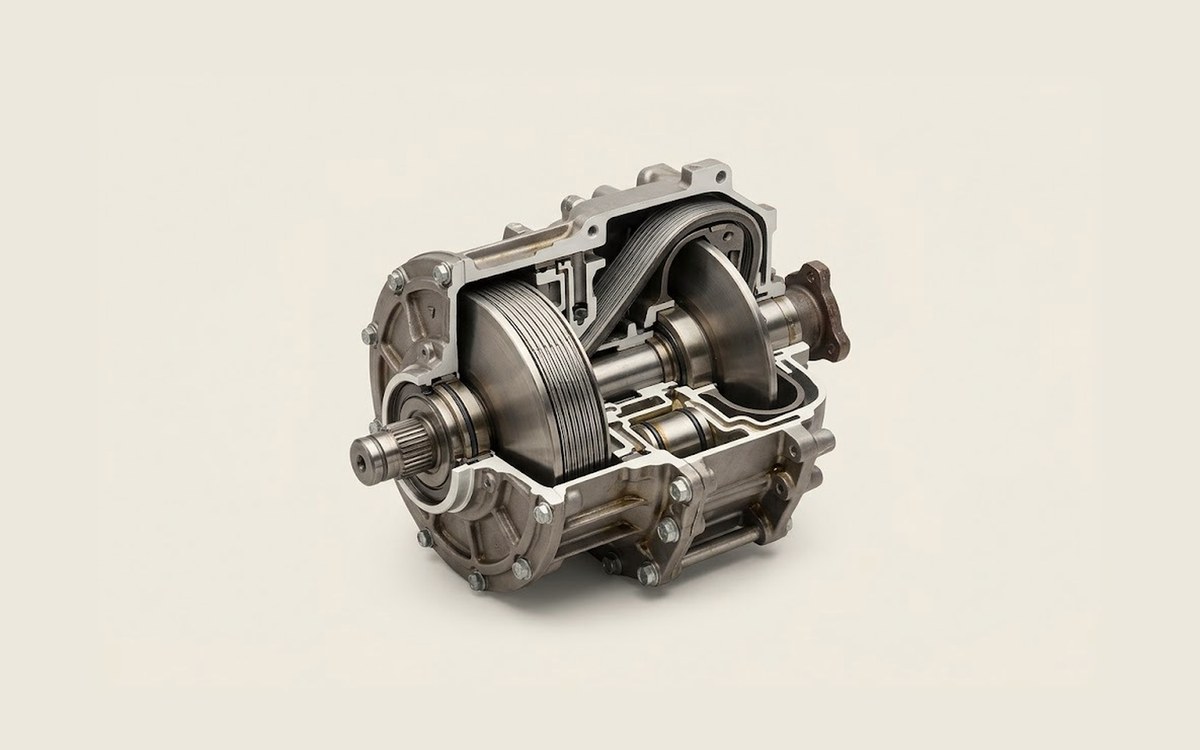 How it works · 3D
How a CVT Works
How the part you're working on actually works — in plain English, on a 3D model.
Open in 3D →
Spotted a mistake? Tell us →
Our articles
 Brand stories
The History of Nissan
Over the course of 80 years, this Japanese automaker has come a long way and risen to become a leader of the global…
Read →
 Garage
Fuel Quality Indicators: What Octane and Cetane Numbers Mean
What is an octane number? What about a cetane number? Which fuel should you choose for a high-compression engine?…
Read →
 Before you buy
How to Pick Up Your Car from the Dealership the Right Way
If you've decided to buy a car from a dealership, it isn't enough to simply choose a model you like, pay for it, and…
Read →