https://autopapyrus.com/catalog/toyota/crown/guides/coolant-replacement/
Toyota Crown 2.5 Hybrid (2018): Coolant Replacement
The 2018 Crown, S220 generation, with the 2.5-liter hybrid has the A25A-FXS hybrid powertrain. This is the hybrid version of the same 2.5 L engine that is called A25A-FKS in the non-hybrid version. This car has two cooling circuits: the engine and the power electronics (inverter and power management control unit). Fill only with an organic hybrid-type coolant such as Toyota SLLC, and do not mix it with red or green antifreezes of other types. The approximate capacity of the engine circuit is about 6 L (6.3 qt), and the power electronics circuit is separate, about 1.8 L (1.9 qt). Check the exact capacities and the replacement interval against the manufacturer's maintenance schedule.
Parts
4| № | Part |
|---|---|
| 01 | Toyota Super Long Life Coolant (SLLC), pink, premixed 50/50, protection down to about -35 °C (-31 °F)Find on Amazon → |
| 02 | Toyota Super Long Life Coolant (SLLC) concentrate, pinkalternative to premixed; dilute with deionized waterFind on Amazon → |
| 03 | Deionized waterfor diluting the concentrateFind on Amazon → |
| 04 | Drain plug sealing washersif the design uses themFind on Amazon → |
Amazon links search by the part name; use Amazon's fit check for your car before ordering. We may earn a commission from qualifying purchases.
Tools
8- jack and jack stands or a lift Amazon →
- wrench or socket for the radiator drain plug Amazon →
- flat-head screwdriver Amazon →
- drain pan of at least 10 L (10.6 qt) Amazon →
- funnel Amazon →
- gloves Amazon →
- rags Amazon →
- diagnostic scan tool with active test function (recommended for bleeding the hybrid system) Amazon →
Read the codes yourself
A scanner plugged into the OBD2 port under the dashboard shows which fault codes the car has stored, before you buy any parts. Cars sold in the US from 1996, and petrol cars in Europe from 2001 (diesels from 2004), have this port.
- Basic code reader, about $20–40: reads and clears engine codes Amazon →
- Bluetooth scanner with a phone app, about $30–100: live sensor data, and on many cars ABS and airbag codes too Amazon →
Check that the scanner lists your make and model year before you buy. We may earn a commission from qualifying purchases.
Step by step
12 steps- Shut off the engine, put the vehicle in OFF mode, and let the system cool for at least one hour. Open the hood. The system is under pressure, so do not open the cap when the engine is hot.
- Park the vehicle on a level surface or a lift. If you are raising it with a jack, use jack stands. Remove the lower plastic cover that protects the radiator and the oil pan.
- Place the drain pan under the radiator. Open the reservoir cap and the radiator cap, if your vehicle has one, so the coolant can drain freely.
- Remove the drain plug at the bottom of the radiator, or disconnect the lower hose if there is no plug. Drain the coolant completely. If there is a drain plug on the engine block, drain through it as well.
- Drain the power electronics circuit separately if it has a drain fitting. If it does not, only the engine circuit coolant will be replaced, and a complete replacement will require shop equipment.
- Drain the coolant from the reservoir, remove it if necessary, and rinse out any sediment with clean water.
- Close all the drain points. Tighten the plugs carefully, without overtightening them in the aluminum threads. Check the exact tightening torque against the manufacturer's maintenance schedule.
- If you need to flush the system, fill it with deionized water, warm the system up, and drain it. Repeat until clean water comes out of the system. Do not use ordinary tap water, because it leaves scale.
- Prepare the coolant. If you have concentrate, dilute it with deionized water in the ratio specified on the container. Fill slowly through the radiator filler neck or through the reservoir to the FULL level.
- Turn the ignition to READY mode. On a hybrid, the engine does not start right away, so you need to make it run in order to bleed the system. To do this, you can use the active test function on the scan tool, or leave the vehicle in READY mode with the heater on maximum. Monitor the level in the reservoir and top it up.
- Once the engine has started and warmed up and the fan has shut off, let the vehicle cool down and check the level again. If the coolant has settled, top it up to the FULL mark. Turn the heater to maximum to make sure the heater blows hot air. If the air is cold, an air pocket remains in the system, and the bleeding must be repeated.
- Reinstall the cover. After a few days of driving, check the coolant level with the engine cold and inspect the connections for leaks.
Common mistakes and warnings
- On a hybrid, the high-voltage components are located near the power electronics cooling circuit
- Do not touch the orange high-voltage cables and connectors
- If you are not confident in your abilities, take the vehicle to a repair shop
- Coolant is toxic, so do not leave it in open containers, and dispose of it at a collection facility
- Tightening torques are not given in this guide, so check the exact values for your vehicle against the manufacturer's maintenance schedule
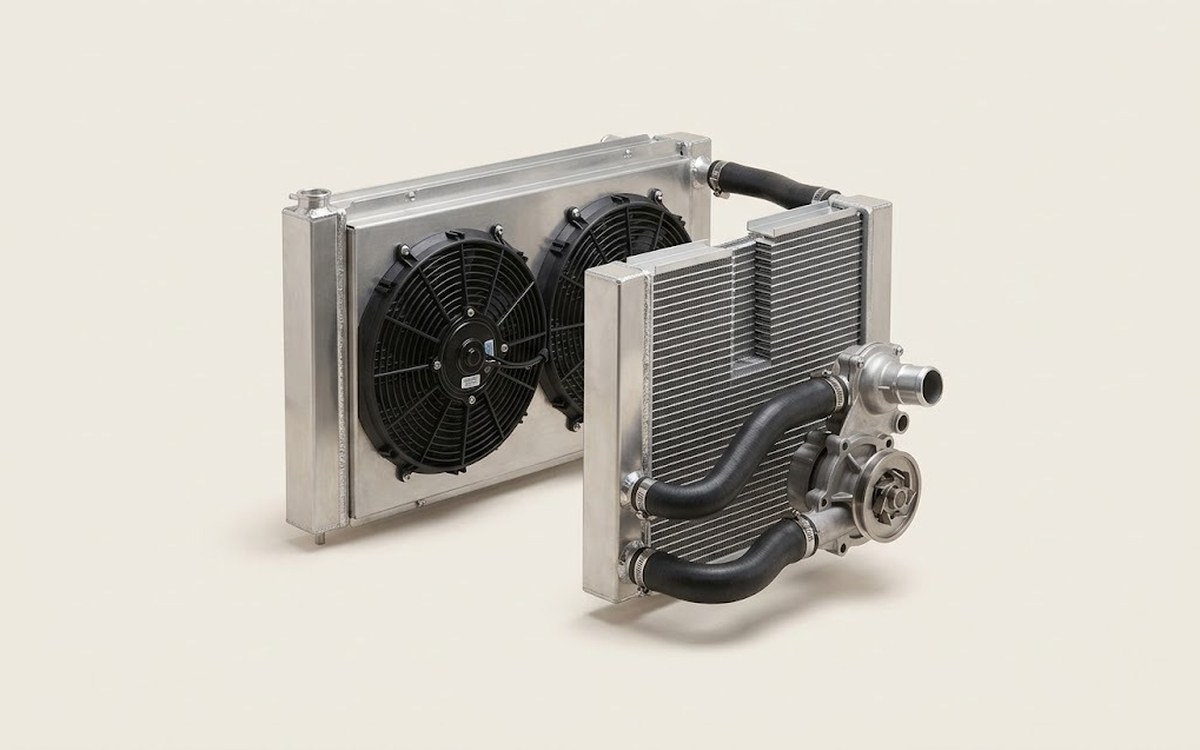 How it works · 3D
How the Engine Cooling System Works
How the part you're working on actually works — in plain English, on a 3D model.
Open in 3D →
Spotted a mistake? Tell us →
Our articles
 Brand stories
The History of Toyota
From weaving looms to reliable mass-produced cars.
Read →
 Garage
Fuel Quality Indicators: What Octane and Cetane Numbers Mean
What is an octane number? What about a cetane number? Which fuel should you choose for a high-compression engine?…
Read →
 Before you buy
How to Pick Up Your Car from the Dealership the Right Way
If you've decided to buy a car from a dealership, it isn't enough to simply choose a model you like, pay for it, and…
Read →