Autopapyrus · Ford Focus 1.8 Duratec HE (2004)
https://autopapyrus.com/guides/ford/focus/coolant-replacement/
https://autopapyrus.com/guides/ford/focus/coolant-replacement/
Compiled automatically from service literature and owner experience. Specs are for the typical configuration — check them against your exact car before you start.
Ford Focus 1.8 Duratec HE (2004): Coolant Replacement
The 1.8 Duratec HE cooling system holds about 6-7 L (6.3-7.4 qt), and most of the coolant can be drained through the lower hose or the radiator drain plug. Fill only with antifreeze of the same type and specification as what was in the system, and do not mix different classes. After filling, be sure to bleed the air out of the system.
Parts
3| № | Part | Genuine part no. | Alternatives |
|---|---|---|---|
| 01 | Coolant concentrate Ford WSS-M97B44-D (Ford Super Plus)or premixed coolant | Motorcraft, Castrol, Total, Shell | |
| 02 | Distilled waterfor 50/50 dilution of concentrate, if needed | ||
| 03 | Expansion tank capif the seal is damaged | 1301104 |
Part numbers are from the manufacturer's original catalogue. Check them against your VIN before ordering.
Tools
6- 8-10 L (8.5-10.5 qt) drain container
- funnel
- screwdriver or pliers for hose clamps
- flat-head screwdriver
- gloves
- water container for flushing (optional)
 There's a full repair manual for this car
Every system, wiring diagrams and torque specs — not just this job. Haynes and 25 more.
See manuals →
Step by step
13 steps- Work on a completely cold engine. Park the car on level ground, shut off the engine, and wait at least 1-2 hours. Never open the cap on a hot system: you could be burned by steam and hot coolant.
- Open the hood and, if necessary, remove the decorative engine cover. Slowly unscrew the expansion tank cap to release any residual pressure.
- Remove the engine undertray if one is installed. Locate the lower radiator hose and the drain plug at the bottom of the radiator on the driver's side.
- Place the drain container underneath. Unscrew the radiator drain plug (plastic; turn it by hand only, without force) or disconnect the lower hose from the radiator by loosening the clamp. Drain the coolant completely.
- For a more complete drain, you can loosen the clamp and disconnect the heater hose or the expansion tank hose. Some coolant remains in the engine block and heater core, so if the coolant is badly contaminated, flush the system: fill with distilled water, warm up the engine with the heater on, let it cool, and drain. Repeat until clean water comes out of the system.
- Reinstall the hose or drain plug and tighten the clamp. Tighten clamps moderately, without stripping the thread or pinching the hose.
- Prepare the mixture. Pour in premixed coolant as is. Dilute concentrate with distilled water about 50/50 (for temperatures below -35 °C (-31 °F), up to 60/40 is acceptable, but no more).
- Pour the coolant into the expansion tank slowly, in a thin stream, to avoid air pockets. Fill to the MAX mark.
- With the cap off, start the engine and run it at 2000-2500 rpm to warm it up. Set the heater to maximum heat and defrost airflow. Watch the level in the tank and top up as air escapes. Wait for the radiator fan to switch on and the thermostat to open: the upper hose will become hot.
- Carefully rev the engine to 3000 rpm a few times, then shut it off. Close the tank cap once no bubbles are visible in the tank.
- Install the undertray and the decorative cover, and check for leaks at the drain plug and clamps.
- After a day or two, check the level on a cold engine and top up to between the MIN and MAX marks if necessary. If the heater output is weak or the temperature gauge jumps around, air is still in the system: repeat the warm-up and top-up procedure.
- Take the used coolant to a recycling facility: antifreeze is toxic and must not be poured onto the ground or down a drain.
Common mistakes and warnings
- Do not mix different types of antifreeze, and do not use coolant that lacks the Ford WSS-M97B44-D specification or a suitable equivalent
- If the system has not been serviced for a long time and you see a brown film or sediment in the tank, flush the system before filling with new antifreeze
- If the engine overheats after the replacement or the level keeps dropping, take the car to a repair shop: the water pump, thermostat, head gasket, or a leak may be at fault
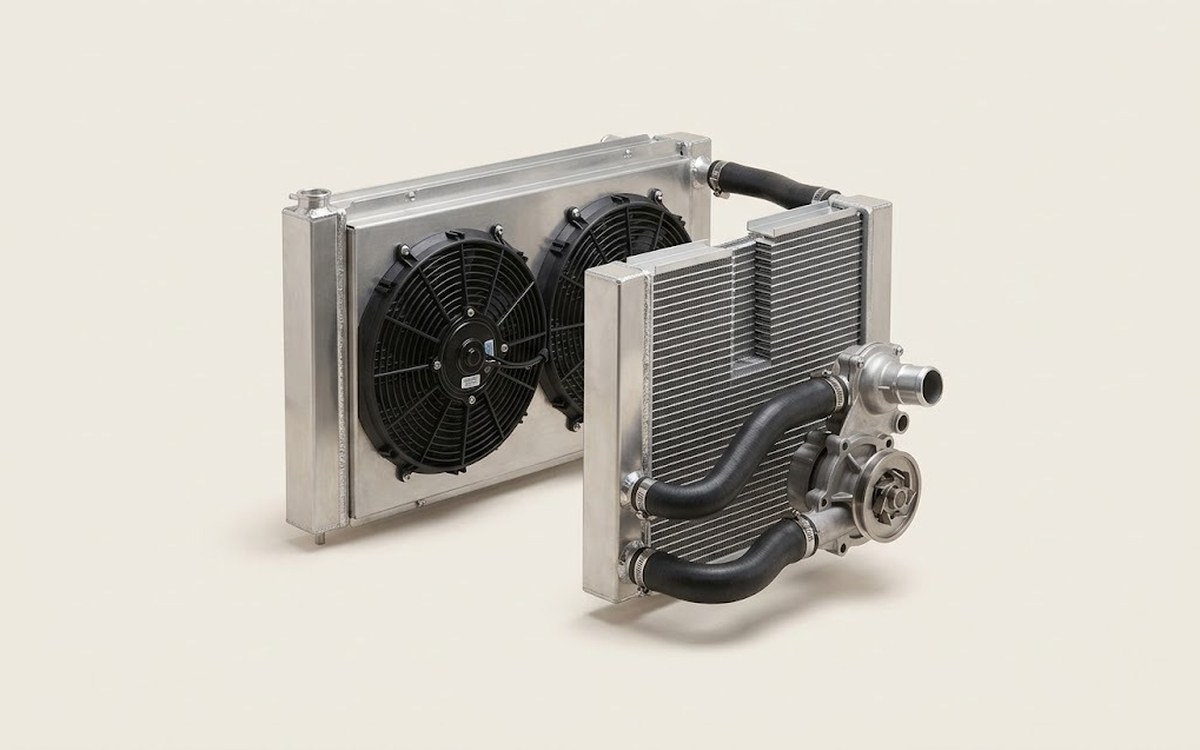 How it works · 3D
How the Engine Cooling System Works
How the part you're working on actually works — in plain English, on a 3D model.
Open in 3D →