Autopapyrus · Honda Accord 1.8 F18B (2000)
https://autopapyrus.com/guides/honda/accord/coolant-antifreeze-replacement/
https://autopapyrus.com/guides/honda/accord/coolant-antifreeze-replacement/
Compiled automatically from service literature and owner experience. Specs are for the typical configuration — check them against your exact car before you start.
Honda Accord 1.8 F18B (2000): Coolant (Antifreeze) Replacement
The total cooling system capacity of the F18B is about 5.8 L (6.1 qt). The coolant should be replaced about every 5 years or 75,000 km. Only do this job on a completely cold engine.
Parts
3| № | Part |
|---|---|
| 01 | Honda Type 2 coolant (ethylene glycol, silicate-free)about 3 L (3.2 qt) of concentrate for a 50/50 mix, or about 6 L (6.3 qt) of premixed |
| 02 | Radiator drain plug washerif needed |
| 03 | Radiator capif needed |
Tools
7- Wrench or socket for the radiator drain plug (usually 10-12 mm)
- screwdriver
- drain pan with a capacity of 7-8 L (7.4-8.5 qt)
- funnel
- gloves
- safety glasses
- distilled water for flushing
 There's a full repair manual for this car
Every system, wiring diagrams and torque specs — not just this job. Haynes and 18 more.
See manuals →
Step by step
15 steps- Park the car on a level surface, apply the parking brake, and wait until the engine has cooled down completely. This is important: the system is under pressure, and hot coolant causes burns.
- Turn the ignition on, set the heater control to maximum heat, and turn the ignition off. This lets the coolant drain from the heater core as well.
- Open the hood and carefully remove the radiator cap. You can also open the cap of the coolant reservoir.
- If the car has an engine undercover, remove it. Place the drain pan under the radiator.
- Open the drain plug at the bottom of the radiator (on the left side in the direction of travel) and drain the coolant. For a more complete drain, you can also unscrew the plug on the engine block, below the exhaust manifold. If the plugs do not come loose, do not force them, to avoid stripping the threads.
- Empty the coolant reservoir: remove the reservoir or disconnect its hose. Rinse the reservoir with water and reinstall it.
- Optionally, flush the system: close the plugs, fill with distilled water, warm up the engine with the heater on, shut it off, let it cool, and drain the water. Repeat until the water coming out is clean.
- Install the drain plugs with serviceable washers. The tightening torque is low, about 20-30 N·m (15-22 lb-ft) for the radiator and block plugs (check the manufacturer's service manual for the exact value). Do not overtighten, especially the radiator plug, which is plastic.
- Prepare a 50/50 mix of concentrate and distilled water (up to 60/40 is acceptable for very cold climates). Slowly pour it into the radiator all the way up to the filler neck.
- Fill the coolant reservoir to the MAX mark. Do not close the radiator cap yet.
- Start the engine with the radiator cap open and the heater on maximum. Let the engine run until the thermostat opens and the fan turns on. The level in the radiator will drop as air escapes from the system. Top up periodically and hold the engine speed at about 2000 rpm.
- When the level stops dropping and no more bubbles come out of the filler neck, top up to the neck and close the radiator cap.
- Shut off the engine, let it cool, and check the level in the coolant reservoir. Top up to the MAX mark if necessary.
- Check for leaks at the drain plugs and hoses. For the next few days, check the level on a cold engine. If the level drops, air may still be trapped in the system. Keep topping up and watch the temperature.
- Take the used coolant to a recycling facility. Do not pour it on the ground, as it is toxic and dangerous to animals.
Common mistakes and warnings
- Never open the radiator cap on a hot engine
- Do not mix coolants of different types or colors, and do not use tap water for dilution
- If the engine overheats after the replacement and the heater blows cold air, an air pocket remains in the system and must be bled out
- Do not keep driving while the engine is overheating, or the cylinder head may warp
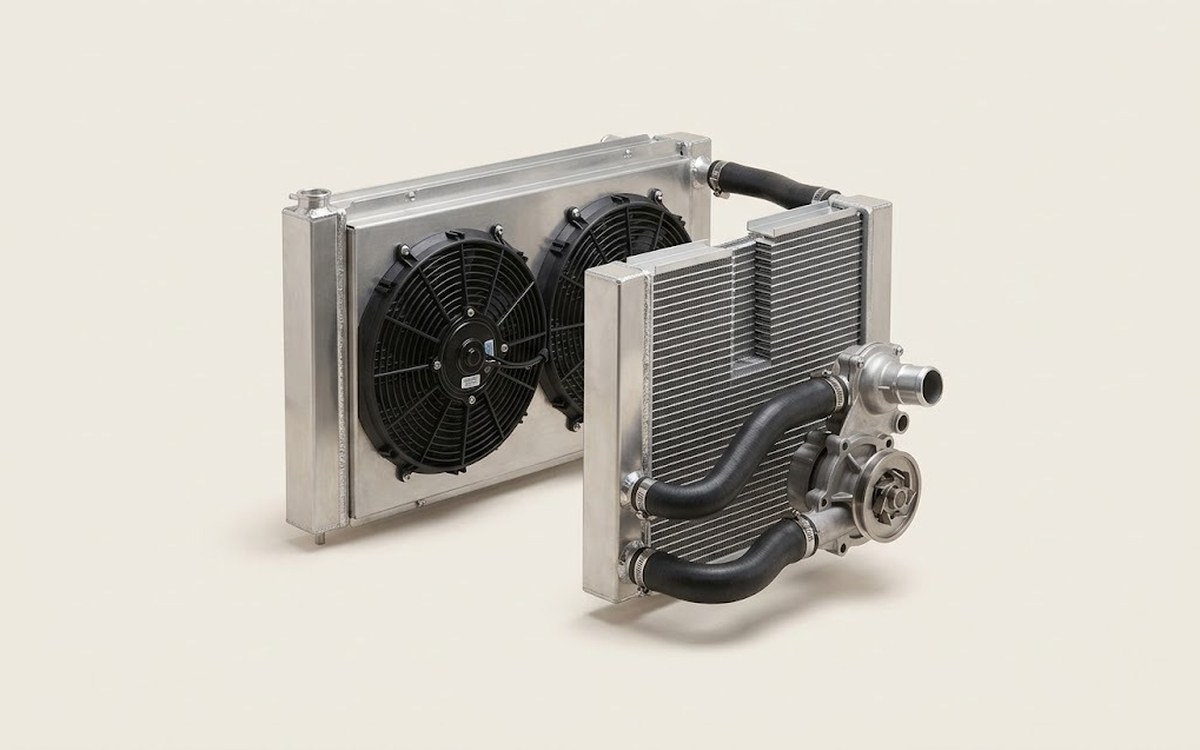 How it works · 3D
How the Engine Cooling System Works
How the part you're working on actually works — in plain English, on a 3D model.
Open in 3D →