Autopapyrus · Renault Laguna III
https://autopapyrus.com/guides/renault/laguna/rear-brake-disc-replacement/
https://autopapyrus.com/guides/renault/laguna/rear-brake-disc-replacement/
Compiled automatically from service literature and owner experience. Specs are for the typical configuration — check them against your exact car before you start.
Renault Laguna III: Rear Brake Disc Replacement
The Laguna III has an electronic parking brake (EPB), so the caliper pistons must be put into service mode before replacing the discs. The rear discs come as an assembly with the wheel bearing and ABS sensor ring. The rear caliper piston is not pushed in. It must be wound back with a special tool.
Part
- 🔩 Rear brake discs with wheel bearing and ABS sensor ring (diameter 300 mm, thickness 11 mm, minimum thickness 9.5 mm). Options: SNR KF15590U, Stellox 60201688SX with PATRON PBK6799 bearings, LPR R1032PCA. Rear brake pads (Mando MPA08, NK 222562 or equivalent)
 There's a full repair manual for this car
Every system, wiring diagrams and torque specs — not just this job. Haynes and 3 more.
See manuals →
Step by step
16 steps- Loosen the lug bolts, raise the rear of the vehicle with a jack, and remove the wheel.
- Put the EPB into service mode: engage a gear (manual transmission) or move the selector to P (automatic transmission). Press the brake pedal and hold it for 1 second. Without releasing the brake pedal, press the accelerator pedal for 1 second. While holding both pedals, press the parking brake button. The red LED will start flashing. Within 5 seconds, press the parking brake button again to retract the caliper pistons.
- Remove the caliper guide bolts with a 7 mm hex bit, move the caliper aside, and secure it with wire. Do not let it hang from the brake hose.
- Remove the old pads and inspect the caliper guide pins. Clean off any dirt under the rubber boots and lubricate them with copper grease.
- Remove the two bolts securing the caliper bracket to the steering knuckle with an 18 mm socket (tightening torque on assembly: 105 N·m (77 lb-ft)).
- Remove the central hub nut with a 36 mm socket. Use an extension or a breaker bar to overcome the tightening torque of 175-280 N·m (129-207 lb-ft).
- Remove the old disc from the hub and inspect the brake lines on the axle beam. Corrosion is common at the mounting point, so check for cracks before starting reassembly.
- If you bought a disc without a bearing, press the new bearing (PATRON PBK6799 or equivalent) into the new disc and transfer the ABS sensor ring from the old disc to the new one.
- Fit the new disc onto the hub and tighten the central nut to 175-280 N·m (129-207 lb-ft). Check the service documentation for the exact value, as different sources give a range. Secure the nut with a cotter pin or by locking it as the design requires.
- Install the caliper bracket on the steering knuckle and tighten the bolts to 105 N·m (77 lb-ft).
- Wind the rear caliper piston back with the special tool. Turn it clockwise until it stops. Simply pushing it in will not work.
- Install the new pads in the caliper bracket, put the caliper back in place, and tighten the guide bolts with the 7 mm hex bit to 35-40 N·m (26-30 lb-ft).
- Exit EPB service mode. Repeat the procedure from step 2, but replace the last press of the parking brake button with pulling the button up to apply the brake.
- Install the wheel, tighten the bolts to 110 N·m (81 lb-ft) in a crisscross pattern, and lower the vehicle.
- Press the brake pedal firmly to the floor several times to seat the pads. Check the brake fluid level in the reservoir and top it up to the MAX mark if needed.
- Bed in the brakes. For the first 200-300 km, avoid hard braking so the pads can wear in against the discs.
Common mistakes and warnings
- On some Laguna III Phase 2 versions, the ABS-EPB module is locked against manual entry into service mode. You will need a Renault CLIP diagnostic scanner or equivalent. Before loosening the brake line fittings, treat the threaded connections with WD-40 a day in advance, because corrosion can cause the line to snap. Brake system work is safety-critical. If you are unsure of your skills, take the car to a repair shop.
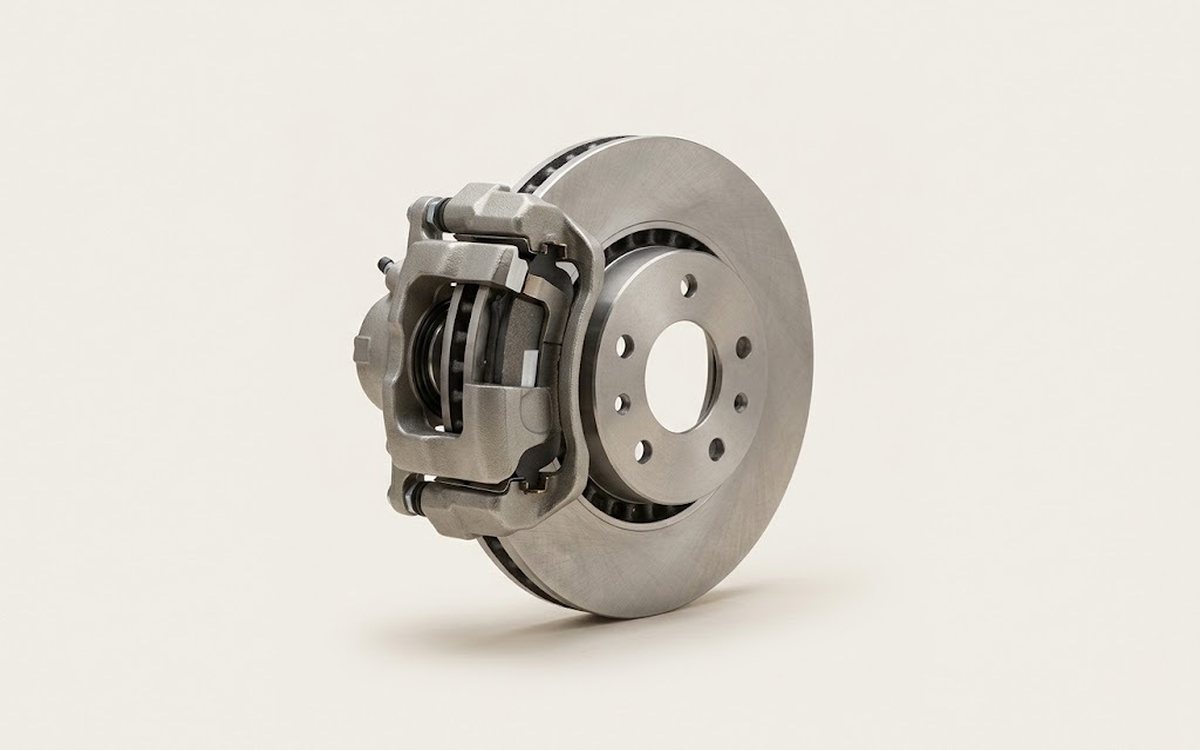 How it works · 3D
How Car Brakes Work
How the part you're working on actually works — in plain English, on a 3D model.
Open in 3D →