Autopapyrus · Land Cruiser 200
https://autopapyrus.com/guides/toyota/land-cruiser/front-shock-absorber-strut-replacement/
https://autopapyrus.com/guides/toyota/land-cruiser/front-shock-absorber-strut-replacement/
Compiled automatically from service literature and owner experience. Specs are for the typical configuration — check them against your exact car before you start.
Land Cruiser 200: Front Shock Absorber (Strut) Replacement
The front shock absorbers on the Land Cruiser 200 work together with an independent double-wishbone suspension. The job is done with the wheels hanging and the control arm unloaded. Exact torque values and the design of the assembly depend on the trim and suspension type (standard, AHC, KDSS), so check the values against the Toyota service manual for your version. The general work sequence is below.
Parts
5| № | Part | Alternatives |
|---|---|---|
| 01 | Front shock absorber assembly (standard, AHC or KDSS suspension)left and right | KYB, Bilstein, Monroe |
| 02 | Shock mount (upper) | |
| 03 | Bump stop | |
| 04 | Dust boot | |
| 05 | Shock mounting bushings |
Tools
9- Floor jack and two jack stands (or a lift)
- lug wrench
- socket and wrench set (most often 17-22 mm)
- torque wrench
- open-end or ratcheting wrench for the shock rod
- spring compressors (if the spring is mounted on the shock)
- penetrating oil
- ball joint separator or hammer
- shop rags
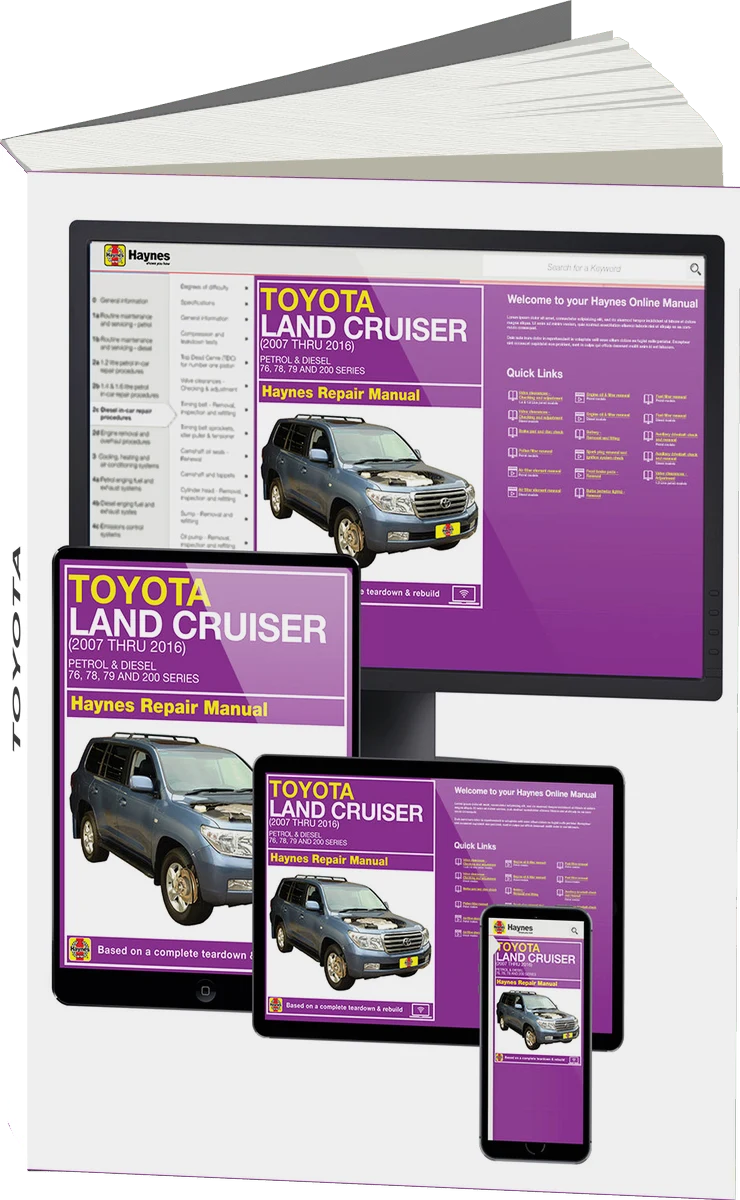 There's a full repair manual for this car
Every system, wiring diagrams and torque specs — not just this job. Haynes and 23 more.
See manuals →
Step by step
13 steps- Park the vehicle on level ground, set the parking brake and chock the rear wheels. Loosen the lug nuts on the front wheels.
- Lift the front axle and place jack stands under the frame or the reinforced body points. Remove the wheel. Place a support under the control arm only if the spring rests on the arm. This unloads the suspension and lets you control its travel.
- Apply penetrating oil to the upper and lower shock mounts and to the rod nut. The threads usually seize.
- If the vehicle has AHC or KDSS, do not open the hydraulic lines or release the pressure unless you know what you are doing. This work is best left to a repair shop. A standard suspension has no hydraulics.
- Disconnect the sensor or actuator connector (if present) and secure the harness so it is not stretched when the control arm is lowered.
- Remove the lower mounting bolt that holds the shock to the control arm. Hold the shock body so it does not drop out. Do not load the control arm and do not let it drop suddenly.
- Open the hood and locate the upper shock mount. It is in the engine bay on the body or frame. While supporting the shock from below, remove the upper mount fasteners. Take the shock out downward and to the side.
- Compare the new shock with the old one: length, mounting points, and the presence of brackets and eyes. Transfer to the new shock any parts that come separately (mount, bump stop, dust boot, bushings). If the spring is mounted on the shock, compress it with spring compressors first and do not remove it without them.
- Replace the worn rod mount, bump stop and dust boot. They wear out along with the shock, and a knocking noise after replacement often comes from them.
- Install the new shock in reverse order. Tighten the upper mount first and only snug the lower one. Tighten the rod nuts and bolts to the torque values in the Toyota service manual for your trim (suspension fasteners of this class usually require roughly 50-150 N·m (37-111 lb-ft), depending on the specific bolt).
- Install the wheel and tighten the lug nuts in a crisscross pattern. Lower the vehicle to the ground and bounce the body a few times.
- Do the final tightening of the lower mount and the other control arm bolts only with the suspension loaded (vehicle on its wheels). Otherwise the bushings will be twisted and will fail quickly.
- After 50-100 km of driving, re-torque the lug nuts and check for leaks and loose mounts. Have the alignment checked after the replacement. If you replaced springs or mounts, an alignment is mandatory.
Common mistakes and warnings
- The suspension and steering are safety-critical systems
- If you have no experience with spring compressors and suspensions, have a repair shop do the replacement
- A loaded spring can cause serious injury
- Do not work under a vehicle supported only by a jack
- On versions with AHC (hydraulic height-control suspension) and KDSS, the system contains fluid under pressure
- Do not open the lines yourself without the proper equipment
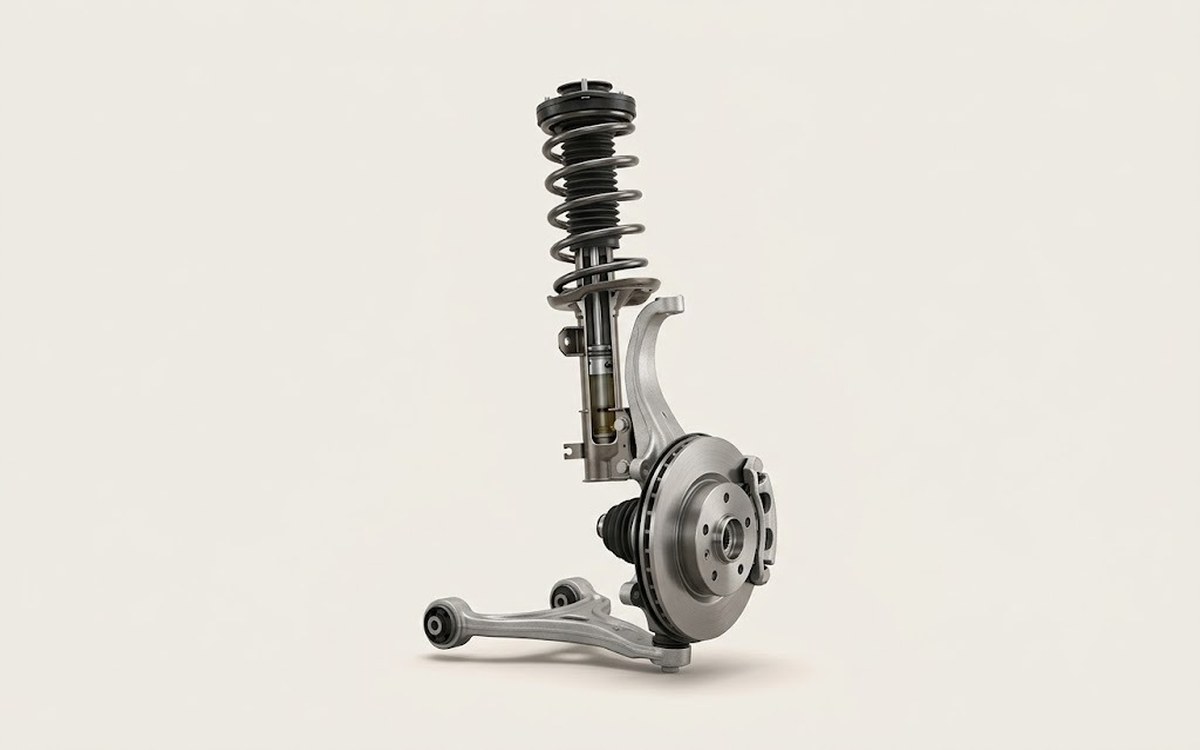 How it works · 3D
How Car Suspension Works
How the part you're working on actually works — in plain English, on a 3D model.
Open in 3D →