https://autopapyrus.com/catalog/toyota/camry/guides/diagnosing-an-engine-misfire/
Toyota Camry XV70: Diagnosing an Engine Misfire
A rough-running engine is caused by misfires in one or more cylinders. Typical causes on the Camry XV70 are a failed ignition coil, worn spark plugs, dirty fuel injectors, an air leak, low fuel pressure, or a fuel pump problem. For 2018-2020 model year vehicles, first check whether the car is covered by the low-pressure fuel pump recall. A failing pump produces symptoms identical to a misfire.
Parts
5| № | Part | Genuine part no. |
|---|---|---|
| 01 | Spark plugsfor 2.5L A25A-FKS, if faultyFind on Amazon → | 90919-01289 |
| 02 | Spark plugsfor 3.5L 2GR-FKS, if faultyFind on Amazon → | |
| 03 | Ignition coilsif faultyFind on Amazon → | 90919-02276 |
| 04 | Fuel injectorsif faultyFind on Amazon → | 23209-25010-01 |
| 23209-25010-02 | ||
| 23209-25010-03 | ||
| 05 | Oxygen sensorsif faultyFind on Amazon → | 89467-33290 |
Amazon links search by the part name and genuine number; use Amazon's fit check for your car before ordering. We may earn a commission from qualifying purchases.
Part numbers are from the manufacturer's original catalogue. Check them against your VIN before ordering.
Tools
4Read the codes yourself
A scanner plugged into the OBD2 port under the dashboard shows which fault codes the car has stored, before you buy any parts. Cars sold in the US from 1996, and petrol cars in Europe from 2001 (diesels from 2004), have this port.
- Basic code reader, about $20–40: reads and clears engine codes Amazon →
- Bluetooth scanner with a phone app, about $30–100: live sensor data, and on many cars ABS and airbag codes too Amazon →
Check that the scanner lists your make and model year before you buy. We may earn a commission from qualifying purchases.
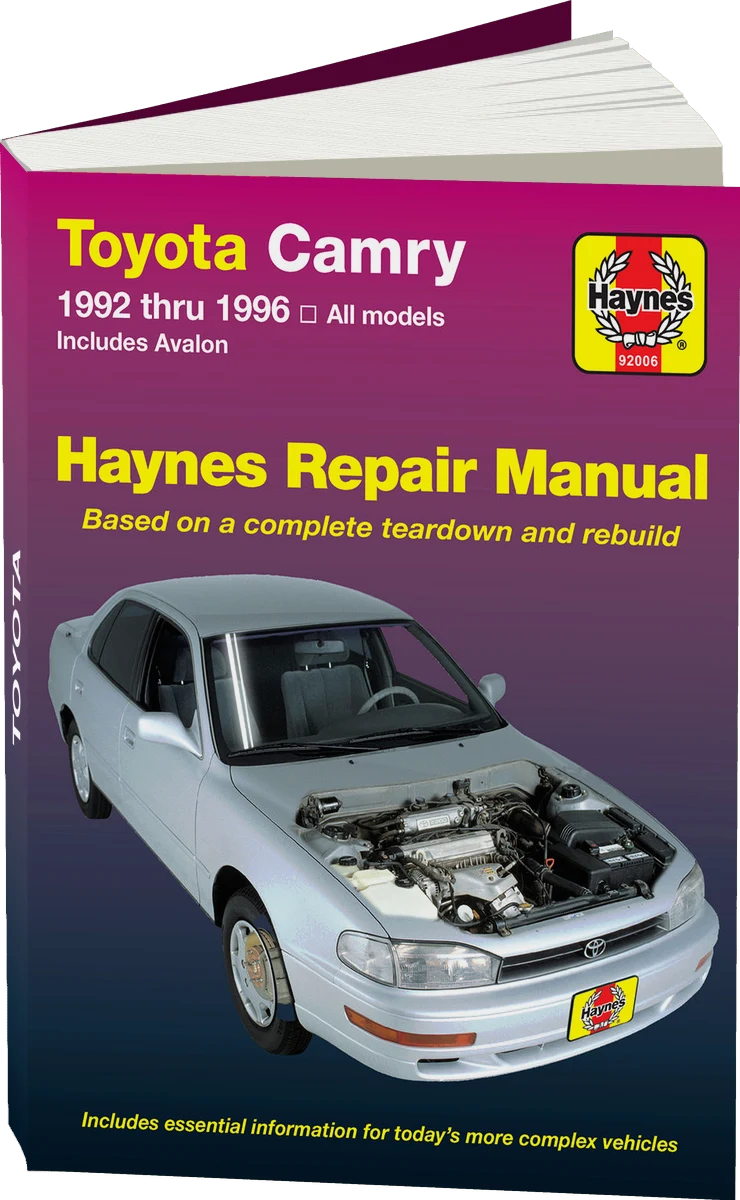 There's a full repair manual for this car
Every system, wiring diagrams and torque specs — not just this job. Haynes and 5 more.
See manuals →
Step by step
9 steps- Connect the OBD-II scan tool and read the trouble codes. Misfires show up as P0301 (cylinder 1), P0302 (cylinder 2), P0303 (cylinder 3), P0304 (cylinder 4), P0305 (cylinder 5, V6 only), and P0306 (cylinder 6, V6 only). Code P0300 indicates multiple or random misfires. Code P0363 indicates a misfire with fuel shut-off.
- If the scan tool points to a specific cylinder (for example P0301), swap the ignition coil from that cylinder with one from a neighboring cylinder that runs normally. Clear the code and start the engine. If the code moves to the other cylinder (becomes P0302), the coil is bad. If the code stays on the original cylinder, the coil is not the problem.
- Remove the spark plug from the problem cylinder. Inspect the electrode and insulator. Black deposits indicate a rich mixture or oil in the combustion chamber, white deposits indicate a lean mixture or overheating, and electrode erosion indicates normal wear (replace plugs every 60,000-100,000 km (37,000-62,000 mi) depending on the type). Check the gap (spec is 1.0-1.1 mm for Toyota iridium plugs).
- Check cylinder compression with a compression tester. Normal pressure for Camry gasoline engines is 10-14 bar. The difference between cylinders should not exceed 1 bar. Low compression indicates worn piston rings, burned valves, or a blown head gasket.
- Inspect the intake manifold, vacuum hoses, and gaskets for air leaks. An air leak leans out the mixture and causes misfires in all cylinders at the same time. You can use a smoke machine, or spray suspect areas with carburetor cleaner while the engine is running (a change in engine speed will point to the leak).
- Check the fuel rail pressure. For the A25A-FKS and 2GR-FKS engines, normal system pressure is 280-320 kPa (2.8-3.2 bar) at idle. Low pressure can be caused by a clogged fuel filter, a weak pump, or a faulty pressure regulator.
- If the previous steps did not reveal the cause, check the injectors. Disconnect the injector connector on the problem cylinder with the engine running. If the way the engine runs does not change, that injector is not delivering fuel (clogged or faulty). Use a multimeter to check the injector coil resistance (spec is 13-16 ohms).
- Check the mass airflow (MAF) sensor and the oxygen sensors. A faulty MAF sensor sends incorrect data to the ECU, which leads to an incorrect air-fuel mixture. Use the scan tool to view Live Data. Airflow should be 2-4 g/s at idle and 8-15 g/s at 2000 rpm.
- For more in-depth diagnostics, use Techstream software. It lets you run active tests (commanding the coils and injectors directly), view misfire counters for each cylinder, and check for compression leaks without removing parts.
Common mistakes and warnings
- Driving with a misfire destroys the catalytic converter
- Unburned fuel enters the exhaust system and overheats the catalyst substrate
- If the Check Engine light comes on with misfire codes, stop driving the car until the cause is fixed
- For 2018-2020 model year vehicles, be sure to check whether the car is covered by the fuel pump recall
- The replacement is free at an authorized dealer
Spotted a mistake? Tell us →
Our articles
 Test drives
Toyota Camry: One Car for Every Market. We Test the New Sedan
The new-generation Toyota Camry is built with the latest technology. It gets a new platform, a larger display and an…
Read →
 Brand stories
The History of Toyota
From weaving looms to reliable mass-produced cars.
Read →
 Garage
Fuel Quality Indicators: What Octane and Cetane Numbers Mean
What is an octane number? What about a cetane number? Which fuel should you choose for a high-compression engine?…
Read →