Autopapyrus · Lada Iskra 1.6 Gasoline 16V 106 hp (2025)
https://autopapyrus.com/guides/lada/iskra/timing-belt-replacement/
https://autopapyrus.com/guides/lada/iskra/timing-belt-replacement/
Compiled automatically from service literature and owner experience. Specs are for the typical configuration — check them against your exact car before you start.
Lada Iskra 1.6 Gasoline 16V 106 hp (2025): Timing Belt Replacement
The VAZ-21127 engine (1.6 16V, 106 hp) in the Lada Iskra uses a timing belt with a scheduled service life of 180,000 km. However, replacement every 75,000-120,000 km is recommended because of the risk of belt failure if the idler roller seizes. On cars built before July 2018, a broken belt bends the valves. From July 2018, pistons with valve reliefs protect the valve train. The procedure requires precise alignment of the timing marks.
Part
- 🔩 Gates timing belt kit K015631XS (5631XS belt, tensioner roller, idler roller) or OE VAZ 21126-1006040-02. Replacing the water pump at the same time is recommended (Gates kit KP15631XS-1 with water pump)
Step by step
18 steps- Park the car on level ground, set the parking brake, and disconnect the negative battery terminal.
- Raise the front right side of the car with a jack and remove the front right wheel to access the crankshaft pulley.
- Remove the upper timing belt cover (5 Torx T-30 screws).
- Set the No. 1 piston to TDC on the compression stroke: turn the crankshaft clockwise by the pulley bolt (17 mm socket) until the mark on the crankshaft pulley aligns with the projection on the oil pump cover. At the same time, the marks on the camshaft pulleys must align with the notches on the rear timing cover.
- Lock the flywheel with a screwdriver through the service hole in the clutch housing (this prevents the crankshaft from turning).
- Remove the accessory drive (crankshaft) pulley bolt - torque 105-110 N·m (77-81 lb-ft) - and remove the pulley.
- Loosen the tensioner roller bolt (15 mm socket), turn the roller clockwise with the special wrench (two pins in the holes on the roller) to release the tension, and remove the old belt.
- Remove the tensioner roller (15 mm bolt, tightening torque 34-41 N·m (25-30 lb-ft)) and the idler roller (13 mm bolt, torque 34-41 N·m (25-30 lb-ft)). Check them for play and scoring - always replace them.
- If replacing the water pump, remove it now (4 bolts, 10 mm), draining the coolant first. Install the new pump with a new gasket or sealant.
- Install the new idler roller with thread locker (torque 34-41 N·m (25-30 lb-ft)).
- Install the new tensioner roller but do not tighten it - leave it free to rotate for tensioning.
- Fit the new belt: first onto the crankshaft pulley, then onto the idler roller, the camshaft pulleys (observing the direction of rotation - the arrow on the belt), and the tensioner roller. Make sure the belt does not sag on the slack runs.
- Align the marks: the projection on the oil pump cover with the mark on the crankshaft pulley, and the camshaft marks with the notches on the rear cover.
- Tension the belt: insert the wrench into the holes of the tensioner roller and turn it counterclockwise until the notch on the outer race of the roller aligns with the rectangular projection on the inner hub. Tighten the roller bolt (torque 34-41 N·m (25-30 lb-ft)).
- Remove the flywheel lock and turn the crankshaft 2 full turns clockwise by the pulley bolt. Make sure all the marks line up again. If the marks do not match, repeat the belt installation from step 12.
- Install the accessory drive pulley (torque 105-110 N·m (77-81 lb-ft)), locking the flywheel.
- Install the upper timing cover (5 Torx T-30 screws) and the right wheel, then reconnect the battery.
- Refill the coolant if you replaced the water pump. Start the engine, let it warm up, and check for unusual noises and leaks.
Common mistakes and warnings
- A broken belt on engines built before July 2018 bends the valves, and cylinder head repair is expensive. Do not use belts from unknown manufacturers - their service life is 2-3 times shorter than that of an original Gates belt. When replacing the belt, always replace both rollers and the water pump - their service life is comparable to the belt's, and disassembling the assembly again costs more. Do not overtighten the roller - excessive tension shortens the life of the belt and bearings. Do the work on a cold engine (15-35 degrees Celsius (59-95 °F)).
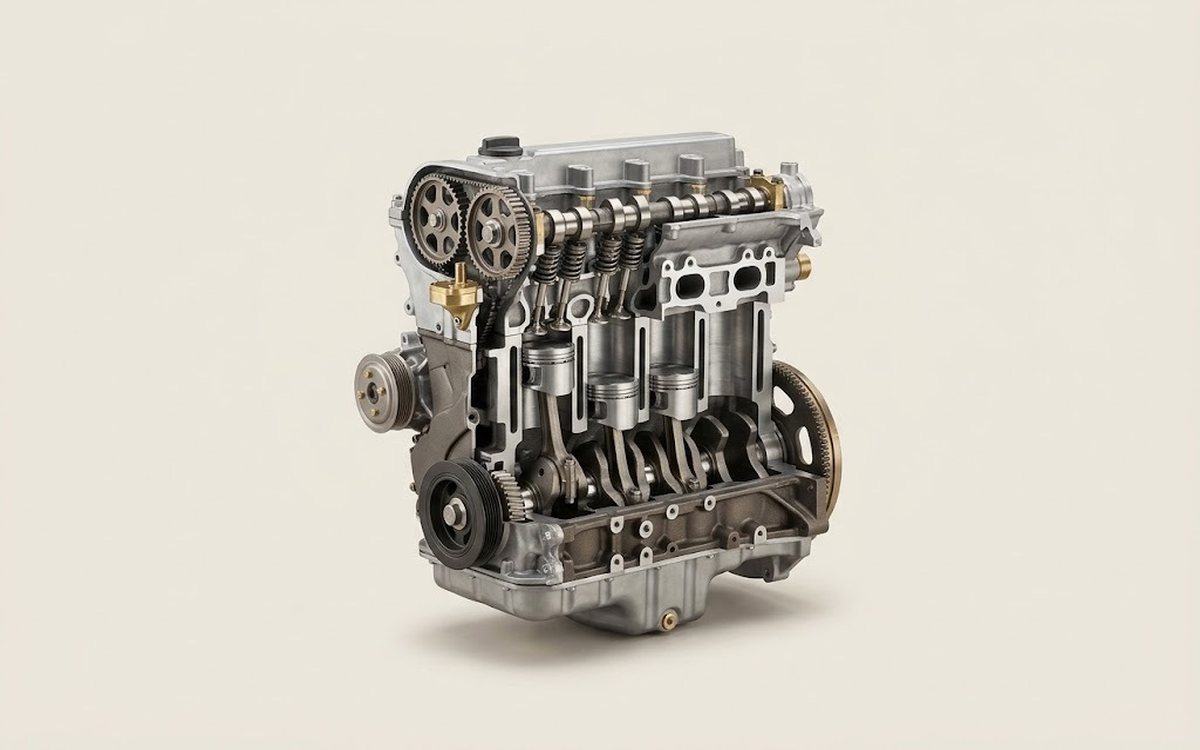 How it works · 3D
How a Car Engine Works
How the part you're working on actually works — in plain English, on a 3D model.
Open in 3D →