Autopapyrus · Chery Tiggo 1.8 SQR481F (2011)
https://autopapyrus.com/guides/chery/tiggo/timing-belt-replacement/
https://autopapyrus.com/guides/chery/tiggo/timing-belt-replacement/
Compiled automatically from service literature and owner experience. Specs are for the typical configuration — check them against your exact car before you start.
Chery Tiggo 1.8 SQR481F (2011): Timing Belt Replacement
The timing belt on the SQR481F engine should be replaced every 60,000 km or 36 months (manufacturer's interval), although some dealers recommend replacing it at 40,000 km as a precaution. The procedure requires precise alignment of the camshaft and crankshaft timing marks and special tools to lock the shafts in position. Incorrect timing leads to valve-to-piston contact and an engine rebuild.
Part
- 🔩 Timing belt 481H-1007073BA (173 teeth, 25.4 mm wide), tensioner pulley 473H-1007060AB, idler pulley 481H-1007070. Aftermarket alternatives: Gates, Contitech, IPS Parts, Mitsuboshi
Step by step
12 steps- Raise the vehicle on a lift or place it over a pit, then remove the right front wheel, the engine undercover, and the fender liner in the wheel well to gain access to the crankshaft pulley.
- Remove the coolant expansion tank (move it aside without disconnecting the hoses) and remove the upper timing belt cover.
- Disconnect the spark plug wires, remove the spark plugs (this makes the crankshaft easier to turn), and remove the valve cover to access the camshaft timing marks.
- Turn the crankshaft clockwise (using a 17-22 mm wrench on the crankshaft pulley bolt) until the marks line up: the mark on the crankshaft pulley (a notch or triangle) should be opposite the mark on the oil pump housing, at approximately the 11 o'clock position. On the camshaft pulleys, the marks should align with the lines on the back plate, or the holes in the pulley hubs should line up with the holes in the cylinder head cover (check with a mirror; the position is approximately 1 o'clock).
- Lock the crankshaft with the special pin (it threads into the hole in the engine block at the 17 mm bolt location, installed to a depth of about 80 mm until it engages the slot in the flywheel). Install the camshaft locking plate into the slots on the ends of the camshafts.
- Loosen the tensioner pulley (16 or 18 mm wrench), turn it counterclockwise to release the belt tension, and remove the old timing belt. Inspect the pulleys. If you find play or bearing noise, replace both pulleys.
- Install the new belt, starting at the crankshaft pulley, then the idler pulley, the camshaft pulleys (intake and exhaust), and finally the tensioner pulley. Make sure the belt teeth seat fully in the pulley grooves and that any slack is on the tensioner pulley side.
- Tension the belt by turning the tensioner pulley eccentric clockwise to 28 N·m (21 lb-ft). Check the belt deflection on the slack span: 7.5-8.5 mm under finger pressure is acceptable.
- Remove the camshaft and crankshaft locking tools. Turn the crankshaft by hand 2 full turns clockwise and make sure all the marks line up again. If the marks are off, repeat the installation starting from step 4.
- Tighten the camshaft pulley bolts (if you loosened them for adjustment) in two stages: first to 130 N·m (96 lb-ft), then loosen to 65 N·m (48 lb-ft). Tighten the DVVT coupling bolt (if equipped with a variable valve timing system) to 120 N·m (89 lb-ft) using a Torx T55-T56 socket.
- Reassemble in reverse order: install the valve cover (with a new gasket), the spark plugs and wires, the upper timing belt cover, the expansion tank, the fender liner, the engine undercover, and the wheel.
- Start the engine and listen to it at idle and at 2000-3000 rpm. There should be no knocking or popping noises. Drive 100-200 km, then check the belt tension visually (remove the upper cover) and adjust the tensioner pulley if necessary.
Common mistakes and warnings
- The SQR481F is an interference engine (the valves hit the pistons if the belt breaks). A belt failure while driving bends the valves and leads to expensive cylinder head repairs. When replacing the belt, ALWAYS replace both pulleys, even if they look fine, because their service life matches that of the belt. Do not use cheap counterfeit pulleys (especially those marked 473H-1007060AB). There are known cases of the pulley bearing failing after 5,000-10,000 km, followed by belt breakage. If you hear popping in the intake or exhaust when starting the engine after installing the belt, shut it off immediately and recheck the marks, because the valve timing may be off by one tooth.
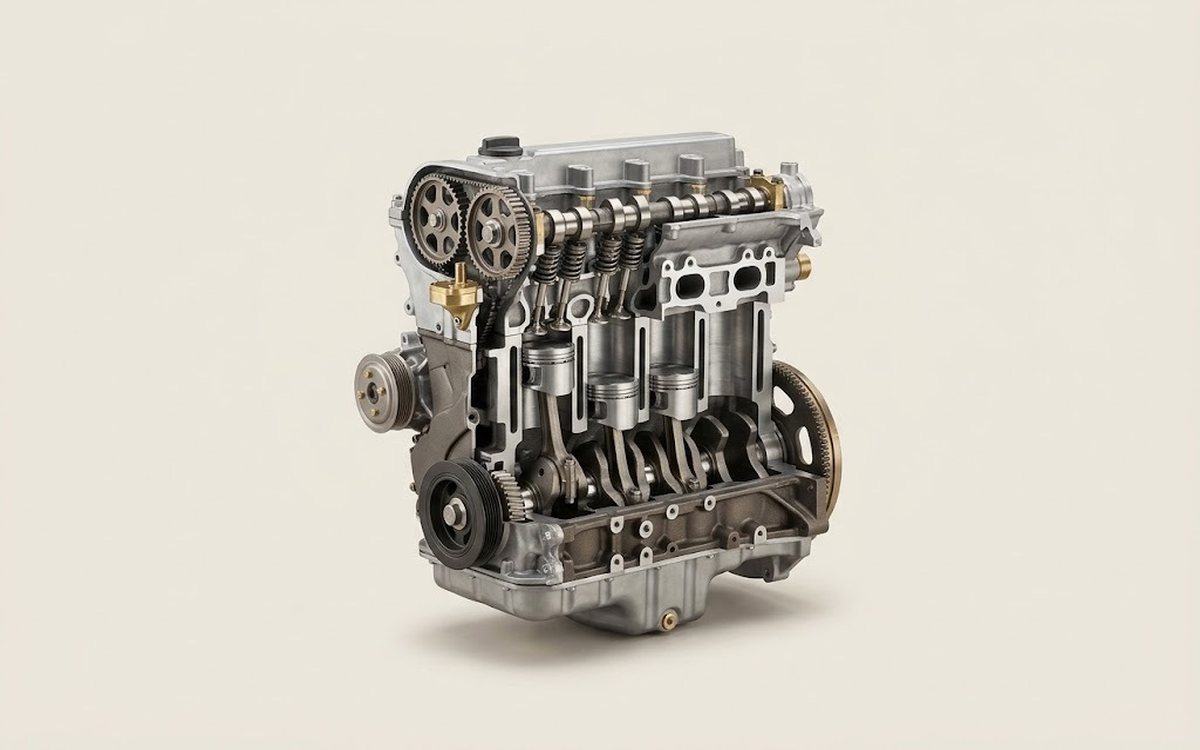 How it works · 3D
How a Car Engine Works
How the part you're working on actually works — in plain English, on a 3D model.
Open in 3D →