Autopapyrus · Lada Iskra
https://autopapyrus.com/guides/lada/iskra/diagnosing-a-front-suspension-knock/
https://autopapyrus.com/guides/lada/iskra/diagnosing-a-front-suspension-knock/
Compiled automatically from service literature and owner experience. Specs are for the typical configuration — check them against your exact car before you start.
Lada Iskra: Diagnosing a Front Suspension Knock
The Lada Iskra has a MacPherson strut front suspension: a strut, a lower control arm, a ball joint and a sway bar. A knock most often comes from a sway bar link, a strut mount, a ball joint or a loose brake caliper. The car is new, so a loose fastener can also be the cause. If the car is under warranty, it is better to show loose connections to the dealer than to disassemble anything yourself.
Parts
10| № | Part |
|---|---|
| 01 | Front sway bar linksif faulty |
| 02 | Front strut bearingif faulty |
| 03 | Front strut mountif faulty |
| 04 | Strut bootif faulty |
| 05 | Strut bump stopif faulty |
| 06 | Ball jointif faulty |
| 07 | Control arm bushingsif faulty |
| 08 | Caliper guide pinsif faulty |
| 09 | Caliper spring clipsif faulty |
| 10 | Complete front strut assemblyif faulty |
Tools
7- lift or jack with jack stands
- wheel chocks
- pry bar
- flashlight
- socket and wrench set
- torque wrench
- lithium or copper grease for brake caliper guide pins
Step by step
11 steps- Identify the nature of the knock. A light, rapid rattle over small bumps is usually a sway bar link or the caliper. A dull thud over potholes and under braking points to the strut mount, control arm or control arm bushings. A knock or crunch with the steering wheel turned at low speed points to the strut and strut bearing. Note the conditions under which it appears.
- Park the car on level ground, apply the parking brake, and chock the rear wheels. Raise the front end on a lift or jack stands. Never use a jack as the only support.
- Inspect the suspension. Check the ball joint boots and tie rod boots for tears and grease leaks. Check the shock absorbers for oil leaks and the control arm bushings for cracks. Check whether the fender liner, the engine skid plate or the wheel arch fasteners are loose: they often knock like a suspension fault.
- Check the wheels. Tighten the wheel bolts in a crisscross pattern, usually to 90-110 N·m (66-81 lb-ft) (exact value per the manufacturer's specification). A loose wheel produces a knock that is easy to mistake for a suspension problem.
- Check the sway bar links. Grab each one by hand and shake it. Play in the joints, or a knock when you move it with a pry bar, means the link must be replaced. This is the most common cause of a light knock and the cheapest to repair.
- Check the ball joint. With the wheel raised, insert a pry bar between the lower control arm and the steering knuckle and lift gently. Noticeable play or a knock means the ball joint is worn. If the ball joint is not sold separately from the control arm, replace the complete control arm.
- Check the wheel bearing and tie rods. Rock the wheel at the top and bottom (the "12 and 6 o'clock" position), then at the sides (the "9 and 3 o'clock" position). Vertical play means the wheel bearing or ball joint. Horizontal play means the tie rod end or tie rod.
- Check the strut mount and the strut. Have a helper rock the body at the front fender or turn the steering wheel with the car stationary. A knock or clicking in the upper part of the strut, near the strut tower, means the mount or bearing is worn. If the strut knocks while driving but you find no play, the spring or bump stop may be broken. Inspect the spring for cracks and check how the spring seats are sitting.
- Check the brake calipers. Remove the wheel and make sure the caliper and bracket are tight and that the guide pins are intact and lubricated. A caliper knock over small bumps is fixed by replacing the guide pins and spring clips; lubricate the pins with high-temperature grease. The brake pads must sit in the bracket without free play. Tightening torques for the caliper bracket and pins are per the manufacturer's specification, not by feel.
- Tighten any loose connections with a torque wrench (control arm, sway bar, strut-to-knuckle mounting and strut mount-to-body) to the specified values for this model. Replace worn parts you find in pairs on the axle, left and right at the same time.
- After the repair, lower the car, torque the wheels to specification, and take a test drive on a familiar road. If you disassembled the suspension, get a wheel alignment.
Common mistakes and warnings
- The suspension and steering are safety-critical systems
- If the knock comes with pulling to one side, steering wheel vibration or noticeable ball joint play, do not keep driving, and if you lack experience, take the car to a repair shop
- Do not disassemble a strut without spring compressors: a compressed spring is dangerous
- If the car is under warranty, show minor defects to the dealer first, because disassembling it yourself may affect the warranty
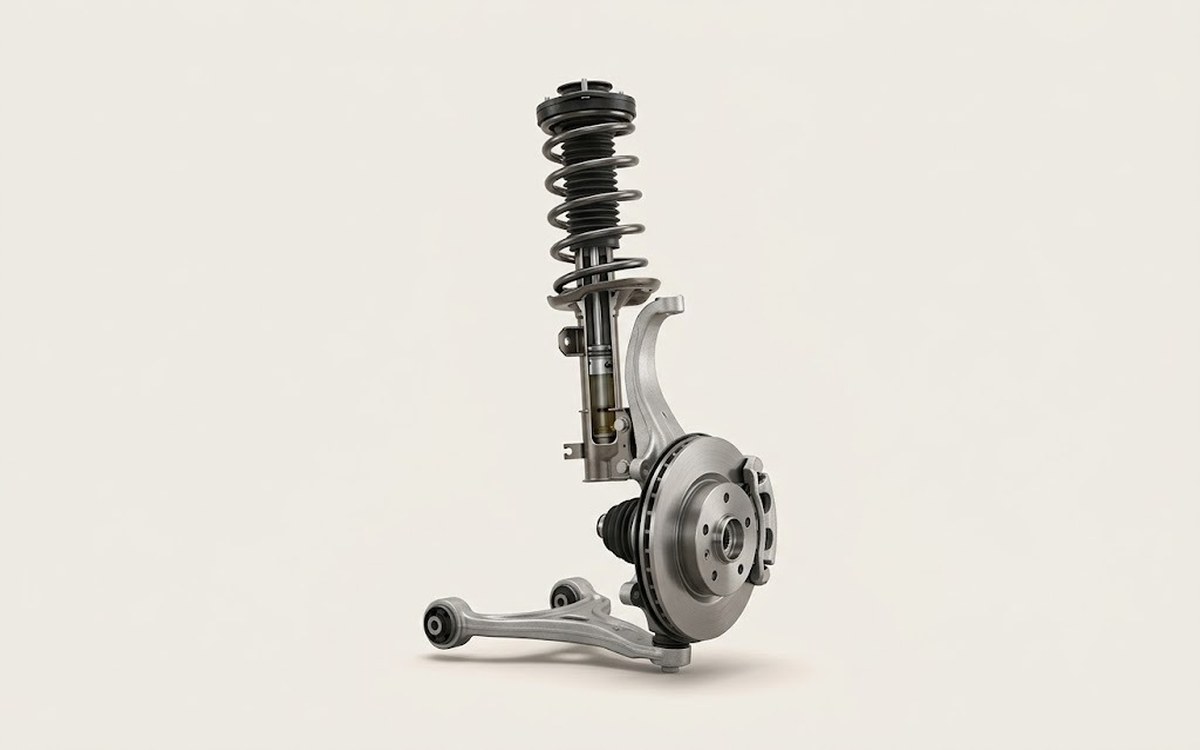 How it works · 3D
How Car Suspension Works
How the part you're working on actually works — in plain English, on a 3D model.
Open in 3D →