Autopapyrus · Toyota Camry 2.5 A25A-FKS (XV70, 2018)
https://autopapyrus.com/guides/toyota/camry/diagnosing-a-suspension-knock/
https://autopapyrus.com/guides/toyota/camry/diagnosing-a-suspension-knock/
Compiled automatically from service literature and owner experience. Specs are for the typical configuration — check them against your exact car before you start.
Toyota Camry 2.5 A25A-FKS (XV70, 2018): Diagnosing a Suspension Knock
The XV70 (2015-2023) is well-engineered, but after 100,000+ km (60,000+ miles) the front suspension wears. A knock can come from the front axle area, the wheel wells, or the steering. Diagnosis starts with a visual inspection and checking for play on a pit or lift.
Part
- 🔩 Confirm by VIN in a parts catalog. Typical candidates: sway bar end links, ball joints, strut mounts (top mount bearings), control arm bushings, lateral arm bushings
 There's a full repair manual for this car
Every system, wiring diagrams and torque specs — not just this job. Haynes and 5 more.
See manuals →
Step by step
8 steps- Drive the Camry onto a pit or lift, raise the front end, and lift both front wheels off the ground. Make sure the car is securely supported.
- Visually inspect each wheel assembly: – Ball joint boots (lower control arms): they must not be torn or cracked. – Tie rod boots (inner and outer): grease leaks indicate wear. – Strut mounts (top strut mounting points): inspect from the engine bay. – Control arm bushings (sway bar and suspension system).
- Check the lower control arm ball joint for play: – Take a pry bar and place it under the steering knuckle. – Gently pry up and down. Play of more than 3-5 mm means the ball joint is worn. – Repeat on both sides.
- Check the upper control arm for play (front and rear ends): – Place the pry bar between the arm and the body/subframe. – Noticeable play with no resistance = worn bushings.
- Check the sway bar end links (on the XV70, front left and right, along the axis of the car): – Grab the link by hand and shake it front-to-back and left-to-right. – They must not rattle. Play = worn rubber-metal joints.
- Check the shock absorbers: – Push down on each corner of the body by hand several times (lower the car at the end). – The body should return to level within 1-2 rebounds. If it keeps bouncing longer or doesn't settle, the shocks are still functional but weak.
- Check the fasteners (if the car has had previous repairs, a bolt may be loose): – Visually inspect the nuts securing the shock absorbers to the steering knuckle. – Tightening torques (for reference only; not all chassis bolts are the same): 140-160 N·m (103-118 lb-ft) for the main strut mounting fasteners. Confirm exact values in the service manual for your VIN.
- Lower the car and drive at low speed (5-10 km/h, about 3-6 mph) on a smooth road with the window open to determine at what speed and under what conditions the knock is audible. This helps pinpoint the source.
Common mistakes and warnings
- The XV70 (2015+) is a popular model and parts are readily available. The typical knock on this generation comes from the sway bar end links (rubber wear after 80,000-120,000 km, or 50,000-75,000 miles). If you are not sure of your diagnosis, have the car put on a lift at a repair shop, where a technician can recheck the play and identify the faulty part by sound (tapping with a pry bar). Replacing individual components (ball joint, sway bar end link, bushing) is cheaper than replacing the entire control arm.
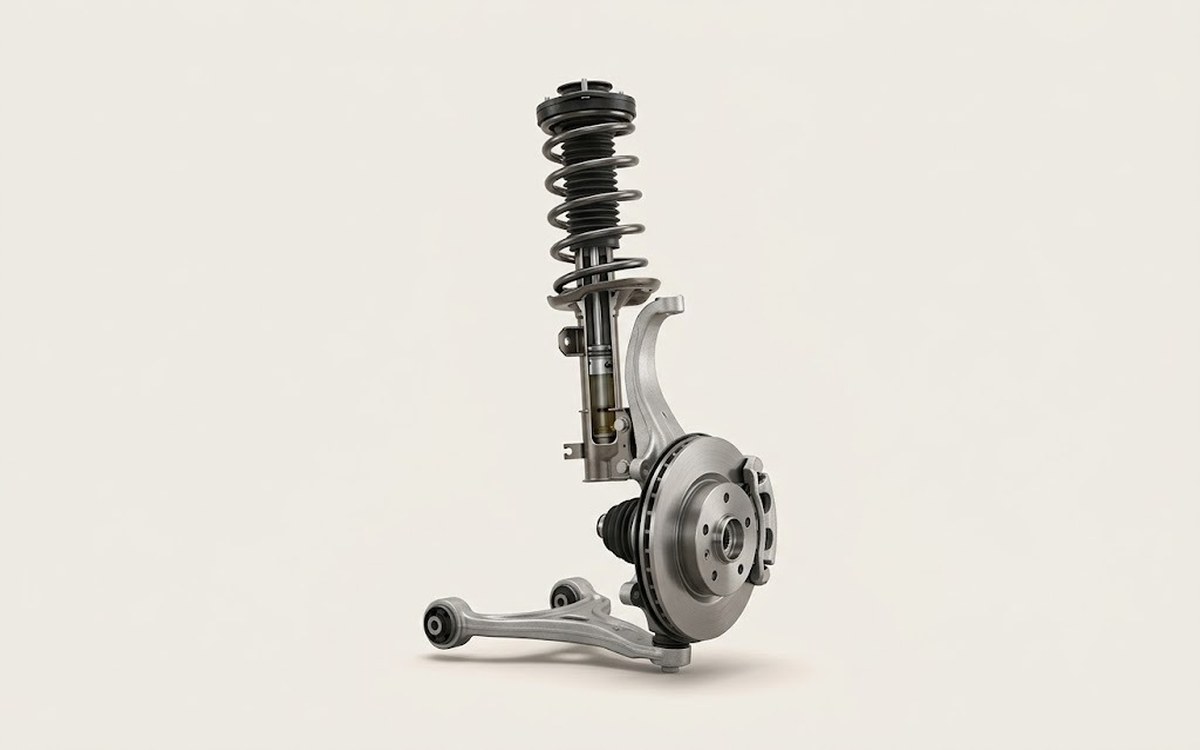 How it works · 3D
How Car Suspension Works
How the part you're working on actually works — in plain English, on a 3D model.
Open in 3D →