Autopapyrus · Lada Granta (Gen 1)
https://autopapyrus.com/guides/lada/granta/diagnosing-a-front-suspension-knock/
https://autopapyrus.com/guides/lada/granta/diagnosing-a-front-suspension-knock/
Compiled automatically from service literature and owner experience. Specs are for the typical configuration — check them against your exact car before you start.
Lada Granta (Gen 1): Diagnosing a Front Suspension Knock
A knock in the front suspension of the Granta is most often caused by one of several things: a caliper loose on its guide pins, worn sway bar links or bushings, a strut mount, a ball joint, or the steering rack. Diagnosis goes from the simplest and most common causes to the more complex ones. The same procedure applies to all engines of this generation.
Part
- 🔩 Typical candidates: sway bar end link, ball joint, control arm bushings, strut mount with bearing, sway bar bushings, caliper guide pins and retaining spring clip, tie rod end
Step by step
10 steps- Identify the nature of the knock. A short, rattling knock over small bumps while driving is most often the calipers or sway bar end links. A dull thud over large bumps points to the strut mount, shock absorber, or bump stop. A knock when turning the steering wheel while stationary points to the tie rod ends, the steering rack, or the mounts. A knock only under braking points to the caliper, ball joint, or control arm bushings.
- Inspect the engine bay and the underside. Check whether the skid plate is hitting the oil pan because of loose mounting bolts, and whether the upper strut mount nuts in the engine bay (on the strut towers) are tight. A loose mount nut causes a knock that feels like a suspension fault.
- Check the calipers. Lift the wheel, remove it, and look at the guide pins and boots. If the caliper rattles on its bracket, the guide pins are worn or the retaining spring is missing. Replace the pins and boots, and lubricate the pins with special caliper grease. Reassemble the brake system carefully and tighten to the specified torque.
- Check the sway bar end links and bushings. Shake the link by hand: there should be no play. Inspect the rubber bushings of the sway bar. When worn, they knock and click over bumps.
- Check the ball joint. With the wheel lifted, insert a pry bar between the control arm and the steering knuckle and lift: noticeable travel or play in the joint means wear. Inspect the boot for tears.
- Check the wheel bearing. Grab the wheel at the top and bottom and rock it in the vertical plane. Then check by spinning it: a hum that rises with speed points to the bearing.
- Check the control arm bushings and the strut mount. Inspect the rubber for cracks and bulging, and use a pry bar to check the arm's movement. With the suspension hanging, rock the strut: a knock at the top means the mount bearing or the mount. Inspect the shock absorber for leaks and the boot and bump stop for damage.
- Check the steering. Shake the tie rods and tie rod ends by hand. With a helper rocking the steering wheel, check for play in the tie rod ends and the rack mounting. A rack knock is often caused by a worn support bushing and a loose mount.
- Replace the worn parts. Tighten all suspension nuts with the car lowered onto its wheels (for control arm bushings and ball joints), using the manufacturer's specified torque. After replacing suspension components, it is recommended to check and adjust the wheel alignment.
- Take a test drive on a bumpy road. If the knock is still there, repeat the diagnosis with a helper: one person rocks the body while the other, under the car on a lift, looks for play by hand or with a stethoscope.
Common mistakes and warnings
- The suspension and brakes are safety-critical systems. If you lack experience, or you find significant play in a ball joint, tie rod ends, or a wheel bearing, do not drive the car and take it to a repair shop. Do not work under a car supported only by a jack. Use jack stands.
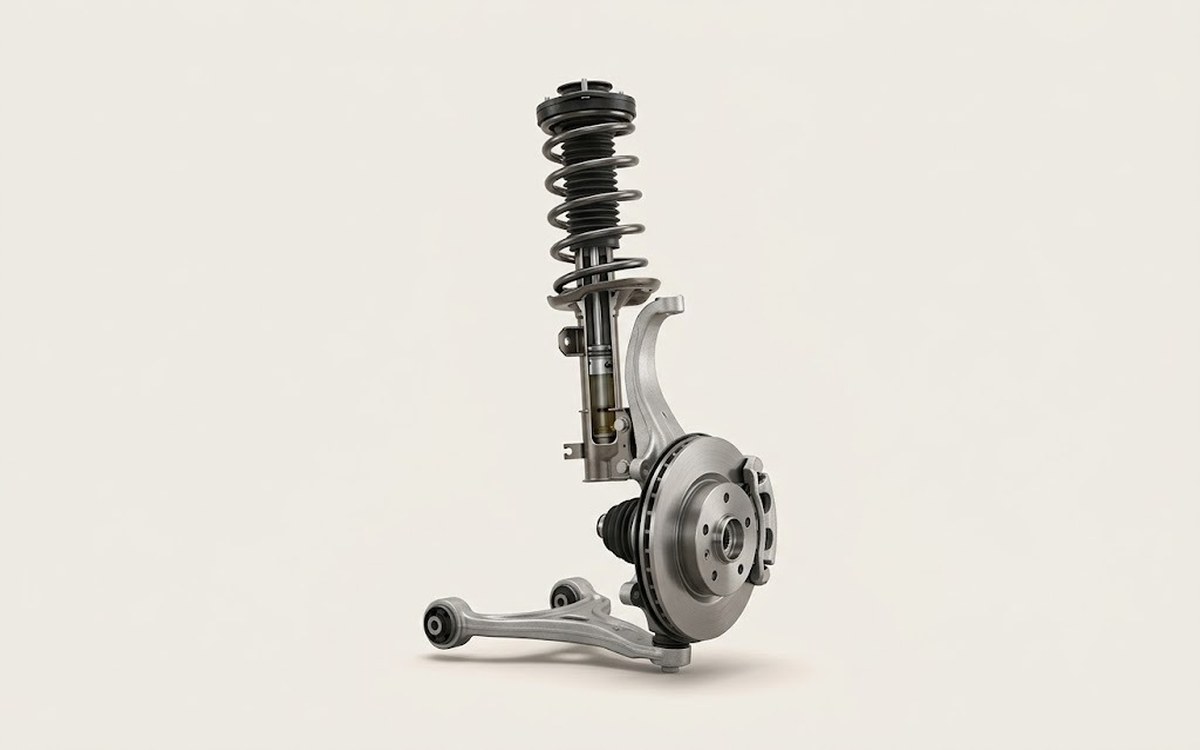 How it works · 3D
How Car Suspension Works
How the part you're working on actually works — in plain English, on a 3D model.
Open in 3D →