Autopapyrus · Lada Granta 1.6 8V (2015)
https://autopapyrus.com/guides/lada/granta/rear-brake-pad-replacement/
https://autopapyrus.com/guides/lada/granta/rear-brake-pad-replacement/
Compiled automatically from service literature and owner experience. Specs are for the typical configuration — check them against your exact car before you start.
Lada Granta 1.6 8V (2015): Rear Brake Pad Replacement
On the Granta I, the rear pads are disc-type and can be replaced without removing the caliper, so the job is simple. Replace them every 40,000-50,000 km or when the pad thickness is under 3 mm. The rotors wear at the same rate. If you feel vibration when braking or see grooves, replace both rotors.
Part
- 🔩 Lada 2190-3502090-10 (rear set, 2 pads). Alternatives: Ferodo FDB4118, Brembo P 56 066. Rear rotor (if needed): 2190-3502075 or ATE 24.0325-0248.1
Step by step
12 steps- Park the car on level ground, set the parking brake, and place chocks under the front wheels.
- Use the jack to raise the rear of the car, one side at a time. Remove the rear wheel.
- Inspect the brake caliper. It has two mounting bolts (17 mm wrench). Do not remove them. Work only on the pads.
- On the back side of the caliper (closer to the flange), find the metal pin or spring clip that holds the pads. Do NOT pull it out.
- Use the screwdriver to release or bend back the upper edge of the old pad, then slide both pads back (away from the rotor).
- If the rotor is smooth and evenly worn in, leave it. If you see grooves or rust, or you felt vibration, remove the rotor (2 bolts, 17 mm wrench, through the holes in the rotor or after removing the caliper).
- Check the caliper piston in its cylinder. It should protrude 1-2 mm. If it is pushed in deep, push it back out with the screwdriver (carefully, without force).
- Install the new pads. Insert the narrow end of the first pad into the rotor slot from below, then fit the second pad into the rotor slots from above (the retaining spring must seat in place).
- Apply copper grease (Liqui Moly, SHELL, Mobil) to the pad edges and the contact points with the caliper. This prevents squealing and vibration.
- Install the wheel and tighten the bolts in a crisscross pattern to 100 N·m (74 lb-ft). If you have no torque wrench, tighten them firmly but don't overdo it.
- Lower the car and repeat on the other side.
- For the first 100-150 km, brake gently to let the pads bed in. Avoid hard braking.
Common mistakes and warnings
- If you hear squealing or knocking when braking, check whether the retaining pin was left in the caliper. If the brake fluid level in the reservoir drops quickly or the pedal feels soft, the caliper cylinder may be leaking. In that case, it is better to replace the caliper (repair is costly, and a new one is cheaper). Do not use cheap, unknown-brand pads without copper grease. They are noisy and wear out the rotor quickly.
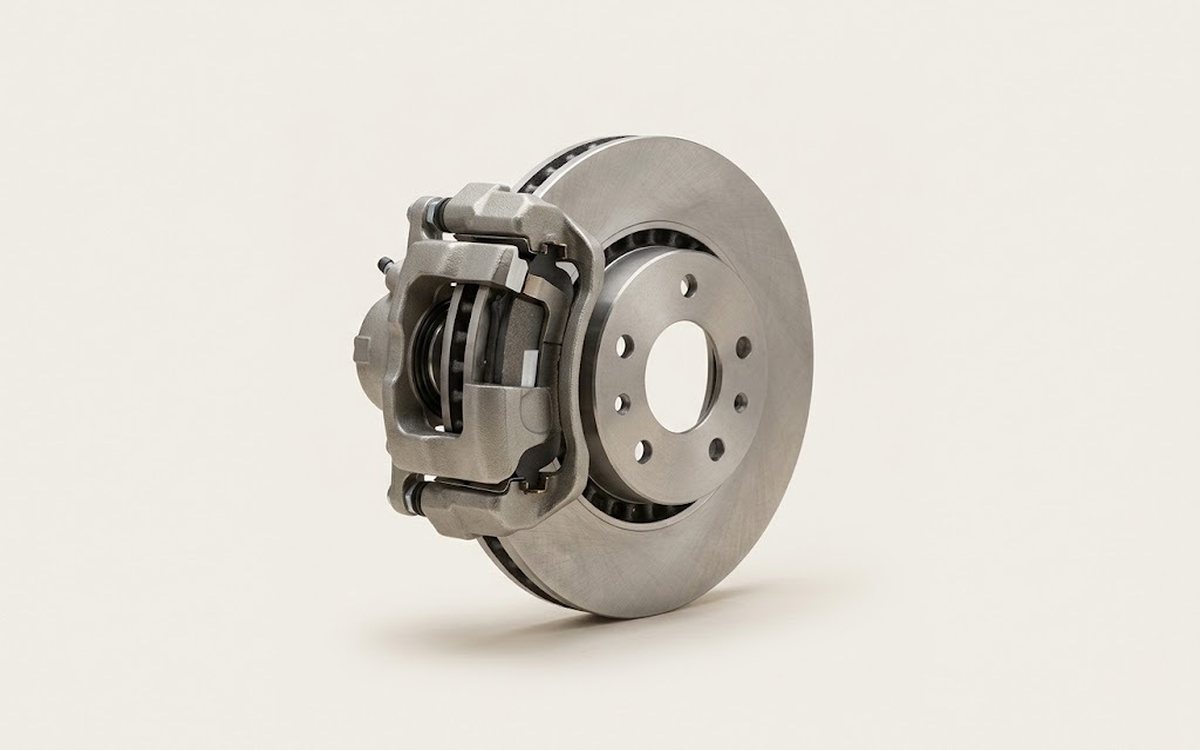 How it works · 3D
How Car Brakes Work
How the part you're working on actually works — in plain English, on a 3D model.
Open in 3D →