Autopapyrus · Honda Vezel (1st generation)
https://autopapyrus.com/guides/honda/vezel/rear-brake-pad-replacement/
https://autopapyrus.com/guides/honda/vezel/rear-brake-pad-replacement/
Compiled automatically from service literature and owner experience. Specs are for the typical configuration — check them against your exact car before you start.
Honda Vezel (1st generation): Rear Brake Pad Replacement
The rear brake pads on the Honda Vezel Hybrid use an electronic parking brake (EPB), so you need a diagnostic scanner to retract the caliper piston. Pad service life is 25,000-30,000 km. Always replace the pads in pairs, on both rear wheels.
Part
- 🔩 Rear brake pads Honda 43022-T7J-H12 (for 2019 model year) or aftermarket equivalents from Akebono, Bosch, Nisshinbo
Step by step
14 steps- Connect an OBD2 scanner (for example, Launch, Autel AP200 or an equivalent with EPB function). Start the engine, enter the EPB menu and activate Brake Pad Maintenance Mode. The system will automatically retract the caliper pistons.
- Turn off the engine, apply the parking brake (to hold the front wheels), and loosen the lug nuts on the rear wheel.
- Raise the rear of the vehicle with the jack and set it on a jack stand. Remove the rear wheel.
- Remove the two caliper guide bolts (17 mm socket). Tightening torque on reassembly: 23-27 N·m (17-20 lb-ft).
- Lift the caliper up and secure it to a suspension component with wire or cord (so it does not hang from the brake hose).
- Remove the old pads from the caliper bracket. Remove the anti-squeal shims.
- Clean the pad seating area and the caliper slides with a wire brush to remove rust and deposits. Check the condition of the brake rotor (if the wear depth is more than 2 mm, replace the rotor).
- Install the new anti-squeal shims on the new pads (they usually come with the set). Insert the pads into the bracket.
- Lower the caliper over the new pads and tighten the guide bolts with a torque wrench (23-27 N·m (17-20 lb-ft)).
- Install the wheel and tighten the lug nuts in a crisscross pattern (lug nut torque 108 N·m (80 lb-ft)).
- Lower the vehicle and repeat the procedure on the other rear wheel.
- Start the engine and press the brake pedal firmly to the floor 5-7 times (so the pistons extend and the pads press against the rotors).
- Connect the scanner and exit the maintenance mode (Deactivate Maintenance Mode). Check the electronic parking brake operation: apply and release it twice.
- Bed in the new pads: for the first 200-300 km, avoid hard braking and brake gently so the pads break in properly.
Common mistakes and warnings
- Without an OBD2 scanner with EPB function, you cannot retract the caliper piston correctly. Trying to push it back manually (with a clamp or screwdriver) can damage the parking brake electric motor, leading to an expensive repair (replacing the whole caliper assembly). If you do not have a scanner, take the car to a repair shop. After replacing the pads, always test the EPB in a safe area before driving on the road.
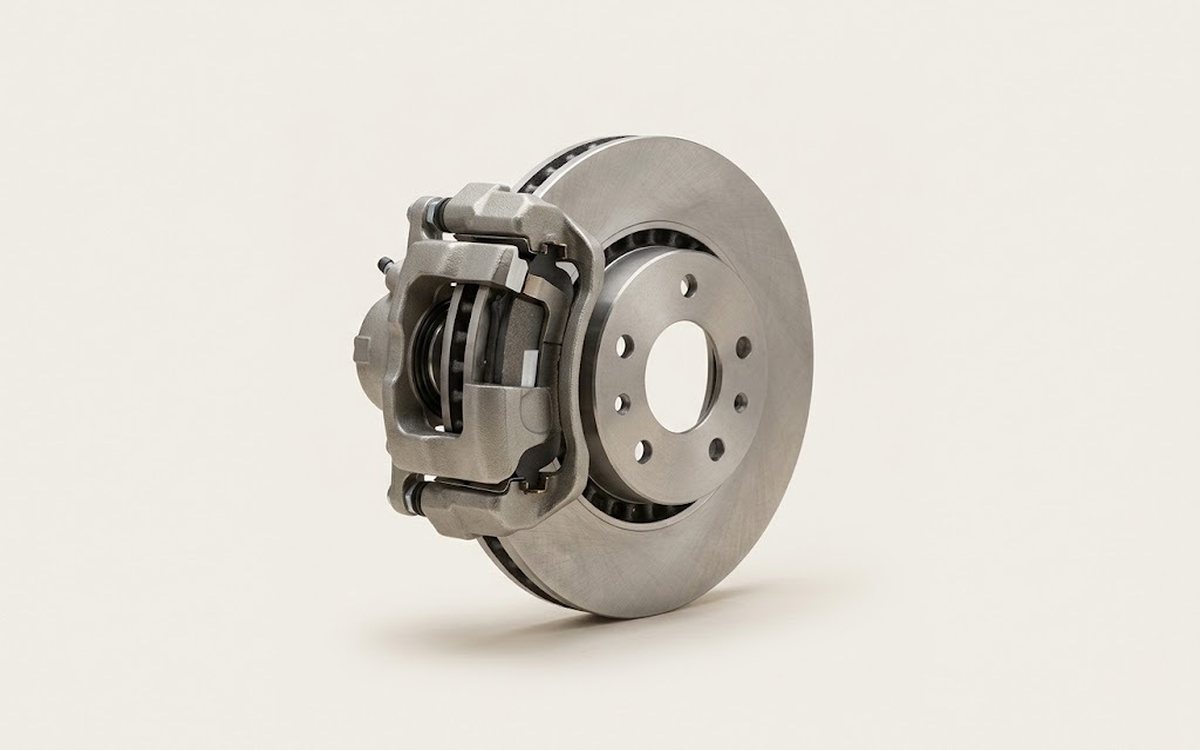 How it works · 3D
How Car Brakes Work
How the part you're working on actually works — in plain English, on a 3D model.
Open in 3D →